Author Archives: jos76

11: Free Voluntary Reading (FVR) with Jade Greene

In this episode we talk about Free Voluntary Reading (FVR) in the in language classroom.

I am joined by Jade Greene, a high school teacher in North Carolina, who helps us understand the benefits of reading in the target language and how to set up FVR in our language classrooms.

Jade speaks about…

  • the primary benefits of promoting a culture of reading in the language classroom
  • choosing books for your classroom library
  • students’ responses to the reading options
  • how FVR works
  • her journey as a CI (Comprehensible Input) author

Connect with Jade Greene:

Follow wherever you listen to podcasts.

10: Equity in the Language Classroom with A.C. Quintero

In this episode we talk about equity in the in language classroom, but it’s really about equity in any classroom.  [sign up for Talking Points]

I am joined by A.C. Quintero who helps us to understand the importance of creating a classroom and student experience that moves beyond equality and focuses on an authentic equity.

A.C. speaks about…

  • what students “bring” to the classroom that language teachers need to be aware of.
  • how we can assess in ways that are equitable and recognize students’ skills in different areas.
  • culturally responsive teaching and how this benefits student.
  • teaching equitably in intentional ways.
  • biases and our responsibility as teachers to recognize them.

Connect with A.C. Quintero:

Follow wherever you listen to podcasts.

9: Teach Grammar as a Concept and in Context with Mike Travers

In this episode we talk about grammar.  This is always a hot topic in language teaching with lots of questions about how (or even if) we should do it.  [sign up for Talking Points]

I am joined by Mike Travers, a teacher in Massachusetts, who has presented on this topic many times at teacher conferences, having been named “Best of Conference.”  So, who better to help with this conversation?

Mike speaks about…

  • The role of grammar in communicative language teaching.
  • ACTFL’s Core Practice of Teaching Grammar as a Concept and in Context.
  • Why is it essential and beneficial that language structures be taught in context.
  • Procedures for teaching grammar in context and as a concept.
  • Possible benefits of explicit grammar instruction.

Connect with Mike Travers:

Follow wherever you listen to podcasts.

8. The Communication Modes


In this episode I discuss the communication modes, including a look back at the legacy teaching focused on the 4 skills: reading, writing, listening, and speaking.  Then moving into the arrival of the Communication Modes, which don’t erase the skills, but rather put them into a communicative context.  

The ACTFL Proficiency Guidelines put communication into these categories: interpersonal, interpretive and presentational.  

Presentational communication 

  • One-way speaking or writing that does not allow for real time clarification of meaning.  
  • Prepared in advance, not spontaneous

interpretive communication 

  • One-way listening or reading that also does not allow for real time clarification of meaning. 
  • This may require accessing personal knowledge of the topic or doing research.  

Interpersonal communication

  • Two-way speaking that allows for clarification of the message in real time.  
  • When communicating interpersonally all speakers and listeners are involved in creating and interpreting the message and work together to assure that there is a collective understanding.

What does it look like in the classroom?

  • The 4 skills are woven together; listen then discuss or read and then write.
  • Begin with interpretive, then move on to other modes
  • IPA: Integrated performance assessment; backwards planning

Blog Post/Slide Share on  the ACTFL Communication Modes

Follow wherever you listen to podcasts.

Unpacking Language Pedagogy

I’m a big fan of teaching practice that is supported by data and research.

I appreciate resources such as the OASIS Database, which provides one-page descriptions of research articles on language learning and language teaching. The summaries provide information in accessible, non-technical language about each study’s goals, how it was conducted, and what was found.

My newest find is Dr. Florencia Henshaw, an instructor and Program Director at the University of Illinois, Urbana-Champaign.

I can’t get enough of her YouTube videos where she unpacks research articles and language terms in ways that are clear and accessible to language teachers.  I rewatch her videos when I need a refresher and catch something new each time.

Dr. Henshaw adds new topics all the time and keeps the videos to about 10 minutes so that the topics are not too overwhelming.  She also does an excellent job of breaking down topics into individual videos that are focused and concise.

7: The Why & How of Positive Teacher-Student Relationships with Ebony Thornton


In this episode we talk about how essential positive teacher-student relationships are, particularly when we want our students to feel valued, comfortable and motivated to speak the target language.  [sign up for Talking Points]

I am joined by Ebony Thornton, a teacher in Georgia, who speaks about…

  • relationships with her own teachers and those that influenced her student-teacher relationships
  • barriers that make teacher-student relationships challenging
  • respecting distance when needed
  • how do you get to know your students
  • how effective relationships enhance the teaching and learning experience
  • the “savior” complex
  • representation in the language classroom
  • #BlackWLTeachers

Connect with Ebony Thronton

Follow wherever you listen to podcasts.

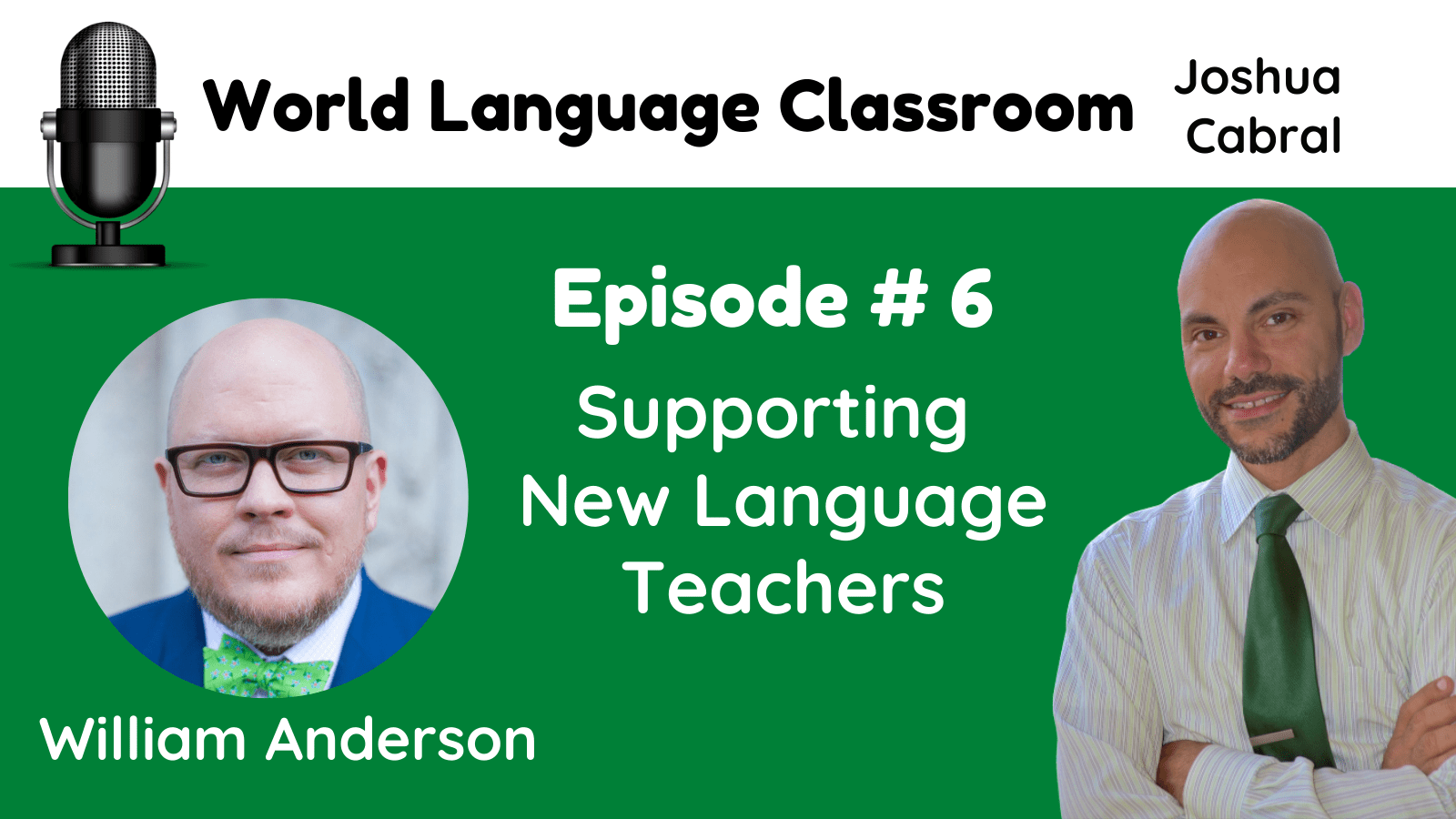
6. Supporting New Teachers with William Anderson

In this episode we talk about supporting new language teachers in your department.  If you are an administrator, a new teacher, or a colleague with new department members there is a place for you to jump into this conversation. [sign up for Talking Points]

I am joined by William Anderson,  who leads a district program with 9 schools and over 40 teachers in the language department.  

William speaks specifically about…

  • what to look for when hiring teachers.
  • how to support new teachers in the areas of classroom management, assessments and planning.
  • what a “good” class or lesson looks like. 
  • what new teachers should be asking for support with (but don’t know that they need to ask).
  • how colleagues can support new teachers.

Connect with William Anderson

Follow wherever you listen to podcasts.

Equity & Social Justice in the World Language Classroom

The world language classroom is certainly a place where we can highlight and embrace equity, equality and social justice.  Given that we engage in discussions of culture almost every day we should keep this equity lens front and center. Before we even begin to think about language learning, or learning of any kind, we need to create welcoming classroom environments where every student feels safe, valued and understood for who they are.

Social Justice in the World Language Classroom

I’ve been familiar with the work and publications of Teaching Tolerance for many years.  Despite the good work of the organization I have always had a problem with the word “tolerance.”  It seems like such a low bar.  I was very happy to see that they decided to change their name to Learning for Justice.  So much better.

There are lots of resources on the LFJ website.  One that I think we can all use in the language classroom is the Social Justice Standards and Anti-Bias Framework.  They are set of anchor standards and age-appropriate learning outcomes divided into four domains—Identity, Diversity, Justice and Action.  The anchors provide common language and they guide teachers and administrators as they seek to make schools more just, equitable and safe.

I particularly appreciate how the standards are leveled for K–12 education.  They remind me of how the ACTFL Can Do Statements are organized.

There are 5 anchor standards for each domain. Social Justice in the World Language ClassroomThen there are grade level and developmentally appropriate outcomes and goals for each anchor. Here is an example of the goals for the Action Anchors for grades 9-12. Social Justice in the World Language Classroom

It is interesting to track a goal through the developmental levels. Let’s take #17 under Action for example:

17. Students will recognize their own responsibility to stand up to exclusion, prejudice and injustice.

K-2:  I can and will do something when I see unfairness—this includes telling an adult.

3-5: I know it’s important for me to stand up for myself and for others, and I know how to get help if I need ideas on how to do this.

6-8: I know how to stand up for myself and for others when faced with exclusion, prejudice and injustice.

9-12: I take responsibility for standing up to exclusion, prejudice and injustice.

You can see the progression from “can do something,” and “know how to get help” to “stand up for myself and others” and “take responsibility.”  The outcomes and goals make the anchors very concrete and understandable.

Since we are often in the proficiency-level head space these Social Justice Standards blend well, particularly in the language classroom where we have infinite opportunities to take on issues of equity and equality.

5. Embracing Proficiency with Katya Hottenstein

In this episode I speak with Katya Hottenstein.
She and I used to work together and we both started our journey toward teaching toward proficiency around the same time.  Katya shares her insights and experience embracing proficiency as her goals in the classroom.

She speaks specifically about…

  • her first few years of teaching before embracing proficiency as a goal
  • when she started looking outside of the box and why
  • what she started to do differently and the results
  • how she uses CI  (Comprehensible Input) in her teaching
  • the benefits of teaching with CI with  a focus on proficiency

Follow wherever you listen to podcasts.

4. What is Communicative Language Teaching?

In this episode I take on the topic of communicative language teaching (CLT).  What is it exactly and how do we teach communicatively? [sign up for Talking Points]

Topics:

  • CLT is an approach and not a method.
  • Difference between an approach and a method?
  •  Bill VanPatten’s description of  CLTR.
  • The role of input.
  • The role of output.
  • The communicative classroom:
    • student-centered
    • students create with language
    • focus is communicating messages

What does this look like in the classroom?

  • Performance
  • Assessment

What does the teacher do in the communicative language classroom?

“[It is not] because some plants will grow in a desert, [that] watering the ones in your garden is a waste of time. In fact, of course, while the desert may provide the minimum conditions for a plant to grow, watering it may help it grow faster, bigger, and stronger, that is to realize its full potential.” —Larsen-Freeman and Long, 1990

This blog has a pdf that you can download with all of these details on communicative language teaching.

Follow wherever you listen to podcasts.