Category Archives: Podcast Episodes

15: Stories as Windows and Mirrors with Jennifer Degenhardt


In this episode we talk about stories in the language classroom.  Stories provide opportunities to see and interpret words and structures in context.  There are numerous opportunities to engage with the text in all of the communication modes.  Additionally, students learn about different cultures and can also see themselves reflected in the story.  This form of representation is incredibly valuable for students on their language learning journey.

I am joined by Jennifer Degenhardt, a language teacher and author of CI (Comprehensible Input) novels for novice and intermediate students.

Jennifer offers her thoughts and insights on…

  • the value in representation
  • how she finds her characters and their stories
  • the research that goes into a book
  • how she writes an “authentic” personal experience
  • what she hears from students and teachers who read her books

Connect with Jennifer Degenhardt:

Follow wherever you listen to podcasts.

14: What About the Textbook with Timothy Chávez


In this episode we are talking about textbooks.  Some of us use them, some of us don’t.  Maybe you are required to use one and maybe it’s a choice.  Wherever you are with textbooks there’s a place for you in this conversation.

I am joined by Timothy Chavez, a Millennial Teacher, who, as you will hear, is part of a generation of students that were “brought up on proficiency in the classroom”…. proficiency natives if you will.  And these proficiency natives are teaching the way the they learned.  How exciting.

Timothy speaks about…

  • his experience as a student with textbooks in the classroom
  • how textbooks were traditionally designed and what might be missing
  • whether or not we need to  ditch the textbook all-together or if there are ways to use them effectively
  • how to integrate a textbook (when required) with proficiency-based approaches to teaching
  • the possibility of teaching without a textbook
  • how teachers advocate to administration if they want to move away from a textbook-based curriculum

Connect with Timothy Chávez:

Follow wherever you listen to podcasts.

13: Diving into Comprehensible Input with John Bracey

In this episode we talk all about comprehensible input (CI), which you will see is a useful approach in teaching and learning any language.

I am joined by John Bracey, a Latin teacher who uses CI very effectively with his students.  He also makes a strong case for all teachers to try out CI, including Latin teachers.

John speaks about…

  • his journey with CI and how he discovered it.
  • the linguistic benefits of CI. 
  • using CI to personalize language and connect with and validate students’ lived experiences.
  • what CI looks like in his classroom.
  • why Latin teachers should use CI.

Connect with John Bracey:

Follow wherever you listen to podcasts.

12: ACTFL Proficiency Levels


In this episode I walk through the ACTFL Proficiency Levels and Performance Descriptors.

What are they?

The ACTFL Performance Descriptors (Can Do’s) for Language Learners…

  • Describe language performance that is the result of instruction in a classroom setting 
  • Reflect how language learners perform in various learning environments.

How are they used in teaching and learning?

  • Help teachers create performance tasks targeted to the performance range, while also challenging learners to use strategies from the next next level up (Krashen, i+1). 
  • Teachers can set realistic expectations at the summative assessment level. 
  • Describe a pathway for learners to keep track of progress, identify areas that need more attention, and have a clear understanding of how to move to the next level.

How are they designed?

The ACTFL Performance Descriptors:

  • “Describe the language performance of language learners in Standards-based, performance-oriented learning environments”
  • “Provide descriptive performance outcomes adaptable to fit differences in languages and learners” (Any language at any level)

How are they organized?

  • Three levels – Novice, Intermediate, Advanced Range (and superior, but for our purposes)
  • Three Modes of Communication – Interpersonal, Interpretive, Presentational (episode 8)

What is involved with each proficiency level?

  • Functions (global tasks the learner can perform in the language)
  • Contexts (learner can function) and Content (topics)
  • Text Type (that which the learner is able to understand and produce in order to perform the functions of the level)

Interpersonal Proficiency Levels:

Novice

  • Function: Can ask highly predictable and formulaic questions and respond to such questions by listing, naming, and identifying. (May show emerging evidence …)
  • Context: Able to function in some personally relevant contexts on topics that relate to basic biographical information.
  • Text Type: Understands and produces highly practiced words and phrases and an occasional sentence.

Intermediate

  • Function: Consistently able to initiate, maintain, and end a conversation to satisfy basic needs and/or to handle a simple transaction.
  • Context: Able to communicate in contexts relevant to oneself and others, and one’s immediate environment.
  • Text Type: Able to understand and produce discrete sentences, strings of sentences and some connected sentences. Able to ask questions to initiate and sustain conversations.

Advanced

  • Function: Can communicate with ease and confidence by understanding and producing narrations and descriptions in all major time frames and deal efficiently with a situation with an unexpected turn of events
  • Context: Content areas include topics of personal and general interest (community, national, and international events) as well as work-related topics and areas of special competence.
  • Text Type: Able to understand and produce discourse in full oral paragraphs that are organized, cohesive, and detailed.

 How to use Proficiency Levels (Performance Descriptors) in the classroom

  • Unit Can Do (focus on function and text type); global tasks the learner can perform in the language and the language they need to do it
  • Assessments (stay with the range)
  • Activities: Too low or too high leads to lack of or limited engagement. 

Blog posts:

  • wlclassroom.com/ican —  walks through writing I can statements that are truly communicative and there is a link to the ACTFL Performance Descriptors
  • wlclassroom.com/levelupshows what language looks like at each proficiency level and what students can focus on (or do) to level up.

Follow wherever you listen to podcasts.

11: Free Voluntary Reading (FVR) with Jade Greene

In this episode we talk about Free Voluntary Reading (FVR) in the in language classroom.

I am joined by Jade Greene, a high school teacher in North Carolina, who helps us understand the benefits of reading in the target language and how to set up FVR in our language classrooms.

Jade speaks about…

  • the primary benefits of promoting a culture of reading in the language classroom
  • choosing books for your classroom library
  • students’ responses to the reading options
  • how FVR works
  • her journey as a CI (Comprehensible Input) author

Connect with Jade Greene:

Follow wherever you listen to podcasts.

10: Equity in the Language Classroom with A.C. Quintero

In this episode we talk about equity in the in language classroom, but it’s really about equity in any classroom.  [sign up for Talking Points]

I am joined by A.C. Quintero who helps us to understand the importance of creating a classroom and student experience that moves beyond equality and focuses on an authentic equity.

A.C. speaks about…

  • what students “bring” to the classroom that language teachers need to be aware of.
  • how we can assess in ways that are equitable and recognize students’ skills in different areas.
  • culturally responsive teaching and how this benefits student.
  • teaching equitably in intentional ways.
  • biases and our responsibility as teachers to recognize them.

Connect with A.C. Quintero:

Follow wherever you listen to podcasts.

9: Teach Grammar as a Concept and in Context with Mike Travers

In this episode we talk about grammar.  This is always a hot topic in language teaching with lots of questions about how (or even if) we should do it.  [sign up for Talking Points]

I am joined by Mike Travers, a teacher in Massachusetts, who has presented on this topic many times at teacher conferences, having been named “Best of Conference.”  So, who better to help with this conversation?

Mike speaks about…

  • The role of grammar in communicative language teaching.
  • ACTFL’s Core Practice of Teaching Grammar as a Concept and in Context.
  • Why is it essential and beneficial that language structures be taught in context.
  • Procedures for teaching grammar in context and as a concept.
  • Possible benefits of explicit grammar instruction.

Connect with Mike Travers:

Follow wherever you listen to podcasts.

8. The Communication Modes


In this episode I discuss the communication modes, including a look back at the legacy teaching focused on the 4 skills: reading, writing, listening, and speaking.  Then moving into the arrival of the Communication Modes, which don’t erase the skills, but rather put them into a communicative context.  

The ACTFL Proficiency Guidelines put communication into these categories: interpersonal, interpretive and presentational.  

Presentational communication 

  • One-way speaking or writing that does not allow for real time clarification of meaning.  
  • Prepared in advance, not spontaneous

interpretive communication 

  • One-way listening or reading that also does not allow for real time clarification of meaning. 
  • This may require accessing personal knowledge of the topic or doing research.  

Interpersonal communication

  • Two-way speaking that allows for clarification of the message in real time.  
  • When communicating interpersonally all speakers and listeners are involved in creating and interpreting the message and work together to assure that there is a collective understanding.

What does it look like in the classroom?

  • The 4 skills are woven together; listen then discuss or read and then write.
  • Begin with interpretive, then move on to other modes
  • IPA: Integrated performance assessment; backwards planning

Blog Post/Slide Share on  the ACTFL Communication Modes

Follow wherever you listen to podcasts.

7: The Why & How of Positive Teacher-Student Relationships with Ebony Thornton


In this episode we talk about how essential positive teacher-student relationships are, particularly when we want our students to feel valued, comfortable and motivated to speak the target language.  [sign up for Talking Points]

I am joined by Ebony Thornton, a teacher in Georgia, who speaks about…

  • relationships with her own teachers and those that influenced her student-teacher relationships
  • barriers that make teacher-student relationships challenging
  • respecting distance when needed
  • how do you get to know your students
  • how effective relationships enhance the teaching and learning experience
  • the “savior” complex
  • representation in the language classroom
  • #BlackWLTeachers

Connect with Ebony Thronton

Follow wherever you listen to podcasts.

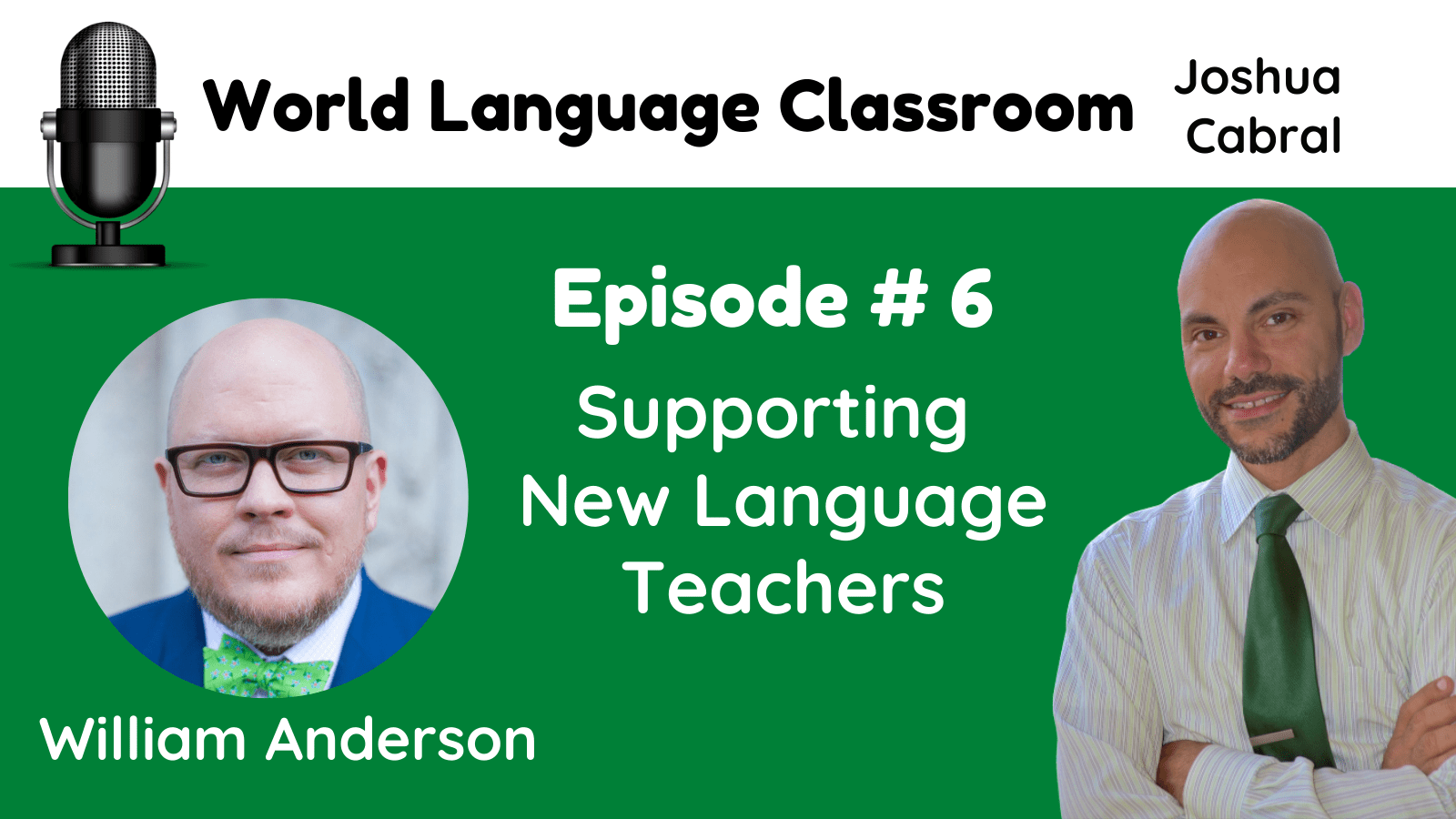
6. Supporting New Teachers with William Anderson

In this episode we talk about supporting new language teachers in your department.  If you are an administrator, a new teacher, or a colleague with new department members there is a place for you to jump into this conversation. [sign up for Talking Points]

I am joined by William Anderson,  who leads a district program with 9 schools and over 40 teachers in the language department.  

William speaks specifically about…

  • what to look for when hiring teachers.
  • how to support new teachers in the areas of classroom management, assessments and planning.
  • what a “good” class or lesson looks like. 
  • what new teachers should be asking for support with (but don’t know that they need to ask).
  • how colleagues can support new teachers.

Connect with William Anderson

Follow wherever you listen to podcasts.