Author Archives: jos76

127: Mindfulness and SEL in the Language Classroom with Jennifer Schwester


Is there a place for mindfulness and SEL (Social Emotional Learning) in the world language classroom?  My guest today, Jennifer Schwester, a French teacher in New Jersey, certainly knows there is.  We discuss why language teachers should consider mindfulness and SEL activities and their many benefits to students. SEL programs are also becoming more prevalent in our schools, and rightfully so. Can’t want to share these ideas with you.

Topics in this Episode:

  • what mindfulness and SEL are 
  • how incorporating mindfulness and social emotional learning activities impact students’ language proficiency and overall language learning experience
  • specific strategies for effectively cultivating a safe space for students to express themselves in the language classroom
  • how  mindfulness and SEL activities help students better understand and respect each other
  • how mindfulness and social emotional learning contribute to students’ abilities to positively engage in our interconnected world, and become compassionate global citizens
  • Journey To The Heart– Melody Beattie

Connect with Jennifer Schwester :

Work with Joshua either in person or remotely.

Teachers want to hear from you and what you are proud of in your classroom.
Join me as a guest on the podcast.

You  can also be a part of Leveling Up coaching episode if there is an area of your teaching that you like to improve or enhance.  Join me on the podcast for a Leveling Up Coaching Episode.  

Follow wherever you listen to podcasts.

126: Cultural Self-Reflection with Jocelynn Hubbard


Are your students comfortable reflecting on their own experiences? Are we, as teachers, comfortable doing this?  This is an important first step in asking our students (and ourselves) to understand and appreciate other cultures and experiences. Today I speak with Jocelynn Hubbard, host of The Culture-Centered Classroom, about how we can engage students in their own cultural self-reflection. We will also learn to do it ourselves.

Topics in this Episode:

  • what cultural self-reflection is and its impact on students in the classroom
  • the process of self-reflection with examples of the types of resources that you use to support the process of cultural self-reflection
  • how to introduce this practice to your students, and some possible challenges that might come up
  • how to create a safe and inclusive environment for your students to explore and discuss their cultural identity openly
  • how cultural self-reflection has influenced Jocelynn’s teaching approach and helped her to better meet the individual needs of her students

Connect with Jocelynn Hubbard :

Work with Joshua either in person or remotely.

Teachers want to hear from you and what you are proud of in your classroom.
Join me as a guest on the podcast.

You  can also be a part of Leveling Up coaching episode if there is an area of your teaching that you like to improve or enhance.  Join me on the podcast for a Leveling Up Coaching Episode.  

Follow wherever you listen to podcasts.

125: Try Something New Part 2 – What Will that New Thing Be?


The new year will soon be here and along with that are thoughts of trying out something new.  Last week we looked at how small, sustainable, and consistent changes or modifications are more likely to stick, rather than attempting to overhaul everything. This week we focus on lots of ideas for what you can actually do in the classroom along with ways to make it happen seamlessly, consistently and successfully. 

Topics in this Episode:

  • What will that new thing be?
    • Communication Modes
    • Classroom Procedures
    • High-Leverage Teaching Practices
    • Assessments
  • How will you make it happen?
  • When is it time for a new goal?
  • Matt Cuts: Try Something New For 30 Days
  • James Clear: Atomic Habits

Work with Joshua either in person or remotely.

Teachers want to hear from you and what you are proud of in your classroom.
Join me as a guest on the podcast.

You  can also be a part of Leveling Up coaching episode if there is an area of your teaching that you like to improve or enhance.  Join me on the podcast for a Leveling Up Coaching Episode.  

Follow wherever you listen to podcasts.

124: Try Something New Part 1 – Why? How? What Gets in the Way?


The new year brings on thoughts of trying out something new.  However, the idea of trying something new or modifying your existing practices in the classroom is not always that easy. In this first of a two-part episode, we look at how small, sustainable, and consistent changes or modifications are more likely to stick, rather than attempting to overhaul everything. This week we focus on real examples of trying new things in the classroom successfully, along with ways to overcome any obstacles that might get in the way.  Part 2 next week will give you lots of ideas for what you can actually do in the classroom.  

Topics in this Episode:

  • Matt Cuts: Try Something New For 30 Days
  • James Clear: Atomic Habits
  • Why try something new?
    • Keep Students engaged
    • Model for students
    • Boost creativity
    • Problem-solving experience
  • What gets in the way of trying some thing new?
    • Fear of failure
    • Time
    • Resistance
    • Staying motivated
  • Tips and suggestions for working through the things that get in the way.

Work with Joshua either in person or remotely.

Teachers want to hear from you and what you are proud of in your classroom.
Join me as a guest on the podcast.

You  can also be a part of Leveling Up coaching episode if there is an area of your teaching that you like to improve or enhance.  Join me on the podcast for a Leveling Up Coaching Episode.  

Follow wherever you listen to podcasts.

123: Addressing Polarizing Topics in the Classroom with Kent Lenci


Are there topics that you avoid in the classroom?  Are there themes that come up and you’re not sure how to handle a potentially polarizing situation? I’ve certainly been there myself and that’s when I turn to my guest today, Kent Lenci, who collaborates with schools as they work toward building a culture of civil discourse in their classrooms and communities. How often do we ask our language students their opinion, on everything from favorite color to politics. We can all use some tools to navigate some of these potentially tricky situations. Kent Lenci is here to provide those tools and insights.

Topics in this Episode:

  • why it’s important to not avoid  challenging topics
  • techniques and strategies teachers can use to create a supportive environment, particularly thinking of students who might be hesitant to express their viewpoints due to fear of judgment or negative consequences.
  • practical classroom management strategies to keep conversations constructive and focused on learning
  • how teachers can be prepared for unexpected reactions or comments and foster an atmosphere of empathy and understanding
  • Kent’s thoughts and insights on Robert Jones, Jr.’s quote: “We can disagree and still love each other unless your disagreement is rooted in my oppression and denial of my humanity and right to exist.”

Connect with Kent Lenci :

Work with Joshua either in person or remotely.

Teachers want to hear from you and what you are proud of in your classroom.
Join me as a guest on the podcast.

You  can also be a part of Leveling Up coaching episode if there is an area of your teaching that you like to improve or enhance.  Join me on the podcast for a Leveling Up Coaching Episode.  

Follow wherever you listen to podcasts.

122: IPAs and World Language Standards


Join me on the podcast for a Leveling Up Coaching Episode.

How do you implement IPAs effectively in your classroom? Today’s episode is a Leveling Up episode, where I coach Judy, a German teacher in Illinois. Implementing IPA’s effectively is the area where wants to level up her teaching practice.

Suggestions:

  • Begin by incorporating IPAs in one unit or topic. This step-by-step approach allows you to refine your techniques and identify what works best for your students.
  • Authentic materials can be just about anything: a short video, a photo, a brochure. Create a Pinterest board where you can pin authentic resources that you find on the internet.
  • Develop clear and detailed rubrics to evaluate students’ performance in IPAs. 
  • Begin with 2-3 modes on the IPA, then add on the other modes with future IPAs.
  • Offer formative practice opportunities before the actual IPA to help students become familiar with the assessment format.
  • Use AI tools, such as ChatGPT to create a possible IPA, or at least offer a template to use.
  • Create a Pinterest board where you can pin authentic resources that you find on the internet

Action Plan:

This Week:

  • Choose one unit or topic from your curriculum where you will create an IPA.
  • Create a clear and detailed rubric that aligns with the IPA tasks

The Coming Weeks:

  • Design and implement formative practice activities related to the selected IPA unit. 
  • Administer the IPA for the selected unit, using the rubric to evaluate students’ performance.

Helpful Podcast Episodes on This Topic:

Helpful Blog Posts on This Topic:

You  can also be a part of Leveling Up coaching episode if there is an area of your teaching that you like to improve or enhance.  Join me on the podcast for a Leveling Up Coaching Episode.

Work with Joshua either in person or remotely.

Teachers want to hear from you and what you are proud of in your classroom.
Join me as a guest on the podcast.

Follow wherever you listen to podcasts.

121: Using Chat Mats in the Language Classroom with Christina Margiore


Have you used chat mats in your classroom? Even if you haven’t, I’m sure that you have heard about this useful tool to support students.  Today, Christina Margiore,  a Spanish teacher on Long Island, New York, joins me to talk us through all the details involved with creating and using chat mats.  If you are using them already, you will get some new ideas for sure.  New to chat mats?  No problem.  You’ll soon be ready to use them with ease. 

Topics in this Episode:

  • what chat mats are and how they are beneficial in the language classroom
  • elements to you include in chat mats
  • building on existing chat mats and creating new chat mats by unit
  • specific examples of how incorporating chat mats into lessons and activities
  • tips for implementing chat mat

Connect with Christina Margiore :

Work with Joshua either in person or remotely.

Teachers want to hear from you and what you are proud of in your classroom.
Join me as a guest on the podcast.

You  can also be a part of Leveling Up coaching episode if there is an area of your teaching that you like to improve or enhance.  Join me on the podcast for a Leveling Up Coaching Episode.  

Follow wherever you listen to podcasts.

120: Rethinking Participation with Timothy Chávez


What does participation look like in your classroom?  How can you make sure that all students are actively engaged and not just a few that have demeanors that lend themselves to speaking up regularly?  In this episode I speak with Timothy Chávez, a Spanish teacher in Massachusetts, who shares his suggestions and techniques for getting all students involved and participating in class.  We recorded this episode live in the Exhibits Hall at the MaFLA conference in October. We had lots of spectators stop by to see how it all works and what it looks like to record an episode. I kept the background sound of the exhibit hall excitement in so that you can feel the energy that we did.

Topics in this Episode:

  • the benefits of Prsida Himmele & William Himmele’s Total Participation Techniques in the world language classroom
  • how these techniques enhance language learning and student engagement
  • how Total Participation Techniques promote a comfortable and inclusive learning environment
  • Specific Total Participation Techniques that Timothy has found most effective
  • Total Participation Techniques used for assessment
  • how Total Participation Techniques can be adapted to ensure that all students are actively participating and feeling confident in their communication skills

Connect with Timothy Chávez:

Work with Joshua either in person or remotely.

Teachers want to hear from you and what you are proud of in your classroom.
Join me as a guest on the podcast.

You  can also be a part of Leveling Up coaching episode if there is an area of your teaching that you like to improve or enhance.  Join me on the podcast for a Leveling Up Coaching Episode.  

Follow wherever you listen to podcasts.

Agile Thinking in the Language Classroom

Decisions, Decisions! In our fast-past and dynamic language classrooms, swift decision-making is a constant.  Nobel Prize winner Daniel Kahneman, who has extensively studied decision-making, speaks of an  intricate balance between two cognitive systems: System 1 and System 2. Kahneman describes System 1 as fast thinking—automatic and error-prone. In contrast, he describes System 2 as slower, deliberate thinking, less prone to error, demanding more time and often involving getting feedback for more accurate decision-making.

Agile Thinking in the Language Classroom (French, Spanish)

System 1 and System 2 Thinking

  1. System 1 Thinking (Fast, Automatic):
    • Intuitive and quick, System 1 thinking is the automatic thought process for everyday decisions.
    • Operating effortlessly, it relies on heuristics and past experiences.
    • Prone to biases, errors, and influenced by emotions, System 1 is efficient for routine tasks but may oversimplify complex situations.
  2. System 2 Thinking (Slow, Deliberate):
    • Deliberate and conscious, System 2 thinking involves careful analysis, seeking additional information, and considering various perspectives.
    • Less prone to biases, it provides a more accurate approach to decision-making.
    • While demanding more time and mental energy, System 2 is essential for navigating complex and nuanced decision-making scenarios.

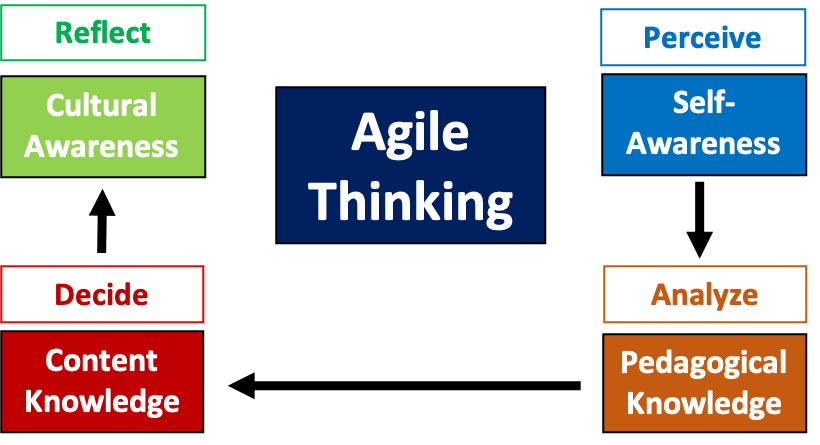
The Agile Thinking Paradigm

Kahneman’s insights become particularly crucial for language teachers.  They suggest the consistent use of routines that focus System 2 thinking and decision making. This intentional shift ensures that decisions are not only reflective and deliberate but also less susceptible to bias and error. Deborah Ball, echoing Kahneman’s insights, challenges teachers to scrutinize our seemingly neutral habits harboring implicit biases. This would be the error-prone System 1 at work. Our teaching is influences by our biases.  Ball advocates creating a “repertoire” of teaching habits explicitly designed to counteract potential biases.  This is where System 2 comes in.

Deliberative decision-making, afforded by System 2, minimizes errors and biases. This intentional shift fosters an environment where instructional choices are thoughtful, nuanced, and conducive to student success. Agile Thinking, a dynamic integration of System 1 and System 2, is  a practical approach that goes beyond theory and empowers teachers to make decisions that respond to diverse student needs.

The Four-Step Framework for Agile Thinking and Decision-Making

Agile Thinking in the Language Classroom (French, Spanish)

  1. Perceive – (Self-Awareness):
    • Cultivate self-awareness: Understand personal biases and cultural perspectives.
    • Embrace cultural awareness: Recognize the diverse backgrounds of students, laying the foundation for agile decision-making.
  2. Analyze (Pedagogical Knowledge):
    • Engage in conscious deliberation: Draw on pedagogical knowledge to increase clarity, accessibility, relevance, and rigor in instruction.
    • Apply pedagogical insights: Consider various instructional approaches to meet the diverse needs of learners.
  3. Decide (Content Knowledge):
    • Implement agile thinking: Generate rapid, flexible, and culturally affirming mental models of teaching and learning.
    • Leverage content knowledge: Utilize subject expertise to adapt lessons for maximum impact.
  4. Reflect (Cultural Awareness):
    • Assess impact: Evaluate the consequences of instructional decisions on students.
    • Promote continuous improvement: Aligning with the self-awareness aspect, foster an environment of ongoing reflection and growth.

I like to make things as concrete as possible, especially when creating systems and routines in my classroom.  I put 3 words words with each step to make this idea of Agile Thinking directly applicable to my classroom language teaching.  These words serve as a check for myself.

Agile Thinking in the Language Classroom (French, Spanish)

Agile Thinking in the Language Classroom (French, Spanish)

Agile Thinking in the Language Classroom (French, Spanish)

Agile Thinking in the Language Classroom (French, Spanish)

This is what it looks like all together so that I have it all in one place.

Agile Thinking in the Language Classroom (French, Spanish)

Agile Thinking and Decision-Making in Your Classroom

I encourage you to embrace agile thinking. This mindset sets the stage for teachers to make decisions that not only enhance language proficiency but also foster confident communication in students. The journey begins with an awareness of decisions, transcends biases, and leads to a more inclusive and effective language education. Engage with the  four-step framework and you will be better equipped to navigate the complexities of teaching with agility, responsiveness, and being less prone to errors.

A Vision Framework for Your Language Classroom

I continually look for ways to enhance my teaching practices.  As part of my ongoing personal educational development this year I implemented a TRU (Teaching for Robust Understanding) Framework.  This teaching framework empowers educators to hone in on their teaching practices and ensure that what we do in our classroom is in line with our intended vision and objectives. Here are some insights from integrating TRU into my teaching, which will hopefully resonate with my language teacher colleagues.

A Vision Framework for Your Language Classroom (French, Spanish) TRU Framework

What is TRU?

Alan H. Schoenfeld, a Distinguished Professor of Education at the University of California, Berkeley, founded the Teaching for Robust Understanding Project. His goal is to distill the vast literature on teaching and learning into a coherent, usable framework. The TRU Framework encompasses five focal dimensions:

A Vision Framework for Your Language Classroom (French, Spanish) TRU Framework

TRU in Language Classroom

Let’s look at how the TRU Framework can be useful and effective in the context of language education, using examples from my own vision framework.  My Vision Framework is titled The Five Dimensions Engaging and Purposeful Classroom. Each of the 5 categories is tailored to my overarching language teaching goal.

Students…

  • feel confident, motived and valued
  • are engaged and learning is purposeful
  • see the content and learning as relevant to their lives

Here are how I concretely articulate these goals and intentions in each of the TRU framework areas:

A Vision Framework for Your Language Classroom (French, Spanish) TRU Framework

“In my classroom, students are not passive recipients of information. Instead, they are active contributors to conversations about language proficiency and cultural nuances. They understand the purpose behind their learning and take ownership of their linguistic journey.”

Questions you to ponder as you look at this in your own classroom: How can you create an environment where students feel empowered to contribute to conversations about language proficiency and cultural understanding? In what ways can you encourage students to take ownership over their language learning journey?

A Vision Framework for Your Language Classroom (French, Spanish) TRU Framework

“Classroom activity structures provide opportunities for students to become knowledgeable, flexible, and resourceful disciplinary thinkers. Topics are relevant to learners, motivating them to make connections and develop productive disciplinary habits of mind.”

Questions you to ponder as you look at this in your own classroom: How can you align your lesson plans with topics that are relevant and motivating for your students? In what ways can you create activities that foster connections and develop productive language habits of mind?

A Vision Framework for Your Language Classroom (French, Spanish) TRU Framework

“Students have opportunities to grapple with and make sense of important language ideas. They are challenged in ways that provide room and support for growth, cultivating a mindset where challenges are seen as opportunities for learning.”

Questions you to ponder as you look at this in your own classroom:  How can you provide challenging tasks that support students in making sense of complex language ideas? In what ways can you guide students through productive struggles, helping them see challenges as opportunities for growth?

A Vision Framework for Your Language Classroom (French, Spanish) TRU Framework

“Classroom activity structures invite and support the active engagement of all students. Individual students are involved in meaningful ways and do not doubt their valued presence in the classroom.”

Questions you to ponder as you look at this in your own classroom: What strategies can you implement to ensure that every student is actively engaged in language learning activities? How can you create a classroom environment where all students feel their contributions are meaningful?

A Vision Framework for Your Language Classroom (French, Spanish) TRU Framework

“Classroom activities elicit student thinking, and subsequent interactions respond to those ideas. Specific feedback is central to formative assessment practice, guiding students in deepening their language comprehension.”

Questions you to ponder as you look at this in your own classroom: How can you design activities that elicit and showcase students’ language proficiency and understanding? In what ways can you provide specific and constructive feedback to guide students in deepening their language comprehension?

Your Vision Framework

As a language teacher, you can use the TRU Framework to create your own vision framework tailored to your classroom.  Consider creating a framework that aligns with the 5 TRU dimensions.  Keep these key elements of your vision handy and in mind as you create curriculum and teach.  I know that they help to keep me on track and focused on my goals, vision and objectives. Here is what my TRU Framework looks like with all the details in one place for easy access.

A Vision Framework for Your Language Classroom (French, Spanish) TRU Framework

Reference:

  • Schoenfeld, A. H., & the Teaching for Robust Understanding Project. (2016). An Introduction to the Teaching for Robust Understanding (TRU) Framework. Berkeley, CA: Graduate School of Education.