Tag Archives: world language classroom podcast

125: Try Something New Part 2 – What Will that New Thing Be?


The new year will soon be here and along with that are thoughts of trying out something new.  Last week we looked at how small, sustainable, and consistent changes or modifications are more likely to stick, rather than attempting to overhaul everything. This week we focus on lots of ideas for what you can actually do in the classroom along with ways to make it happen seamlessly, consistently and successfully. 

Topics in this Episode:

  • What will that new thing be?
    • Communication Modes
    • Classroom Procedures
    • High-Leverage Teaching Practices
    • Assessments
  • How will you make it happen?
  • When is it time for a new goal?
  • Matt Cuts: Try Something New For 30 Days
  • James Clear: Atomic Habits

Work with Joshua either in person or remotely.

Teachers want to hear from you and what you are proud of in your classroom.
Join me as a guest on the podcast.

You  can also be a part of Leveling Up coaching episode if there is an area of your teaching that you like to improve or enhance.  Join me on the podcast for a Leveling Up Coaching Episode.  

Follow wherever you listen to podcasts.

124: Try Something New Part 1 – Why? How? What Gets in the Way?


The new year brings on thoughts of trying out something new.  However, the idea of trying something new or modifying your existing practices in the classroom is not always that easy. In this first of a two-part episode, we look at how small, sustainable, and consistent changes or modifications are more likely to stick, rather than attempting to overhaul everything. This week we focus on real examples of trying new things in the classroom successfully, along with ways to overcome any obstacles that might get in the way.  Part 2 next week will give you lots of ideas for what you can actually do in the classroom.  

Topics in this Episode:

  • Matt Cuts: Try Something New For 30 Days
  • James Clear: Atomic Habits
  • Why try something new?
    • Keep Students engaged
    • Model for students
    • Boost creativity
    • Problem-solving experience
  • What gets in the way of trying some thing new?
    • Fear of failure
    • Time
    • Resistance
    • Staying motivated
  • Tips and suggestions for working through the things that get in the way.

Work with Joshua either in person or remotely.

Teachers want to hear from you and what you are proud of in your classroom.
Join me as a guest on the podcast.

You  can also be a part of Leveling Up coaching episode if there is an area of your teaching that you like to improve or enhance.  Join me on the podcast for a Leveling Up Coaching Episode.  

Follow wherever you listen to podcasts.

123: Addressing Polarizing Topics in the Classroom with Kent Lenci


Are there topics that you avoid in the classroom?  Are there themes that come up and you’re not sure how to handle a potentially polarizing situation? I’ve certainly been there myself and that’s when I turn to my guest today, Kent Lenci, who collaborates with schools as they work toward building a culture of civil discourse in their classrooms and communities. How often do we ask our language students their opinion, on everything from favorite color to politics. We can all use some tools to navigate some of these potentially tricky situations. Kent Lenci is here to provide those tools and insights.

Topics in this Episode:

  • why it’s important to not avoid  challenging topics
  • techniques and strategies teachers can use to create a supportive environment, particularly thinking of students who might be hesitant to express their viewpoints due to fear of judgment or negative consequences.
  • practical classroom management strategies to keep conversations constructive and focused on learning
  • how teachers can be prepared for unexpected reactions or comments and foster an atmosphere of empathy and understanding
  • Kent’s thoughts and insights on Robert Jones, Jr.’s quote: “We can disagree and still love each other unless your disagreement is rooted in my oppression and denial of my humanity and right to exist.”

Connect with Kent Lenci :

Work with Joshua either in person or remotely.

Teachers want to hear from you and what you are proud of in your classroom.
Join me as a guest on the podcast.

You  can also be a part of Leveling Up coaching episode if there is an area of your teaching that you like to improve or enhance.  Join me on the podcast for a Leveling Up Coaching Episode.  

Follow wherever you listen to podcasts.

122: IPAs and World Language Standards


Join me on the podcast for a Leveling Up Coaching Episode.

How do you implement IPAs effectively in your classroom? Today’s episode is a Leveling Up episode, where I coach Judy, a German teacher in Illinois. Implementing IPA’s effectively is the area where wants to level up her teaching practice.

Suggestions:

  • Begin by incorporating IPAs in one unit or topic. This step-by-step approach allows you to refine your techniques and identify what works best for your students.
  • Authentic materials can be just about anything: a short video, a photo, a brochure. Create a Pinterest board where you can pin authentic resources that you find on the internet.
  • Develop clear and detailed rubrics to evaluate students’ performance in IPAs. 
  • Begin with 2-3 modes on the IPA, then add on the other modes with future IPAs.
  • Offer formative practice opportunities before the actual IPA to help students become familiar with the assessment format.
  • Use AI tools, such as ChatGPT to create a possible IPA, or at least offer a template to use.
  • Create a Pinterest board where you can pin authentic resources that you find on the internet

Action Plan:

This Week:

  • Choose one unit or topic from your curriculum where you will create an IPA.
  • Create a clear and detailed rubric that aligns with the IPA tasks

The Coming Weeks:

  • Design and implement formative practice activities related to the selected IPA unit. 
  • Administer the IPA for the selected unit, using the rubric to evaluate students’ performance.

Helpful Podcast Episodes on This Topic:

Helpful Blog Posts on This Topic:

You  can also be a part of Leveling Up coaching episode if there is an area of your teaching that you like to improve or enhance.  Join me on the podcast for a Leveling Up Coaching Episode.

Work with Joshua either in person or remotely.

Teachers want to hear from you and what you are proud of in your classroom.
Join me as a guest on the podcast.

Follow wherever you listen to podcasts.

121: Using Chat Mats in the Language Classroom with Christina Margiore


Have you used chat mats in your classroom? Even if you haven’t, I’m sure that you have heard about this useful tool to support students.  Today, Christina Margiore,  a Spanish teacher on Long Island, New York, joins me to talk us through all the details involved with creating and using chat mats.  If you are using them already, you will get some new ideas for sure.  New to chat mats?  No problem.  You’ll soon be ready to use them with ease. 

Topics in this Episode:

  • what chat mats are and how they are beneficial in the language classroom
  • elements to you include in chat mats
  • building on existing chat mats and creating new chat mats by unit
  • specific examples of how incorporating chat mats into lessons and activities
  • tips for implementing chat mat

Connect with Christina Margiore :

Work with Joshua either in person or remotely.

Teachers want to hear from you and what you are proud of in your classroom.
Join me as a guest on the podcast.

You  can also be a part of Leveling Up coaching episode if there is an area of your teaching that you like to improve or enhance.  Join me on the podcast for a Leveling Up Coaching Episode.  

Follow wherever you listen to podcasts.

120: Rethinking Participation with Timothy Chávez


What does participation look like in your classroom?  How can you make sure that all students are actively engaged and not just a few that have demeanors that lend themselves to speaking up regularly?  In this episode I speak with Timothy Chávez, a Spanish teacher in Massachusetts, who shares his suggestions and techniques for getting all students involved and participating in class.  We recorded this episode live in the Exhibits Hall at the MaFLA conference in October. We had lots of spectators stop by to see how it all works and what it looks like to record an episode. I kept the background sound of the exhibit hall excitement in so that you can feel the energy that we did.

Topics in this Episode:

  • the benefits of Prsida Himmele & William Himmele’s Total Participation Techniques in the world language classroom
  • how these techniques enhance language learning and student engagement
  • how Total Participation Techniques promote a comfortable and inclusive learning environment
  • Specific Total Participation Techniques that Timothy has found most effective
  • Total Participation Techniques used for assessment
  • how Total Participation Techniques can be adapted to ensure that all students are actively participating and feeling confident in their communication skills

Connect with Timothy Chávez:

Work with Joshua either in person or remotely.

Teachers want to hear from you and what you are proud of in your classroom.
Join me as a guest on the podcast.

You  can also be a part of Leveling Up coaching episode if there is an area of your teaching that you like to improve or enhance.  Join me on the podcast for a Leveling Up Coaching Episode.  

Follow wherever you listen to podcasts.

119: Teacher ToolBox Episode (Vol 5)


This is the fifth teacher toolbox episode. I hear from listeners all the time that they like the actionable tips and suggestions for activities that they can use with students next week, or even tomorrow. That usually means effective and beneficial, but somewhat minimal prep. That’s what I bring you on these Teacher Toolbox episodes. I have lots to share with you.

Sorry (not sorry), But They Will Keep Asking

“Can we play a game?” Embrace the request and discover 15 activities that can be easily adapted to any language or level. Fill your teacher toolbox with ways for students to engage enthusiastically with the target language in all modes.  

Activities mentioned in this episode:

This Google Doc has all of the links.

Interpersonal

Interpretive

Presentational

Work with Joshua either in person or remotely.

Teachers want to hear from you and what you are proud of in your classroom.
Join me as a guest on the podcast.

You  can also be a part of Leveling Up coaching episode if there is an area of your teaching that you like to improve or enhance.  Join me on the podcast for a Leveling Up Coaching Episode.  

Follow wherever you listen to podcasts.

118: What If Common Assessments Are Not Proficiency-Based


Join me on the podcast for a Leveling Up Coaching Episode.

Do you have to balance common assessments with your proficiency-focused classroom?  Is this a bit of a challenge when those common assessments are not all that focus on proficiency and communication? Today’s episode is a Leveling Up episode, where I coach Lisa, a French teacher in Michigan. Balancing common district assessments in a Proficiency-Focused Classroom  is the area where wants to level up her teaching practice. So let’s start the conversation. 

Suggestions:

  • Might have to be a both/and during these years of transition. Allow for this.
  • Leave 1-2 days at the end of a unit to check in on the material that should be covered on the district common assessment. Any topics that were not covered during the unit can be quickly added on at the end so that students are prepared.

Action Plan:

This Week:

  • Review the district assessments and analyze the proficiency objectives in your curriculum. Identify specific areas where the two align and make sure that the focus remains on language proficiency, while also setting students up for success on the common assessments.
  • Make note of the topics that will be added on to the final days of the unit to align with the common assessment.

The Coming Weeks:

  • Initiate discussions with department heads or administrators to advocate for the importance of proficiency-focused assessment in language learning.
  • Present evidence of its benefits and explore possibilities of incorporating proficiency tasks into district assessments.
  • Start with the walkers and get them into running mode, then move onto those standing on the side.

Helpful Podcast Episodes on This Topic:

Helpful Blog Posts on This Topic:

You  can also be a part of Leveling Up coaching episode if there is an area of your teaching that you like to improve or enhance.  Join me on the podcast for a Leveling Up Coaching Episode.

Work with Joshua either in person or remotely.

Teachers want to hear from you and what you are proud of in your classroom.
Join me as a guest on the podcast.

Follow wherever you listen to podcasts.

Effective Strategies for Checking Comprehension in Language Learning

We increasingly understand the central role of students’ understanding of language as they move up in proficiency and acquire language.  This makes comprehension checks a vital part of the process.

Effective Strategies for Checking Comprehension in Language Learning (French, Spanish)

The Role of Comprehensible Input

The importance of comprehensible input cannot be overstated. It’s the foundation on which students build their linguistic abilities. Krashen’s Input Hypothesis emphasizes the significance of comprehensible input as the key to acquiring language.  It is, therefore, crucial to ensure that the language input is just a step above the students’ current understanding level.

Make Sure the Input is Comprehensible

Use techniques such as visual cues, body language, cognates, and examples of common associations to make input more comprehensible.  Slow down the pace, and simplify complex language structures to facilitate better understanding.

Regular Comprehension Checks

Frequent comprehension checks are essential to gauge student engagement and understanding. Effective comprehension checks provide insights into students’ learning progress and allow teachers to make informed instructional adjustments.

What to Do with What We Learn From the Comprehension Check

Insights from comprehension checks allow teachers to tailor instruction to meet individual student needs effectively. Identifying students’ readiness levels helps in providing appropriate learning support and ensuring no student is left behind.

Strategies for Effective Comprehension Checks

  • Use targeted questions that require thoughtful responses, aligning with the students’ proficiency levels.
  • Integrate formative assessments such as exit tickets, quizzes, and short surveys to gauge student understanding at different stages of the lesson.
  • Organize group discussions or peer-to-peer interactions that encourage students to articulate their understanding of the language material.
  • Introduce interactive activities that require students to apply the language knowledge gained, such as role-plays, debates, or problem-solving tasks.
  • Incorporate visual representations like diagrams, infographics, and concept maps to reinforce language comprehension and facilitate visual learning.
  • Promote the use of reflective journals or learning logs where students can express their understanding of the language content and any areas where they need further clarification.

Total Participation Techniques

In addition to the effective comprehension checks, consider incorporating specific Total Participation Techniques outlined in the book Total Participation Techniques: Making Every Student an Active Learner by Prsida Himmele and William Himmele. Some of the techniques highlighted in the book that could be particularly beneficial for formative comprehension checks include:

  • Think-Pair-Share: Encourage students to think about a question or prompt, discuss their thoughts with a partner, and then share their ideas with the entire class.
  • Four Corners: Use the Four Corners technique to prompt students to choose a corner of the classroom that aligns with their response to a specific question or statement.
  • Implement the RallyRobin technique, which allows students to work in pairs and take turns sharing ideas or responses.
  • Assign short writing exercises where students can express their understanding of the material.
  • Encourage students to review and provide constructive feedback on each other’s work.
  • Jigsaw Activities: Implement jigsaw activities that require students to work collaboratively in groups, with each student responsible for a specific aspect of a larger concept.

Questions to Reflect On

  • Are you integrating regular comprehension checks into your teaching practice?
  • How can you ensure that students are demonstrating their comprehension at the desired proficiency level?
  • What adjustments can you make based on the insights gathered from your comprehension checks?

Checking for comprehension in the language learning process is a crucial step in fostering a robust linguistic foundation for students. By incorporating effective comprehension checks and implementing the strategies above, you can ensure that your students are not only engaging with the material but are also comprehending and internalizing the language input effectively.  These checks also provide essential formative information for moving ahead.


Student-Generated Graphic Organizers in the Language Classroom

Effective learning routines nurture students’ language proficiency and communication skills. We often think of the communication modes, proficiency levels and 90+% target language as the routines that we foster in the classroom.  I’d like to move the focus to another routine that supports these efforts. Student-generated graphic organizers are visual tools that offer a unique pathway for students to comprehend and engage with the target language.

The effectiveness of graphic organizers lies in how well they adhere to general principles of highly-effective learning routines. They are simple, versatile, and foster higher-level cognitive processes. They can be used across various age groups and content areas. I have personally found this tool to be indispensable in my teaching. There are lots of versions and options out there, but I want to share 5 that prove to be most useful.

Keep in mind that students creates these on their own.  They learn how to make them, what they are used for, and how to add in the language and details.  This creation process supports the critical thinking focus. The examples are color-coded to show where students write in the topic (orange boxes) and where they write in the supporting thoughts and details (blue).  The second image is what these organizers look like when students create them on their own.

Linear Details: Students us this organizer to illustrate the sequential order of events in a narrative. For example, students can create a flow map to outline the sequence of actions in a short story. This visual representation supports students in understanding a storyline with greater clarity.
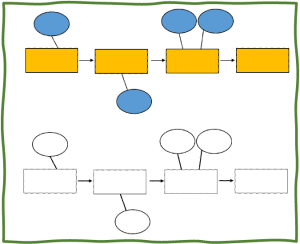
Causes and Effects: Students use this organizer to analyze reasons, such as those that lead to historical events. For example, the students can highlight the French Revolution, with the causes that led to this moment in history and the subsequent effects  Students can grasp the intricate interplay between events and their ramifications. This organizer can also be use to look at and consider current events and those that happen in a story.

Brainstorming: This organizer is useful in coming up with quick details. For example, students can create a bubble map in the target language to write down topic details, describe an image, list activities, or assemble thoughts on cultural topics before writing or engaging in a speaking activity.

Comparing and Contrasting : Students use this organizer to compare and contrast various themes. For example, students can outline the similarities and differences in traditions and values among different cultures, fostering a deeper understanding of cultural diversity and nuances. This is also useful for comparing characters in a story before responding to to prompt in writing or engaging in a class discussion.

Categorizing: Students use this map to categorize vocabulary based on themes. For example, in a unit focused on food, students can categorize food items into groups such as fruits, vegetables, meat, and dairy, facilitating a more systematic approach to vocabulary acquisition.

These student-generated graphic organizers, created by the students themselves as part of the language learning process, not only deepen their understanding of the language but also hone their critical thinking and organizational skills. They stimulate critical thinking, encourage effective communication, and foster a deeper understanding of language and culture. By making the invisible visible, they empower students to navigate the intricacies of language learning with confidence and proficiency.

There have been many influences on my understanding of these concepts.  In particular Thinking Maps and Brain Frames have contributed to my more concrete understanding of how to use student-generated graphic organizers.
