Category Archives: Activities and Games

Enrichment Activities in the Foreign Language Classroom (aka games)

Enrichment activities (aka games) are a terrific teaching and learning tool. In addition to providing students with opportunities to practice speaking and understanding the target language in class, it is also a great way to motivate students. When the focus is not on verb forms or noun gender students tend to have less anxiety about speaking the language and the context and repetitive nature of games help to improve listening comprehension.

In addition, games are useful:
• for providing a relaxed context for risk-taking.
• for building community in the classroom.
• for language interaction in an authentic situation.
• as a way of practicing and reviewing structures and idiomatic expressions

When developing a game, consider the following:
• Does the game provide for oral interaction among students?
• Are all students involved?
• Can the game be played in small groups to increase student participation?
• Is there a task to be completed that is independent of grammar (Focus on Form, not Forms)?

Guess Who Speaking Activity for the Entire Class

This is a great activity to get the entire class involved in saying and listening to the vocabulary in the target language. The teacher begins by cutting the strips of paper on the dotted line and giving five students a slip with two pictures on it. These students go to the front of the class without revealing their pictures to the rest of the class.

The other students in the class each receive the first sheet and begin by writing down the names of the five students in the front of the room.

One at a time members of the class take turns trying to guess who has which picture  on their sheet. All students record the answers as they are given.

An order of students should be established by the teacher and this order will be repeated until a student has correctly identified all the people/pictures on his/her turn. If the answers are not correct the questions continue.

Students should be informed that each person has only two pictures and that no two people have the same picture.

You can also download several version of this activity here:

Foreign Language Sentence Writing Activity Focusing on Verb Forms (Powerpoint)

This is a great activity to get students writing sentences with correct verb forms that move them towards more complex sentences.  In addition, students need to demonstrate that they know what the verbs mean as well as the correct form of the verb in order to complete each activity.

Begin each activity with click e that will reveal the verbs (infinitives) and one or two question words.  At this point students see six subjects and six infinitives, each numbered 1 through 6. A second click reveals three number combinations. The first number is the subject and the second number is the verb.

Students then have one minute (the triangle disappears to show time passing) to write three sentences that include the subject, the correct form of the verb and the additional information based on the question word(s).  When one minute has passed the verbs are covered.

The next screen shows the three sentences that students should have written so that they can check their work.  The second half of the sentence is an example as students will have different endings.

This activity can be created for any language in Powerpoint format by using the animation tools.  Download a template HERE.

You can also download full activities here:

Speaking Activity to Practice Pronouns in a Foreign Language

This is a fun and engaging way to gets students speaking while using direct and indirect objects with confidence. Students complete this activity in pairs. There are sheet for Student A and one  for Student B. The goal is to find the three rows (diagonal, horizontal and vertical) that do not have a “dommage” or “Lastima”  in them.

Speaking Activity to Practice Pronouns in a Foreign (World) Language. (French, Spanish) wlteacher.wordpress.comPlayer A begins by choosing a number on the grid and saying the number to Player B in the target language. Player B then says the sentences on the top of the square to Player A, who then must repeat the sentence back with all of the direct and indirect objects replaced by pronouns. Player B has the correct response on his sheet and can verify if it is correct in the target language.  If it is not correct, the correct answer is not given because the player can try it again on another turn.

If the response is correct, Player A marks it off on the grid on the bottom of the page.  If Player A chooses a box with a “dommage” or “Lastima” in it Player B says “dommage” or “Lastima” (or the word that means “shame” or “pity” in the target language) and Player A marks it off on his grid on the bottom of the page. This indicates that the row and column where there is a “dommage” is not one of the three rows that he needs to find.

Play continues with Player B choosing a number and Player A saying the sentence on the grid to Player B. Turns continue back and forth between Player A and Player B until one of them has determined the three rows without a “dommage”  or “lastima” and he is declared the winner.

You can download these below:

Activity to Practice Verb Forms in a Foreign Language

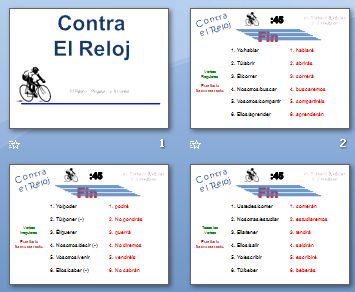
Students enjoy practicing verb forms with this powerpoint activity.  It is called “Against the clock.”  On each screen there are subjects and infinitives.  Students are given 6 subject/verb pairs and 40-50 seconds to write the correct verb form,  either on paper or on a mini white board. When the time is up the sentences disappear and the students stop writing. The animation can be  set to do this so that  all the teacher has to do is click once to start. After it is done the teacher can click once more and the correct sentences come on the screen. It is quite impressive how quickly students can write the correct verb forms when they are trying to “beat the clock.”

These are fairly easy to create if you know your way around Powerpoint. You can also download these:

Foreign Language Writing and Spelling Practice Activity

This is a fun and engaging activity that will help students to practice and review the spelling of  vocabulary. Students work/play in groups of 2 or 3.  Cards with pictures first need to be cut out individually and placed in a pile next to the game board with the picture side facing down.  This is also a good use of Memory/Concentration cards that you have in your classroom.

Foreign (Worlf) Language Writing and Spelling Practice Activity (French, Spanish) wlteacher.wordpress.com

The first player begins by taking the first card from the top of the pile and looking at the picture. He/she must then write the word for the picture in the grid on the game board (without articles). Players should use pencil so that the letters can be erased if the word is not spelled correctly.  If another player questions the spelling, he/she can either look at the spelling on the reference sheet or ask the teacher. If the spelling is incorrect the word must be erased and the player loses the turn. If the spelling is correct, play continues to the next player. Once it is decided that the word is spelled correctly in the grid, the player counts up the point value of each letter (in the corner of the box) and adds it to the total under the grid.

Foreign (Worlf) Language Writing and Spelling Practice Activity (French, Spanish) wlteacher.wordpress.comPlayers can write the words anywhere in the grid (horizontally: left/right or vertically: top/bottom). If a player uses a letter already on the board he/she doubles the point value of the square of the shared letter. New words do not have to build on existing words. Players can’t add onto a word that is already in the puzzle, but words can begin and end in adjoining squares.  If a player is unable to identify the word or can’t fit in on the board the turn is forfeited. It is best to set a time limit and the deck of picture cards can be shuffled and reused, or the rule can be to go through the deck 2-4 times. The player with the highest total wins the game.

Foreign (Worlf) Language Writing and Spelling Practice Activity (French, Spanish) wlteacher.wordpress.com

These activities can be made by creating grids in a WORD document or you can download these activities that are ready to use:

Foreign Language Speaking Activity that Moves Students from Novice to Intermediate

At the novice level, students are speaking with single words and lists initially, then move on to chunked phrases.  As students move up to the intermediate proficiency level they begin to create discrete sentences on their own that move beyond chunked phrases.  This tends to be the most challenging for students as they begin to create with language and are not relying on memorized phrases to chunk together.  Teachers can help scaffold this process for students by assisting them in creating sentences.

Foreign Language Speaking Activity that Moves Students from Novice to Intermediate (French, Spanish) www.wlclassroom.comI have found that using question words with students is a simple and effective way to have students add details to their sentences that move from memorized, chunked phrases to discrete sentences that are created by the student.  The more they do this the more they will grow in confidence and begin to do it on their own when writing.

Here is a version of Memory (or concentration) with a twist. Instead of using pictures and words this version uses verb forms.  Half of the cards have a subject pronoun and an infinitive. The other cards have the correct verb form to match each subject/verb pair.  Along with the conjugated verb forms are 2 or 3 questions words as well as an affirmative or negative symbol [(+) (-)]. 

In order for the player to win the pair he or she  must say a complete sentence that includes the subject and correct verb form as well as the information from the question words and in the negative if indicated. If the player is not able to make a complete sentence he does not get the pair of cards and must turn them back over.  The winner is the player who has the most cards when all of the cards have been claimed.  The verb cards look like this:

screen-shot-2017-02-26-at-2-34-50-pm

This activity helps move student speaking from the novice level to the intermediate level by showing them how easily and effectively they can can speak in complete, discrete sentences.

You can download resources to use with this proficiency-building activity by clicking the links below.


Foreign Language Vocabulary Activities (The Barrier)

I try to find new ways to use these materials beyond their original intended purpose before giving up on them.  One such activity is the Memory or Concentration game that always seems to be on a shelf somewhere in the classroom.

In this variation two students sit facing each other and place a barrier such a book between each other so that each one can’t see the tabletop area in front of the other person.  One student takes the picture cards and the other takes the cards with the words.   The student with the words lines the cards up in any order that he wants.  He then reads off the list to the other person who lines up his picture cards in the order that he hears.  When done, the barrier is removed and they can check to see that they are lined up in the same order.  They can then switch sides or try other variations such as having the student with the picture cards read off the list and the student with the word cards lines them up in the correct order.  Here is what it may look like:

French Memory Games

Spanish Memory Games

Foreign Language Verb Form Practice Activity (Powerpoint)

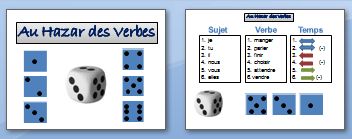
This is a great way to have students practice verb forms and tenses . The powerpoint is projected  on a white board so that you can write in the  the subjects, the verbs, and the tenses (present, future, Preterit, Imperfect, commands, etc.) or they can be easily typed right onto the powerpoint slides as in the example below.  On each click the die “rolls” and three dice appear. The students say or write the verb form represented by the number combination. I usually have students write their answers on small dry-erase boards. This is a great template for use with any verbs or tenses.

Foreign Language Vocabulary Practice-Go Fish!

Foreign (World) Language Vocabulary Practice: Go Fish!  (French, Spanish) wlteacher.wordpress.comStudents know how to play Go Fish and it great to be able to tap into this to have students practice vocabulary.  This activity remains very communicative because students must use the vocabulary to play, but the goal is to collect the cards.   The teacher simply needs to print out and cut up the cards and give a group of 3-4 students the pile to play. Several sets work best so that several groups can play. This is a an effective review game and a ideal opportunity for students to speak with each other in the foreign language.  Go Fish! also works well as a station activity.

Download Go Fish! games here: