Category Archives: Writing

191: Pre-Speaking and Writing Routines That Build Confidence


Do you have effective routines that support your students’ language proficiency and communication skills?  We often think of the communication modes, proficiency levels and 90+% target language as the routines that we foster in the classroom. In this episode you’ll hear about another type of routine, student-created graphic organizers.  These are visual tools that offer a unique pathway for students to comprehend and engage with the target language.

Blog post with visuals to see examples of student-created graphic organizers.

Topics in this Episode:

  • effective learning routines
  • student-created graphic organizers (Thinking Maps, Brains Frames)
  • benefits of students creating their own graphic organizers
  • when to use student-created graphic organizers (pre-speaking, pre-writing)
  • 5 useful types of student-created graphic organizers
    • linear details
    • cause and effect
    • brainstorming
    • compare and contrast
    • categorizing

Blog post with visuals to see examples of student-created graphic organizers.

Work with Joshua either in person or remotely.

Teachers want to hear from you and what you are proud of in your classroom.
Join me as a guest on the podcast.

Follow wherever you listen to podcasts.

189: Project That Engages Students in Story Details


We are all well aware of the importance of comprehensible input in our classrooms, and to support this many of us use stories as the way to do it.  Do you use short stories, novels or graphic novels or comprehensible (CI) readers with your students? I’m excited to see that many teachers are using and leveraging texts with their students. I want to take this a step further in this episode and tell you about a project that engages students creatively with story details and newly acquired vocabulary and structures. 

Blog post about the “unpack the book” project with examples and templates.

Topics in this Episode:

  • the “unpack the book” project
  • preparing to read
  • keep track of details while reading
    • characters
    • chapter summaries
    • hashtags
  • the project book pages
    • cover
    • vocabulary
    • hashtags
    • characters
    • events
    • quotes
    • culture

Blog post about the “unpack the book” project with examples and templates.

Work with Joshua either in person or remotely.

Teachers want to hear from you and what you are proud of in your classroom.
Join me as a guest on the podcast.

Follow wherever you listen to podcasts.

Creative Project to Engage with Comprehensible Novels

As language teachers, we’re always looking for ways to engage students beyond traditional book reports. The “Unpack the Book” project is an innovative, interactive way for students to deeply engage with a Comprehensible (CI) novel while fostering creativity and language proficiency. Here are detailed strategies and concrete tips for implementing this project in your language classroom.

Overview of the “Unpack the Book” Project

“Unpack the Book” challenges students to create a scrapbook that summarizes and explores key elements of the CI novel they’ve read. The final product is both creative and reflective of their comprehension and interpretation of the novel. To support implementation, you can download the template in French, Spanish, Italian, Portuguese and German.

Preparation Before Reading

Before students begin reading, set the stage with pre-reading activities:

  • Introduce Key Vocabulary: Provide a word bank of essential terms from the novel.
  • Discuss the Novel’s Context: Talk about the cultural and historical background of the story.
  • Make Predictions: Have students hypothesize what they think will happen based on the title and cover.

Encourage students to maintain a document while reading, which should include:

  • Characters: Note the main characters in each chapter.
  • Short Summaries: Write 2-3 sentence summaries per chapter.
  • Hashtags: Create a hashtag that encapsulates the main idea or emotion of each chapter. Example: #LostAndFound for a chapter about a character’s discovery.

download the template in French, Spanish, Italian, Portuguese and German.

Students Engage with the Content and unpack the book

These are the pages of the scrapbook along with what they should include:

Cover: A picture representing the book, such as a character or cultural symbol.

Vocabulary: A list of 20 new words with translations.

Hashtags: One hashtag per chapter to summarize key themes.

Characters: Brief descriptions of the main characters.

Events: Summaries of three major events.

Quotes: Five impactful quotes from the book, including the speaker’s name.

Culture: 2-3 cultural elements from the book.

download the template in French, Spanish, Italian, Portuguese and German.

Assembling and Presenting the scrapBook

Students will fold and assemble their scrapbooks, adding a tactile and interactive element to their learning. They can present their work through:

  • Classroom Presentations: Students share their books and discuss their findings.
  • Gallery Walks: Students display their books and engage with peers’ work.
  • Small Group Discussions: Encourage students to reflect on cultural connections.

Assessment and Reflection

Assessing the Project: Evaluate creativity, language accuracy, and depth of engagement.

Student Reflection: Have students answer reflection questions, such as:

  • How did creating this mini-book help you connect with the characters and themes of the novel?

Conclusion

The “Unpack the Book” project is a dynamic way to enhance languageproficiency and cultural understanding. Try it in your classroom and share your students’ experiences!

download the template in French, Spanish, Italian, Portuguese and German.

184: 10 Interactive Writing Activities For Your Classroom


Are you always on the lookout for new and inventive ideas to bring to our classrooms. I have one simple, yet powerful, tool.  A mini-folding book is a compact, 8-page book made from a single sheet of paper. They are easy to create and can be customized for a wide range of classroom activities.  In this episode I’ll tell you how to create the book and then I’ll share 10 Ways to use Mini-Folding Books.

Blog post with instructions for folding the paper and the 10 ideas for using mini-folding books.

Topics in this Episode:

  • what mini-folding books are
  • how to create a mini-folding book
  • 10 ways to use mini-folding books in the classroom
    1. Personal Information Books
    2. Vocabulary Books
    3. Story Books
    4. Cultural Books
    5. Grammar Practice Books
    6. Dialogue Books
    7. Travel Guide Books
    8. Recipe Books
    9. Pen Pal Introductions
    10. Review Books

Work with Joshua either in person or remotely.

Teachers want to hear from you and what you are proud of in your classroom.
Join me as a guest on the podcast.

Follow wherever you listen to podcasts.

Spanish Language and Culture Units

Spanish Language and Culture Units

Your students will learn all about geography, climate, food, traditions, ethnicities, religions, history and language of Latino and Hispanic countries in these units. Students engage with the ideas in various ways, from an accessible reading and a Map Talk to writing about the countries and comparing them to another country. There are options for completing a project on paper or digitally as well.

Spanish Language and Culture Units

Here is What is included in EACH units:

Page 1: A young person introduces himself or herself and provides details about the country. Students can read on their own, in pairs or small groups or you can read it together as a class.

Spanish Language and Culture Units

Page 2: This a Map Talk script with the details mentioned on page 1 in more accessible language. You can simply provide this document instead of page 1 if your students are at a lower proficiency level. This list of details is most effective when used along with a map of the country and you engage the class in a Map Talk. There is a page that walks you through how to do a Map Talk.

Spanish Language and Culture Units

Page 3: This is a page for students to keep track of new vocabulary. There are 10 essential words from the text listed with their English meaning along with 10 open spots for students to write in any additional new vocabulary.

Spanish Language and Culture Units

Pages 4 + 5: These are graphic organizers for students to keep track of the details about the country. They can be used with the narrative on page 1 or with the Map Talk on Page 2.

Spanish Language and Culture Units

Pages 6 + 7: These are note pages for students to keep track of the details about the country. They can be used with the narrative on page 1 or with the Map Talk on Page 2. These are an alternative to the graphic organizers on pages 3 + 4.

Spanish Language and Culture Units

Pages 8 + 9: Students write in details about the country in the boxes at the top and draw pictures representing the information in the blank box below. Students can also search for pictures and the print and glue them in the boxes. This is a also a digital version in Google Slides.

Pages 10 + 11: This is an alternative to the project on pages 7+8. Here, students report the information in a mock social media post. They put a picture and then write about it in the caption. Students can get inventive with this and write as if they saw these things in person. This is also a digital version in Google Slides.Page 12: This is a Venn Diagram for students to compare one country to another country. Once the other country is chosen students can research some of the details presented about the in this unit and then fill in the Venn Diagram. Students will then write a paragraph comparing the two countries.


Page 13: For students at lower proficiency levels, this page has sentence stems that students can use to write sentences.

Page 14: This is a true/false assessment for students once they have worked with the information about the country. If the sentence is false there is a line for students to write the correct information.

Spanish Language and Culture Units

Page 15: Answers to the true/false assessment.

Spanish Language and Culture Units

These units have everything that you need to bring the Spanish language and Latino and Hispanic cultures to your classroom.

Spanish Language and Culture Units

French Language and Culture Units

French Language and Culture Units

Your students will learn all about geography, climate, food, traditions, ethnicities, religions, history and language of Francophone countries in these units. Students engage with the ideas in various ways, from an accessible reading and a Map Talk to writing about the countries and comparing them to another country. There are options for completing a project on paper or digitally as well.

French Language and Culture Units

Here is What is included in EACH units:

Page 1: A young person introduces himself or herself and provides details about the country. Students can read on their own, in pairs or small groups or you can read it together as a class.

French Language and Culture Units

Page 2: This a Map Talk script with the details mentioned on page 1 in more accessible language. You can simply provide this document instead of page 1 if your students are at a lower proficiency level. This list of details is most effective when used along with a map of the country and you engage the class in a Map Talk. There is a page that walks you through how to do a Map Talk.

French Language and Culture Units

Page 3: This is a page for students to keep track of new vocabulary. There are 10 essential words from the text listed with their English meaning along with 10 open spots for students to write in any additional new vocabulary.

Pages 4 + 5: These are graphic organizers for students to keep track of the details about the country. They can be used with the narrative on page 1 or with the Map Talk on Page 2.

Pages 6 + 7: These are note pages for students to keep track of the details about the country. They can be used with the narrative on page 1 or with the Map Talk on Page 2. These are an alternative to the graphic organizers on pages 3 + 4.

French Language and Culture Units

Pages 8 + 9: Students write in details about the country in the boxes at the top and draw pictures representing the information in the blank box below. Students can also search for pictures and the print and glue them in the boxes. This is a also a digital version in Google Slides.

Pages 10 + 11: This is an alternative to the project on pages 7+8. Here, students report the information in a mock social media post. They put a picture and then write about it in the caption. Students can get inventive with this and write as if they saw these things in person. This is also a digital version in Google Slides.

Page 12: This is a Venn Diagram for students to compare one country to another country. Once the other country is chosen students can research some of the details presented about the in this unit and then fill in the Venn Diagram. Students will then write a paragraph comparing the two countries.

Page 13: For students at lower proficiency levels, this page has sentence stems that students can use to write sentences.

Page 14: This is a true/false assessment for students once they have worked with the information about the country. If the sentence is false there is a line for students to write the correct information.

French Language and Culture Units

Page 15: Answers to the true/false assessment.

French Language and Culture Units

These units have everything that you need to bring the French language and Francophone cultures to your French.

French Language and Culture Units

1 Page, Mini-Folding Books, A Useful Tool In The Language Classroom

As language teachers we are always on the lookout for new and inventive ideas to bring to our classrooms.  One simple yet powerful tool that can make a significant impact is the mighty mini-folding book. These small, easy-to-create books can be used in various ways to enhance language learning, making them a valuable addition to any world language classroom.

What Are Mini-Folding Books?

Mini-folding books are compact, 8-page books made from a single sheet of paper. The beauty of these mini-books lies in their simplicity and adaptability. They are easy to create and can be customized for a wide range of classroom activities, making them an excellent resource for promoting active participation and concise communication among students.

The tactile nature of these books engages students in a hands-on activity that not only enhances their learning experience but also provides a sense of accomplishment. The compact size encourages students to focus on clear and effective communication, making it an excellent tool for language practice.

Creating a Mini-Folding Book

Creating a mini-folding book is a straightforward process that requires only a single sheet of paper and a few folds. Here’s a step-by-step guide to making your own mini-book:


Get started quickly with this template that you can edit and customize to suit your specific classroom needs.  It also includes the 10 ways to use the mini-folding book that you will see below.

10 Ways to Use Mini-Folding Books 

Mini-folding books are incredibly versatile and can be used in various ways to support language learning. Here are ten creative ideas for integrating them into your classroom:

  1. Personal Information Books
    • Activity Description: Students write about themselves on topics like age, birthday, origin, preferences, free time activities, and family.
    • Implementation Tips: Leave out their names for classmates to guess who it is, adding an authentic reading component. Add a selfie on the back for confirmation and engagement.
    • Classroom Example: Display the mini-books on a bulletin board for other classes to read and guess.
  2. Vocabulary Books
    • Activity Description: Assign students to create a mini-book for a specific vocabulary set (e.g., fruits, animals, clothing).
    • Implementation Tips: Each page contains a word and a corresponding picture or sentence.
    • Classroom Example: Use as a study tool or share with peers for a vocabulary review.
  3. Story Books
    • Activity Description: Have students write and illustrate a short story in the target language.
    • Implementation Tips: Focus on simple sentences and visuals to convey the story.
    • Classroom Example: Students can read their stories to the class or exchange with a partner.
  4. Cultural Books
    • Activity Description: Create mini-books about cultural topics, such as holidays, traditions, or famous landmarks.
    • Implementation Tips: Include a mix of text and images to represent cultural aspects.
    • Classroom Example: Display these books during cultural events or projects.
  5. Grammar Practice Books
    • Activity Description: Develop mini-books focusing on specific grammar points, such as verb conjugations or adjective agreements.
    • Implementation Tips: Each page can include a rule, example, and a practice sentence.
    • Classroom Example: Use for quick grammar reviews or as a reference during writing activities.
  6. Dialogue Books
    • Activity Description: Write short dialogues or conversations in the target language.
    • Implementation Tips: Ensure dialogues are simple and relevant to students’ daily interactions.
    • Classroom Example: Pair students to practice the dialogues and then perform them for the class.
  7. Travel Guide Books
    • Activity Description: Students create mini travel guides for a country or city where the target language is spoken.
    • Implementation Tips: Include key phrases, important sites, and cultural tips.
    • Classroom Example: Share with classmates to create a class library of travel guides.
  8. Recipe Books
    • Activity Description: Write mini-books containing simple recipes in the target language.
    • Implementation Tips: Each page can have an ingredient, a step in the recipe, and an illustration.
    • Classroom Example: Bring in samples or have a class cooking day based on the recipes.
  9. Pen Pal Introductions
    • Activity Description: Students write mini-books introducing themselves to a pen pal or exchange student.
    • Implementation Tips: Include personal information, hobbies, and questions for the pen pal.
    • Classroom Example: Send these mini-books to pen pals and read their responses.
  10. Review Books
    • Activity Description: Create mini-books to review a specific unit or topic studied in class.
    • Implementation Tips: Summarize key points, vocabulary, and concepts.
    • Classroom Example: Use as a study guide before exams or as a quick refresher.

Mini-folding books are a versatile and engaging tool that can be easily incorporated into any world language classroom. Their simplicity, combined with the endless possibilities for customization, makes them a powerful resource for enhancing language learning. Whether you’re looking to practice vocabulary, reinforce grammar, or explore cultural topics, mini-folding books offer a fun and effective way to engage students and support their language development.

Ready to give it a try? Get a copy of  the template and start creating mini-folding books with your students today!

Student-Generated Graphic Organizers in the Language Classroom

Effective learning routines nurture students’ language proficiency and communication skills. We often think of the communication modes, proficiency levels and 90+% target language as the routines that we foster in the classroom.  I’d like to move the focus to another routine that supports these efforts. Student-generated graphic organizers are visual tools that offer a unique pathway for students to comprehend and engage with the target language.

The effectiveness of graphic organizers lies in how well they adhere to general principles of highly-effective learning routines. They are simple, versatile, and foster higher-level cognitive processes. They can be used across various age groups and content areas. I have personally found this tool to be indispensable in my teaching. There are lots of versions and options out there, but I want to share 5 that prove to be most useful.

Keep in mind that students creates these on their own.  They learn how to make them, what they are used for, and how to add in the language and details.  This creation process supports the critical thinking focus. The examples are color-coded to show where students write in the topic (orange boxes) and where they write in the supporting thoughts and details (blue).  The second image is what these organizers look like when students create them on their own.

Linear Details: Students us this organizer to illustrate the sequential order of events in a narrative. For example, students can create a flow map to outline the sequence of actions in a short story. This visual representation supports students in understanding a storyline with greater clarity.
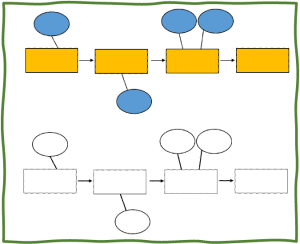
Causes and Effects: Students use this organizer to analyze reasons, such as those that lead to historical events. For example, the students can highlight the French Revolution, with the causes that led to this moment in history and the subsequent effects  Students can grasp the intricate interplay between events and their ramifications. This organizer can also be use to look at and consider current events and those that happen in a story.

Brainstorming: This organizer is useful in coming up with quick details. For example, students can create a bubble map in the target language to write down topic details, describe an image, list activities, or assemble thoughts on cultural topics before writing or engaging in a speaking activity.

Comparing and Contrasting : Students use this organizer to compare and contrast various themes. For example, students can outline the similarities and differences in traditions and values among different cultures, fostering a deeper understanding of cultural diversity and nuances. This is also useful for comparing characters in a story before responding to to prompt in writing or engaging in a class discussion.

Categorizing: Students use this map to categorize vocabulary based on themes. For example, in a unit focused on food, students can categorize food items into groups such as fruits, vegetables, meat, and dairy, facilitating a more systematic approach to vocabulary acquisition.

These student-generated graphic organizers, created by the students themselves as part of the language learning process, not only deepen their understanding of the language but also hone their critical thinking and organizational skills. They stimulate critical thinking, encourage effective communication, and foster a deeper understanding of language and culture. By making the invisible visible, they empower students to navigate the intricacies of language learning with confidence and proficiency.

There have been many influences on my understanding of these concepts.  In particular Thinking Maps and Brain Frames have contributed to my more concrete understanding of how to use student-generated graphic organizers.

114: Teaching and Assessing Writing


Join me on the podcast for a Leveling Up Coaching Episode.

How do you approach writing with students, particularly at the very beginning of their language learning journey? Today’s episode is a Leveling Up episode, where I coach Jenn, a middle school Spanish teacher in Illinois. Writing is the area where wants to level up her teaching practice. So let’s start the conversation. 

Suggestions:

  • Revisit the percentage of each communication mode in your grading and focus more on interpretative mode at the novice level.
  • Use clear, aligned rubrics for consistent and objective assessment of Novice-level writing in language classes.
  • Consider a single point rubric
  • Foster self-reflection and revisions to support language development and boost students’ confidence in their writing abilities. Leverage the single-point rubric

Action Plan:

This Week:

  • Gather resources: Compile a list of Novice-level vocabulary and simple sentence structures suitable for writing tasks.
  • Develop scaffolded prompts: Create a set of writing prompts that guide students to construct basic sentences and short paragraphs using the identified vocabulary and structures with opportunities to go beyond the expected proficiency level

The Coming Weeks:

  • Create single- point rubrics that align with the Novice-level writing expectations to assess vocabulary usage, sentence variety, and grammar
  • Implement scaffolded tasks: Introduce the scaffolded writing prompts in class, guiding students through the process of constructing sentences and paragraphs.
  • Provide formative feedback: Use the rubrics to offer constructive feedback on students’ writing and encourage self-reflection and revisions.

You  can also be a part of Leveling Up coaching episode if there is an area of your teaching that you like to improve or enhance.  Join me on the podcast for a Leveling Up Coaching Episode.

Work with Joshua either in person or remotely.

Teachers want to hear from you and what you are proud of in your classroom.
Join me as a guest on the podcast.

Follow wherever you listen to podcasts.

Preparing for AP Success Beginning at the Novice Level

Do you have AP language classes in your program?  When do you begin focusing on the linguistic and cultural competence skills that students will need to succeed at this level? A Pre-AP focus can be quite beneficial in the language learning process, fostering critical skills and mindsets early on. Whether students pursue a language at the AP level or not, these skills not only enhance and support academic success, but  they also cultivate confidence and competence.

Preparing for AP Success Beginning at the Novice Level (French, Spanish)

Let’s look at the benefits of integrating Pre-AP strategies and curriculum into language program curriculum and objectives. These provide students with a strong foundation for their language learning pursuit.  They will be well-equipped to succeed in an AP class, or, if they don’t follow that route, they will still have the skills needed to communicate effectively and with confidence.

Building Strong Language Foundations

To pave the path for success, emphasizing core language skills—Interpersonal Speaking Interpretive Listening and Reading, Presentational Speaking and Writing—is pivotal in lower-level classes. These skills are the foundation of language proficiency and serve as the building blocks for advanced language studies. Incorporating authentic resources, such as news articles, videos, and podcasts, enriches language learning experiences. Students greatly benefit from exposure to real-world materials, providing a glimpse into how language operates in authentic contexts.

Cultivating Critical Thinking

Even at lower proficiency levels, cultivating critical thinking skills is attainable. In lower-level classes, introduce basic analysis and synthesis abilities. For instance, encourage students to analyze short texts or compare different viewpoints on straightforward topics. Questioning techniques play a pivotal role in promoting critical thinking. Pose thought-provoking questions that urge students to delve deeper into a text’s meaning, nurturing thoughtful discussions and enhancing overall comprehension.

Integrating AP Themes in Lower-Level Classes

Delaying the exploration of AP themes until AP classes is not necessary.

Beauty and Aesthetics

  • At lower proficiency levels, you can introduce discussions on topics like art, music, and cultural expressions. Challenge students to describe a famous painting using simple vocabulary and then compare their interpretations.

Science and Technology

  • Basic science and technology-related vocabulary can be introduced . Have students read simplified news articles about technological advancements and discuss their implications in the target language.

Personal and Public Identities

  • Exploring personal interests and identities is relevant at any proficiency level. In a straightforward “About Me” presentation activity, students can introduce themselves and share their hobbies.

Families and Communities

  • Family structures and communities are universal topics that can be discussed even with basic language skills. Encourage students to create posters representing a community event or a family gathering.

Global Challenges

  • Basic global challenges, like environmental issues, can be introduced in lower-level classes. For instance, students can engage in dialogues discussing simple ways to contribute to solving these challenges.

Contemporary Life

  • Everyday life topics are relatable for all learners. Consider a role-play activity where students simulate common situations like ordering food at a restaurant using basic conversational phrases.

Differentiation and Inclusion

Acknowledge the diverse learning needs in your classes. Implement strategies that cater to various learning styles and skill levels. Tiered assignments serve as an excellent approach to adapting tasks to different proficiency levels, challenging advanced learners while providing extra support for those who require it.

Your Turn…

The advantages of focusing on these “AP skills” extends beyond advanced content; it lays a solid foundation for language learners. By integrating these strategies and curriculum into lower-level classes, educators equip students with the tools and mindset required for success in advanced language courses. Try out these suggestions and tailor them to your unique classroom contexts as you empower students to grow in proficiency and reach higher levels of cultural competence.
