Category Archives: Teaching Methodology and Research

Agile Thinking in the Language Classroom

Decisions, Decisions! In our fast-past and dynamic language classrooms, swift decision-making is a constant.  Nobel Prize winner Daniel Kahneman, who has extensively studied decision-making, speaks of an  intricate balance between two cognitive systems: System 1 and System 2. Kahneman describes System 1 as fast thinking—automatic and error-prone. In contrast, he describes System 2 as slower, deliberate thinking, less prone to error, demanding more time and often involving getting feedback for more accurate decision-making.

Agile Thinking in the Language Classroom (French, Spanish)

System 1 and System 2 Thinking

  1. System 1 Thinking (Fast, Automatic):
    • Intuitive and quick, System 1 thinking is the automatic thought process for everyday decisions.
    • Operating effortlessly, it relies on heuristics and past experiences.
    • Prone to biases, errors, and influenced by emotions, System 1 is efficient for routine tasks but may oversimplify complex situations.
  2. System 2 Thinking (Slow, Deliberate):
    • Deliberate and conscious, System 2 thinking involves careful analysis, seeking additional information, and considering various perspectives.
    • Less prone to biases, it provides a more accurate approach to decision-making.
    • While demanding more time and mental energy, System 2 is essential for navigating complex and nuanced decision-making scenarios.

The Agile Thinking Paradigm

Kahneman’s insights become particularly crucial for language teachers.  They suggest the consistent use of routines that focus System 2 thinking and decision making. This intentional shift ensures that decisions are not only reflective and deliberate but also less susceptible to bias and error. Deborah Ball, echoing Kahneman’s insights, challenges teachers to scrutinize our seemingly neutral habits harboring implicit biases. This would be the error-prone System 1 at work. Our teaching is influences by our biases.  Ball advocates creating a “repertoire” of teaching habits explicitly designed to counteract potential biases.  This is where System 2 comes in.

Deliberative decision-making, afforded by System 2, minimizes errors and biases. This intentional shift fosters an environment where instructional choices are thoughtful, nuanced, and conducive to student success. Agile Thinking, a dynamic integration of System 1 and System 2, is  a practical approach that goes beyond theory and empowers teachers to make decisions that respond to diverse student needs.

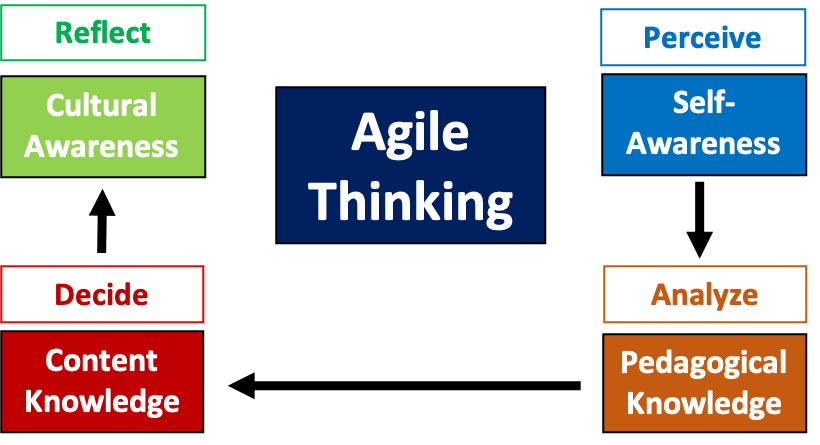
The Four-Step Framework for Agile Thinking and Decision-Making

Agile Thinking in the Language Classroom (French, Spanish)

  1. Perceive – (Self-Awareness):
    • Cultivate self-awareness: Understand personal biases and cultural perspectives.
    • Embrace cultural awareness: Recognize the diverse backgrounds of students, laying the foundation for agile decision-making.
  2. Analyze (Pedagogical Knowledge):
    • Engage in conscious deliberation: Draw on pedagogical knowledge to increase clarity, accessibility, relevance, and rigor in instruction.
    • Apply pedagogical insights: Consider various instructional approaches to meet the diverse needs of learners.
  3. Decide (Content Knowledge):
    • Implement agile thinking: Generate rapid, flexible, and culturally affirming mental models of teaching and learning.
    • Leverage content knowledge: Utilize subject expertise to adapt lessons for maximum impact.
  4. Reflect (Cultural Awareness):
    • Assess impact: Evaluate the consequences of instructional decisions on students.
    • Promote continuous improvement: Aligning with the self-awareness aspect, foster an environment of ongoing reflection and growth.

I like to make things as concrete as possible, especially when creating systems and routines in my classroom.  I put 3 words words with each step to make this idea of Agile Thinking directly applicable to my classroom language teaching.  These words serve as a check for myself.

Agile Thinking in the Language Classroom (French, Spanish)

Agile Thinking in the Language Classroom (French, Spanish)

Agile Thinking in the Language Classroom (French, Spanish)

Agile Thinking in the Language Classroom (French, Spanish)

This is what it looks like all together so that I have it all in one place.

Agile Thinking in the Language Classroom (French, Spanish)

Agile Thinking and Decision-Making in Your Classroom

I encourage you to embrace agile thinking. This mindset sets the stage for teachers to make decisions that not only enhance language proficiency but also foster confident communication in students. The journey begins with an awareness of decisions, transcends biases, and leads to a more inclusive and effective language education. Engage with the  four-step framework and you will be better equipped to navigate the complexities of teaching with agility, responsiveness, and being less prone to errors.

A Vision Framework for Your Language Classroom

I continually look for ways to enhance my teaching practices.  As part of my ongoing personal educational development this year I implemented a TRU (Teaching for Robust Understanding) Framework.  This teaching framework empowers educators to hone in on their teaching practices and ensure that what we do in our classroom is in line with our intended vision and objectives. Here are some insights from integrating TRU into my teaching, which will hopefully resonate with my language teacher colleagues.

A Vision Framework for Your Language Classroom (French, Spanish) TRU Framework

What is TRU?

Alan H. Schoenfeld, a Distinguished Professor of Education at the University of California, Berkeley, founded the Teaching for Robust Understanding Project. His goal is to distill the vast literature on teaching and learning into a coherent, usable framework. The TRU Framework encompasses five focal dimensions:

A Vision Framework for Your Language Classroom (French, Spanish) TRU Framework

TRU in Language Classroom

Let’s look at how the TRU Framework can be useful and effective in the context of language education, using examples from my own vision framework.  My Vision Framework is titled The Five Dimensions Engaging and Purposeful Classroom. Each of the 5 categories is tailored to my overarching language teaching goal.

Students…

  • feel confident, motived and valued
  • are engaged and learning is purposeful
  • see the content and learning as relevant to their lives

Here are how I concretely articulate these goals and intentions in each of the TRU framework areas:

A Vision Framework for Your Language Classroom (French, Spanish) TRU Framework

“In my classroom, students are not passive recipients of information. Instead, they are active contributors to conversations about language proficiency and cultural nuances. They understand the purpose behind their learning and take ownership of their linguistic journey.”

Questions you to ponder as you look at this in your own classroom: How can you create an environment where students feel empowered to contribute to conversations about language proficiency and cultural understanding? In what ways can you encourage students to take ownership over their language learning journey?

A Vision Framework for Your Language Classroom (French, Spanish) TRU Framework

“Classroom activity structures provide opportunities for students to become knowledgeable, flexible, and resourceful disciplinary thinkers. Topics are relevant to learners, motivating them to make connections and develop productive disciplinary habits of mind.”

Questions you to ponder as you look at this in your own classroom: How can you align your lesson plans with topics that are relevant and motivating for your students? In what ways can you create activities that foster connections and develop productive language habits of mind?

A Vision Framework for Your Language Classroom (French, Spanish) TRU Framework

“Students have opportunities to grapple with and make sense of important language ideas. They are challenged in ways that provide room and support for growth, cultivating a mindset where challenges are seen as opportunities for learning.”

Questions you to ponder as you look at this in your own classroom:  How can you provide challenging tasks that support students in making sense of complex language ideas? In what ways can you guide students through productive struggles, helping them see challenges as opportunities for growth?

A Vision Framework for Your Language Classroom (French, Spanish) TRU Framework

“Classroom activity structures invite and support the active engagement of all students. Individual students are involved in meaningful ways and do not doubt their valued presence in the classroom.”

Questions you to ponder as you look at this in your own classroom: What strategies can you implement to ensure that every student is actively engaged in language learning activities? How can you create a classroom environment where all students feel their contributions are meaningful?

A Vision Framework for Your Language Classroom (French, Spanish) TRU Framework

“Classroom activities elicit student thinking, and subsequent interactions respond to those ideas. Specific feedback is central to formative assessment practice, guiding students in deepening their language comprehension.”

Questions you to ponder as you look at this in your own classroom: How can you design activities that elicit and showcase students’ language proficiency and understanding? In what ways can you provide specific and constructive feedback to guide students in deepening their language comprehension?

Your Vision Framework

As a language teacher, you can use the TRU Framework to create your own vision framework tailored to your classroom.  Consider creating a framework that aligns with the 5 TRU dimensions.  Keep these key elements of your vision handy and in mind as you create curriculum and teach.  I know that they help to keep me on track and focused on my goals, vision and objectives. Here is what my TRU Framework looks like with all the details in one place for easy access.

A Vision Framework for Your Language Classroom (French, Spanish) TRU Framework

Reference:

  • Schoenfeld, A. H., & the Teaching for Robust Understanding Project. (2016). An Introduction to the Teaching for Robust Understanding (TRU) Framework. Berkeley, CA: Graduate School of Education.

118: What If Common Assessments Are Not Proficiency-Based


Join me on the podcast for a Leveling Up Coaching Episode.

Do you have to balance common assessments with your proficiency-focused classroom?  Is this a bit of a challenge when those common assessments are not all that focus on proficiency and communication? Today’s episode is a Leveling Up episode, where I coach Lisa, a French teacher in Michigan. Balancing common district assessments in a Proficiency-Focused Classroom  is the area where wants to level up her teaching practice. So let’s start the conversation. 

Suggestions:

  • Might have to be a both/and during these years of transition. Allow for this.
  • Leave 1-2 days at the end of a unit to check in on the material that should be covered on the district common assessment. Any topics that were not covered during the unit can be quickly added on at the end so that students are prepared.

Action Plan:

This Week:

  • Review the district assessments and analyze the proficiency objectives in your curriculum. Identify specific areas where the two align and make sure that the focus remains on language proficiency, while also setting students up for success on the common assessments.
  • Make note of the topics that will be added on to the final days of the unit to align with the common assessment.

The Coming Weeks:

  • Initiate discussions with department heads or administrators to advocate for the importance of proficiency-focused assessment in language learning.
  • Present evidence of its benefits and explore possibilities of incorporating proficiency tasks into district assessments.
  • Start with the walkers and get them into running mode, then move onto those standing on the side.

Helpful Podcast Episodes on This Topic:

Helpful Blog Posts on This Topic:

You  can also be a part of Leveling Up coaching episode if there is an area of your teaching that you like to improve or enhance.  Join me on the podcast for a Leveling Up Coaching Episode.

Work with Joshua either in person or remotely.

Teachers want to hear from you and what you are proud of in your classroom.
Join me as a guest on the podcast.

Follow wherever you listen to podcasts.

Effective Strategies for Checking Comprehension in Language Learning

We increasingly understand the central role of students’ understanding of language as they move up in proficiency and acquire language.  This makes comprehension checks a vital part of the process.

Effective Strategies for Checking Comprehension in Language Learning (French, Spanish)

The Role of Comprehensible Input

The importance of comprehensible input cannot be overstated. It’s the foundation on which students build their linguistic abilities. Krashen’s Input Hypothesis emphasizes the significance of comprehensible input as the key to acquiring language.  It is, therefore, crucial to ensure that the language input is just a step above the students’ current understanding level.

Make Sure the Input is Comprehensible

Use techniques such as visual cues, body language, cognates, and examples of common associations to make input more comprehensible.  Slow down the pace, and simplify complex language structures to facilitate better understanding.

Regular Comprehension Checks

Frequent comprehension checks are essential to gauge student engagement and understanding. Effective comprehension checks provide insights into students’ learning progress and allow teachers to make informed instructional adjustments.

What to Do with What We Learn From the Comprehension Check

Insights from comprehension checks allow teachers to tailor instruction to meet individual student needs effectively. Identifying students’ readiness levels helps in providing appropriate learning support and ensuring no student is left behind.

Strategies for Effective Comprehension Checks

  • Use targeted questions that require thoughtful responses, aligning with the students’ proficiency levels.
  • Integrate formative assessments such as exit tickets, quizzes, and short surveys to gauge student understanding at different stages of the lesson.
  • Organize group discussions or peer-to-peer interactions that encourage students to articulate their understanding of the language material.
  • Introduce interactive activities that require students to apply the language knowledge gained, such as role-plays, debates, or problem-solving tasks.
  • Incorporate visual representations like diagrams, infographics, and concept maps to reinforce language comprehension and facilitate visual learning.
  • Promote the use of reflective journals or learning logs where students can express their understanding of the language content and any areas where they need further clarification.

Total Participation Techniques

In addition to the effective comprehension checks, consider incorporating specific Total Participation Techniques outlined in the book Total Participation Techniques: Making Every Student an Active Learner by Prsida Himmele and William Himmele. Some of the techniques highlighted in the book that could be particularly beneficial for formative comprehension checks include:

  • Think-Pair-Share: Encourage students to think about a question or prompt, discuss their thoughts with a partner, and then share their ideas with the entire class.
  • Four Corners: Use the Four Corners technique to prompt students to choose a corner of the classroom that aligns with their response to a specific question or statement.
  • Implement the RallyRobin technique, which allows students to work in pairs and take turns sharing ideas or responses.
  • Assign short writing exercises where students can express their understanding of the material.
  • Encourage students to review and provide constructive feedback on each other’s work.
  • Jigsaw Activities: Implement jigsaw activities that require students to work collaboratively in groups, with each student responsible for a specific aspect of a larger concept.

Questions to Reflect On

  • Are you integrating regular comprehension checks into your teaching practice?
  • How can you ensure that students are demonstrating their comprehension at the desired proficiency level?
  • What adjustments can you make based on the insights gathered from your comprehension checks?

Checking for comprehension in the language learning process is a crucial step in fostering a robust linguistic foundation for students. By incorporating effective comprehension checks and implementing the strategies above, you can ensure that your students are not only engaging with the material but are also comprehending and internalizing the language input effectively.  These checks also provide essential formative information for moving ahead.


Student-Generated Graphic Organizers in the Language Classroom

Effective learning routines nurture students’ language proficiency and communication skills. We often think of the communication modes, proficiency levels and 90+% target language as the routines that we foster in the classroom.  I’d like to move the focus to another routine that supports these efforts. Student-generated graphic organizers are visual tools that offer a unique pathway for students to comprehend and engage with the target language.

The effectiveness of graphic organizers lies in how well they adhere to general principles of highly-effective learning routines. They are simple, versatile, and foster higher-level cognitive processes. They can be used across various age groups and content areas. I have personally found this tool to be indispensable in my teaching. There are lots of versions and options out there, but I want to share 5 that prove to be most useful.

Keep in mind that students creates these on their own.  They learn how to make them, what they are used for, and how to add in the language and details.  This creation process supports the critical thinking focus. The examples are color-coded to show where students write in the topic (orange boxes) and where they write in the supporting thoughts and details (blue).  The second image is what these organizers look like when students create them on their own.

Linear Details: Students us this organizer to illustrate the sequential order of events in a narrative. For example, students can create a flow map to outline the sequence of actions in a short story. This visual representation supports students in understanding a storyline with greater clarity.

Causes and Effects: Students use this organizer to analyze reasons, such as those that lead to historical events. For example, the students can highlight the French Revolution, with the causes that led to this moment in history and the subsequent effects  Students can grasp the intricate interplay between events and their ramifications. This organizer can also be use to look at and consider current events and those that happen in a story.

Brainstorming: This organizer is useful in coming up with quick details. For example, students can create a bubble map in the target language to write down topic details, describe an image, list activities, or assemble thoughts on cultural topics before writing or engaging in a speaking activity.

Comparing and Contrasting : Students use this organizer to compare and contrast various themes. For example, students can outline the similarities and differences in traditions and values among different cultures, fostering a deeper understanding of cultural diversity and nuances. This is also useful for comparing characters in a story before responding to to prompt in writing or engaging in a class discussion.

Categorizing: Students use this map to categorize vocabulary based on themes. For example, in a unit focused on food, students can categorize food items into groups such as fruits, vegetables, meat, and dairy, facilitating a more systematic approach to vocabulary acquisition.

These student-generated graphic organizers, created by the students themselves as part of the language learning process, not only deepen their understanding of the language but also hone their critical thinking and organizational skills. They stimulate critical thinking, encourage effective communication, and foster a deeper understanding of language and culture. By making the invisible visible, they empower students to navigate the intricacies of language learning with confidence and proficiency.

There have been many influences on my understanding of these concepts.  In particular Thinking Maps and Brain Frames have contributed to my more concrete understanding of how to use student-generated graphic organizers.

Comprehension-Based Communicative Language Teaching

Comprehension-Based Communicative Language Teaching (CCLT) is a teaching approach that encourages teachers to embrace the essential role of comprehension and understanding as a first step in acquiring language. I’d like to dive into CCLT, taking inspiration from the incredible work of Claudia Fernandez, who writes about this topic in the book “Honing Our Craft.

Comprehension-Based Communicative Language Teaching (French, Spanish)

What is Comprehension-Based Communicative Language Teaching?

CCLT is a teaching approach that redefines the role of comprehension in language acquisition. To understand the significance of CCLT, we must first look at its roots in Communicative Language Teaching (CLT), which emphasized the importance of communication. CLT introduced the concept of Communicative Competence (Canale and Swain, 1980), highlighting the role of interaction and production in language learning. However, it was Krashen’s Input Hypothesis (1985) that shifted the spotlight towards comprehension, suggesting that understanding messages is essential and sufficient for language acquisition.

What is Communication…Really?

One common misconception in language teaching is equating communication solely with oral production. This misconception has led to a disproportionate emphasis on production within current teaching practices, often relegating comprehension to a secondary role. CCLT aims to dispel this notion and place input (comprehension) at the center of the curriculum. While production is not neglected, it’s the understanding of messages that takes precedence.

How Do We DO CCLT?

In a CCLT classroom, remember to speak the target language for most of the class time. Make input activities meaningful and engaging, fostering an environment where students naturally strive for comprehension.

Don’t forget that accuracy in language is developed gradually, and comprehension is, in fact, a form of communication. Avoid planning classes solely around grammar points—grammar is a tool, not the ultimate goal of language learning.

In Conclusion

Comprehension-Based Communicative Language Teaching offers a fresh perspective on language education. It shifts the focus from rote production to meaningful comprehension, aligning with how language is acquired in the real world. By embracing CCLT, you empower your students to not just speak the language but truly understand and communicate with confidence—a goal at the heart of language education.

Reference:

Claudia Fernandez (2024) “Chapter 4: What is and What is Not Comprehension-Based Communicative Language Teaching? (CCLT) ” in Henshaw, Florencia G., et al. Honing Our Craft: World Language Teaching Today. Klett World Languages, 2024.

Canale, M., & Swain, M. (1980). Theoretical Bases of Communicative Approaches to Second Language Teaching and Testing. Applied Linguistics, 1, 1-47.

Krashen, S. (1985). The input hypothesis: Issues and implications. New York: Longman.

Competency-Based Grading: A Paradigm Shift for Language Classrooms

In the ever-evolving landscape of education, we often find ourselves questioning traditional grading systems. As teachers committed to fostering language proficiency and learner autonomy, we should be at the forefront of embracing innovative approaches. I’d like to dive into into the concept of competency or even proficiency-based grading, drawing inspiration from the insightful work of Jude Krushnowski, whose contributions to this topic in the book “Honing Our Craft” offer valuable guidance.

A Shift in Grading Paradigm

Traditional grading often leaves room for ambiguity. It’s not uncommon for factors like punctuality, participation, or effort to influence a student’s grade. This approach results in what some have aptly termed a “hodgepodge grade” where attitude and effort muddle the assessment of actual language proficiency. Imagine two students with different grades, primarily due to non-academic factors, and consider how this affects equity in our classrooms.

Standards-Based Grading Principles

Competency, Proficiency or Standards-Based Grading (SBG), hinges on three core principles:

  1. Mastery Focus: SBG prioritizes the mastery of specific language skills, allowing grades to precisely describe that mastery level. The goal is for students to progressively enhance their performance through feedback, learning, and revision.
  2. Feedback and Rubrics: SBG thrives on providing multiple opportunities for students to demonstrate their learning, typically tied to well-defined rubrics. These rubrics help us evaluate various aspects of language proficiency, such as task completion, comprehensibility, and text type.
  3. Separation of Factors: SBG firmly separates academic achievement from non-academic factors like punctuality or homework completion. This division ensures that our grades genuinely reflect language proficiency.

Using Standards in Language Classrooms

SBG can seamlessly integrate with any set of standards, including world readiness standards and ACTFL Can Do Statements. The heart of SBG lies in rubric design, which offers multiple categories to assess various language skills. We categorize performance levels as emerging, partially sustained, mostly sustained, and fully sustained, providing students with clear benchmarks for improvement.

Multiple Attempts and Eliminating Bias

SBG encourages multiple attempts for students to demonstrate their learning, emphasizing the importance of feedback in the revision process. These retakes should not be identical to the initial assessment but rather an opportunity for growth. This practice not only reduces academic dishonesty but also promotes a fairer grading system.

The Questions Around Homework

Homework should contribute to mastery, not serve as a mere completion grade. By connecting homework to retakes, we provide students with a tangible reason to complete assignments while simultaneously eliminating the opportunity for implicit bias to creep into our grading.

In Conclusion

In practice, planning units around learning goals, collaborating with colleagues on common rubrics, and establishing clear reassessment guidelines are essential. Additionally, we should focus on formative and summative assessments, considering whether formative assessments will count towards grades or merely serve as prerequisites for summative assessments or retakes.

As educators, our primary aim is to facilitate the development of language proficiency and communication skills in our students. Competency, Proficiency or Standards-Based Grading grading aligns seamlessly with this mission, offering a transparent and equitable representation of what our students can truly do. It’s time to embrace this paradigm shift in education and empower our students to communicate with confidence.

You can also listen to my podcast episode on this topic.

Reference:

Jude Krushnowski (2024) “Chapter 7: Standards-Based Grading for Proficiency-Based Language Instruction” in Henshaw, Florencia G., et al. Honing Our Craft: World Language Teaching Today. Klett World Languages, 2024.

113: Honing Our Craft with Dr. Florencia Henshaw & Dr. Kim Potowski


Have you listened to the last 2 episodes about Comprehension-Based Language Teaching and Standards-Based Grading? I referenced the book Honing Our Craft, World Language Teaching Today as I prepared those topics. In today’s episode I have the 2 editors of Honing Our Craft, Dr. Florencia Henshaw and Dr. Kim Potowski, who speak about their objectives behind this project, working through the content with 15 contributors and how language teachers can most efficiently and effectively use this very user-friendly resource.

Honing Our Craft

  • Edited by Florecia Henshaw (Director of Advanced Spanish at the University of Illinois, Urbana-Champaign) & Kim Potowski (Professor of Spanish Linguistics at the University of Illinois, Chicago)
  • 12 chapters written by educators for educators, with a focus on bridging the gap between research and practical application.
  • Practical applications and suggestions for language educators that they can adapt to their particular contexts. 
  • Use this link and the discount code JOSHUA25HOC to save 25% on the book.

In This Episode:

  • What Florencia and Kim would you like educators to gain from reading Honing Our Craft.
  • The “user friendly”chapter layout.
  • The process of editing a volume like Honing Our Craft, where the initial idea come from and the writer/editor relationship.
  • How Florencia and Kim suggest that teachers use Honing Our Craft 

Remember to use this link and the discount code JOSHUA25HOC to get save 25% on the book.

Connect with Dr. Florencia Henshaw:

Connect with Dr. Kim Potowski:

Work with Joshua either in person or remotely.

Teachers want to hear from you and what you are proud of in your classroom.
Join me as a guest on the podcast.

You  can also be a part of Leveling Up coaching episode if there is an area of your teaching that you like to improve or enhance.  Join me on the podcast for a Leveling Up Coaching Episode.  

Follow wherever you listen to podcasts.

Evidence-Based Language Teaching

Have you ever found yourself looking for strategies that are not just trendy but grounded in solid empirical evidence? As we guide our students toward proficiency and communicative and cultural competence, the importance of evidence-based teaching cannot be overstated. But how can we integrate these evidence-based approaches efficiently, given our time constraints and the often lengthy research materials?

 Evidence-Based Language Teaching (French, Spanish)

Let’s take a look at the crucial role of evidence-based teaching with some ideas for navigating the sea of research.  Along with this you’ll also see concrete examples of how to easily integrate research-backed strategies into your language classroom.

Why Evidence-Based Teaching

  1. Maximizing Impact: Evidence-based teaching is like a well-illuminated path in the dense forest of language education. It ensures that the strategies we employ are not just a shot in the dark but are grounded in empirical evidence. Embracing evidence-based approaches enables us to make the most significant impact on our students’ language proficiency.
  2. Time Efficiency: In the busy lives of educators, time is an invaluable resource. Evidence-based teaching allows us to make informed decisions swiftly. Instead of wading through an overwhelming sea of teaching methods, we can focus on what research shows to be effective. 

Where can we access this valuable research without getting lost in a time-consuming quest for evidence? The good news is that there are accessible avenues. Consider attending conferences, workshops, webinars, or tuning into the World Language Classroom Podcast. Engaging with social media can also provide insights, but be sure to vet your sources. Trust content that is grounded in research and empirical findings rather than anecdotes of personal experience, which, while honest, may not be universally applicable to teaching practice.

Examples For Implementing Evidence-Based Teaching

Grammar and Structures

  • Ellis’s (2002) research suggests that grammar instruction is more effective when it is meaningful, contextual, and communicative. Rather than rote memorization, students benefit from grammar lessons that connect to real-life language use.
  • Implementation: Provide students with texts or conversations that naturally feature the target grammar point. This aligns with Ellis’s research and fosters a deeper understanding of the grammar point within authentic language use.

Comprehensible Input

  • Krashen’s Input Hypothesis (1985) serves as a foundation in language acquisition research. It underscores that language learners progress when they understand input slightly more advanced than their current level.
  • Implementation: Tailor your lessons to provide students with comprehensible input. Utilize context, visuals, and scaffolding to ensure their understanding and engagement with the language while maintaining a focus on meaning and communication. 

As we navigate language education evidence-based approaches serve as our guide toward proficiency growth with efficiency and purpose.

References:

Ellis, R. (2002). The Place of Grammar Instruction in the Second/Foreign Language Curriculum. In E. Hinkel & S. Fotos New Perspectives on Grammar Teaching in Second Language Classrooms (pages 14-34). Routledge: London

Krashen, S. D. (1985). The Input Hypothesis: Issues and Implications. Longman.


Supporting Proficiency Growth in the Language Classroom

One of our priorities as language teachers is to support students in their efforts to communicate proficiently and with confidence. Though this can seem to be very lofty objective, there are practical procedures that we can implement to facilitate students’ progression to higher proficiency levels. These techniques and approaches offer guidance for teachers looking to empower their students on the path to proficiency.

Supporting Proficiency Growth in the Language Classroom (French, Spanish)

Language Proficiency

Before we jump into the strategies, let’s take a moment to consider language proficiency. How do you currently assess your students’ proficiency levels? Are you familiar with the ACTFL guidelines and their descriptions of Novice, Intermediate, and Advanced proficiency? It’s crucial to have a clear understanding of where your students are and where you want them to go. Take look at this blog post to see what language text types look like at the various proficiency levels.  You can also learn all about the proficiency levels in this podcast episode.

Let’s explore some strategies that will support students in leveling up their proficiency..

Novice Proficiency: Building a Strong Foundation

  • Comprehensible Input: Novice-level students thrive on comprehensible input. This means providing them with language that they can understand, even if it’s slightly beyond their current proficiency level. Engage them with simple stories, visuals, and gestures that make the language come alive.
  • Repetition and Recycling: Repetition is key for Novice learners. Encourage students to practice vocabulary and phrases repeatedly through games, dialogues, and interactive activities.

Intermediate Proficiency: Moving Toward Independence

  • Authentic Communication: As students progress to the Intermediate level, shift the focus to authentic communication. Encourage them to express opinions, share experiences, and engage in conversations.
  • Expanding Vocabulary: Intermediate learners benefit from expanding their vocabulary. Introduce them to synonyms, idiomatic expressions, and culturally relevant words and phrases.

Practical Strategies to Empower Students in Increasing Proficiency

Integrated Skills: Encourage students to read texts, watch videos, and engage in discussions that require them to use all aspects of language – listening, speaking, reading, and writing.

Cultural Context: Connect language proficiency to cultural context. Help students understand how language is used in real-life situations within different cultures.

Feedback and Assessment: Provide timely and constructive feedback. Give students specific comments on their language use, highlighting areas for improvement.

Self-Assessment: Have students reflect on their language progress and set goals for improvement.

Peer Collaboration: Arrange activities that require students to work together, provide feedback to each other, and learn from their peers.

Celebrate Progress:  Celebrate progress, no matter how small. Recognize students’ achievements and growth in proficiency. Whether it’s an improved pronunciation or successfully navigating a conversation, acknowledging their efforts boosts confidence.

Putting It All Together

Supporting students’ proficiency growth is a dynamic journey. It involves understanding their current proficiency levels, scaffolding their learning, and fostering a supportive and engaging classroom environment. As language teachers, we have the privilege of guiding our students along this exciting path, equipping them with the skills and confidence to become proficient communicators.