Category Archives: Cultural Exploration

159: The Inspiring Story of the Mariposa in Nicaragua


I have something that I want to share with you as we go into this new school year. If you know me you know that I have talked a lot about my experiences in Nicaragua and I have been there this summer.  I had an opportunity to sit down with Paulette Goudge and talk about what this Mariposa experience is and to bring it to you on this episode of the podcast. I can wait for you to hear all about what goes on in La Concha, Nicaragua.  So, let’s jump in.

Topics in this Episode:

    • I have been visiting San Juan de la Concepción, Nicaragua for over 10 years. Hear about my personal experience working with Paulette Goudge and La Mariposa.
    • Paulette’s first visits to Nicaragua in the 1980’s and adopting her daughter.
    • The vision for La Mariposa.
    • The Mariposa has many community projects to support the local community and provides income to families that would otherwise not be able to earn.
    • While La Mariposa is called an eco-hotel and Spanish school, it is so much more than that with all of the volunteer opportunities available.
    • Who goes to La Mariposa?
    • Sustainable food practices.
    • Visit the La Mariposa: mariposaspanishschool.com

Work with Joshua either in person or remotely.

Teachers want to hear from you and what you are proud of in your classroom.
Join me as a guest on the podcast.

Follow wherever you listen to podcasts.

133: The Deep Connection of Language and Culture with Rabbi Daniel Atwood

How much do you connect the language that you teach with the culture where that language is used? Today, Rabbi Daniel Atwood, a Hebrew teacher in Chicago, joins me to explore this idea in depth.  We look at how he teaches a language that is deeply connected to a faith tradition and how he brings this to life in his classroom.…So let’s jump in. 

Topics in this Episode:

  • how Danial introduce Hebrew script to learners and helps them overcome any apprehensions they might have about learning a new writing system
  •  incorporating elements of culture, history, and religious traditions into language lessons
  • creating an immersive environment in your classroom, virtually or physically, that allows students to explore and appreciate culture
  • navigating the potential religious sensitivities of certain topics or materials while still fostering an inclusive and diverse learning environment

Connect with Rabbi Daniel Atwood :

Work with Joshua either in person or remotely.

Teachers want to hear from you and what you are proud of in your classroom.
Join me as a guest on the podcast.

You  can also be a part of Leveling Up coaching episode if there is an area of your teaching that you like to improve or enhance.  Join me on the podcast for a Leveling Up Coaching Episode.  

Follow wherever you listen to podcasts.

126: Cultural Self-Reflection with Jocelynn Hubbard


Are your students comfortable reflecting on their own experiences? Are we, as teachers, comfortable doing this?  This is an important first step in asking our students (and ourselves) to understand and appreciate other cultures and experiences. Today I speak with Jocelynn Hubbard, host of The Culture-Centered Classroom, about how we can engage students in their own cultural self-reflection. We will also learn to do it ourselves.

Topics in this Episode:

  • what cultural self-reflection is and its impact on students in the classroom
  • the process of self-reflection with examples of the types of resources that you use to support the process of cultural self-reflection
  • how to introduce this practice to your students, and some possible challenges that might come up
  • how to create a safe and inclusive environment for your students to explore and discuss their cultural identity openly
  • how cultural self-reflection has influenced Jocelynn’s teaching approach and helped her to better meet the individual needs of her students

Connect with Jocelynn Hubbard :

Work with Joshua either in person or remotely.

Teachers want to hear from you and what you are proud of in your classroom.
Join me as a guest on the podcast.

You  can also be a part of Leveling Up coaching episode if there is an area of your teaching that you like to improve or enhance.  Join me on the podcast for a Leveling Up Coaching Episode.  

Follow wherever you listen to podcasts.

Agile Thinking in the Language Classroom

Decisions, Decisions! In our fast-past and dynamic language classrooms, swift decision-making is a constant.  Nobel Prize winner Daniel Kahneman, who has extensively studied decision-making, speaks of an  intricate balance between two cognitive systems: System 1 and System 2. Kahneman describes System 1 as fast thinking—automatic and error-prone. In contrast, he describes System 2 as slower, deliberate thinking, less prone to error, demanding more time and often involving getting feedback for more accurate decision-making.

Agile Thinking in the Language Classroom (French, Spanish)

System 1 and System 2 Thinking

  1. System 1 Thinking (Fast, Automatic):
    • Intuitive and quick, System 1 thinking is the automatic thought process for everyday decisions.
    • Operating effortlessly, it relies on heuristics and past experiences.
    • Prone to biases, errors, and influenced by emotions, System 1 is efficient for routine tasks but may oversimplify complex situations.
  2. System 2 Thinking (Slow, Deliberate):
    • Deliberate and conscious, System 2 thinking involves careful analysis, seeking additional information, and considering various perspectives.
    • Less prone to biases, it provides a more accurate approach to decision-making.
    • While demanding more time and mental energy, System 2 is essential for navigating complex and nuanced decision-making scenarios.

The Agile Thinking Paradigm

Kahneman’s insights become particularly crucial for language teachers.  They suggest the consistent use of routines that focus System 2 thinking and decision making. This intentional shift ensures that decisions are not only reflective and deliberate but also less susceptible to bias and error. Deborah Ball, echoing Kahneman’s insights, challenges teachers to scrutinize our seemingly neutral habits harboring implicit biases. This would be the error-prone System 1 at work. Our teaching is influences by our biases.  Ball advocates creating a “repertoire” of teaching habits explicitly designed to counteract potential biases.  This is where System 2 comes in.

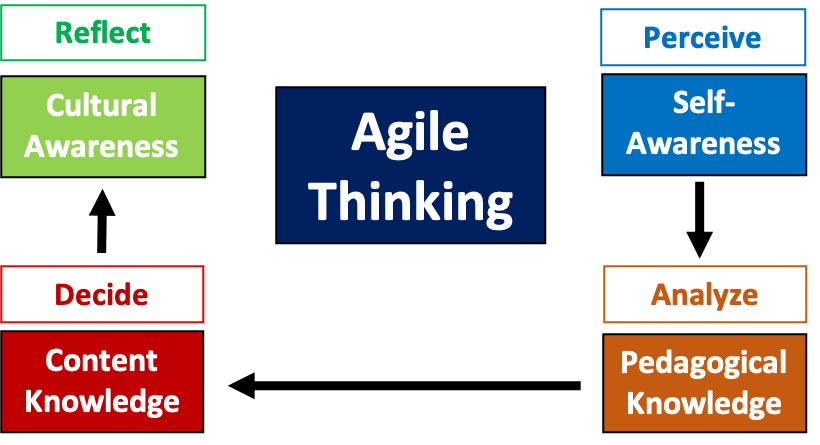
Deliberative decision-making, afforded by System 2, minimizes errors and biases. This intentional shift fosters an environment where instructional choices are thoughtful, nuanced, and conducive to student success. Agile Thinking, a dynamic integration of System 1 and System 2, is  a practical approach that goes beyond theory and empowers teachers to make decisions that respond to diverse student needs.

The Four-Step Framework for Agile Thinking and Decision-Making

Agile Thinking in the Language Classroom (French, Spanish)

  1. Perceive – (Self-Awareness):
    • Cultivate self-awareness: Understand personal biases and cultural perspectives.
    • Embrace cultural awareness: Recognize the diverse backgrounds of students, laying the foundation for agile decision-making.
  2. Analyze (Pedagogical Knowledge):
    • Engage in conscious deliberation: Draw on pedagogical knowledge to increase clarity, accessibility, relevance, and rigor in instruction.
    • Apply pedagogical insights: Consider various instructional approaches to meet the diverse needs of learners.
  3. Decide (Content Knowledge):
    • Implement agile thinking: Generate rapid, flexible, and culturally affirming mental models of teaching and learning.
    • Leverage content knowledge: Utilize subject expertise to adapt lessons for maximum impact.
  4. Reflect (Cultural Awareness):
    • Assess impact: Evaluate the consequences of instructional decisions on students.
    • Promote continuous improvement: Aligning with the self-awareness aspect, foster an environment of ongoing reflection and growth.

I like to make things as concrete as possible, especially when creating systems and routines in my classroom.  I put 3 words words with each step to make this idea of Agile Thinking directly applicable to my classroom language teaching.  These words serve as a check for myself.

Agile Thinking in the Language Classroom (French, Spanish)

Agile Thinking in the Language Classroom (French, Spanish)

Agile Thinking in the Language Classroom (French, Spanish)

Agile Thinking in the Language Classroom (French, Spanish)

This is what it looks like all together so that I have it all in one place.

Agile Thinking in the Language Classroom (French, Spanish)

Agile Thinking and Decision-Making in Your Classroom

I encourage you to embrace agile thinking. This mindset sets the stage for teachers to make decisions that not only enhance language proficiency but also foster confident communication in students. The journey begins with an awareness of decisions, transcends biases, and leads to a more inclusive and effective language education. Engage with the  four-step framework and you will be better equipped to navigate the complexities of teaching with agility, responsiveness, and being less prone to errors.

Preparing for AP Success Beginning at the Novice Level

Do you have AP language classes in your program?  When do you begin focusing on the linguistic and cultural competence skills that students will need to succeed at this level? A Pre-AP focus can be quite beneficial in the language learning process, fostering critical skills and mindsets early on. Whether students pursue a language at the AP level or not, these skills not only enhance and support academic success, but  they also cultivate confidence and competence.

Preparing for AP Success Beginning at the Novice Level (French, Spanish)

Let’s look at the benefits of integrating Pre-AP strategies and curriculum into language program curriculum and objectives. These provide students with a strong foundation for their language learning pursuit.  They will be well-equipped to succeed in an AP class, or, if they don’t follow that route, they will still have the skills needed to communicate effectively and with confidence.

Building Strong Language Foundations

To pave the path for success, emphasizing core language skills—Interpersonal Speaking Interpretive Listening and Reading, Presentational Speaking and Writing—is pivotal in lower-level classes. These skills are the foundation of language proficiency and serve as the building blocks for advanced language studies. Incorporating authentic resources, such as news articles, videos, and podcasts, enriches language learning experiences. Students greatly benefit from exposure to real-world materials, providing a glimpse into how language operates in authentic contexts.

Cultivating Critical Thinking

Even at lower proficiency levels, cultivating critical thinking skills is attainable. In lower-level classes, introduce basic analysis and synthesis abilities. For instance, encourage students to analyze short texts or compare different viewpoints on straightforward topics. Questioning techniques play a pivotal role in promoting critical thinking. Pose thought-provoking questions that urge students to delve deeper into a text’s meaning, nurturing thoughtful discussions and enhancing overall comprehension.

Integrating AP Themes in Lower-Level Classes

Delaying the exploration of AP themes until AP classes is not necessary.

Beauty and Aesthetics

  • At lower proficiency levels, you can introduce discussions on topics like art, music, and cultural expressions. Challenge students to describe a famous painting using simple vocabulary and then compare their interpretations.

Science and Technology

  • Basic science and technology-related vocabulary can be introduced . Have students read simplified news articles about technological advancements and discuss their implications in the target language.

Personal and Public Identities

  • Exploring personal interests and identities is relevant at any proficiency level. In a straightforward “About Me” presentation activity, students can introduce themselves and share their hobbies.

Families and Communities

  • Family structures and communities are universal topics that can be discussed even with basic language skills. Encourage students to create posters representing a community event or a family gathering.

Global Challenges

  • Basic global challenges, like environmental issues, can be introduced in lower-level classes. For instance, students can engage in dialogues discussing simple ways to contribute to solving these challenges.

Contemporary Life

  • Everyday life topics are relatable for all learners. Consider a role-play activity where students simulate common situations like ordering food at a restaurant using basic conversational phrases.

Differentiation and Inclusion

Acknowledge the diverse learning needs in your classes. Implement strategies that cater to various learning styles and skill levels. Tiered assignments serve as an excellent approach to adapting tasks to different proficiency levels, challenging advanced learners while providing extra support for those who require it.

Your Turn…

The advantages of focusing on these “AP skills” extends beyond advanced content; it lays a solid foundation for language learners. By integrating these strategies and curriculum into lower-level classes, educators equip students with the tools and mindset required for success in advanced language courses. Try out these suggestions and tailor them to your unique classroom contexts as you empower students to grow in proficiency and reach higher levels of cultural competence.

Pecha Kucha in the Language Classroom, At All Levels

Are you familiar with Pecha Kucha?  It’s a Powerpoint or Google Slides presentation style that originated in Japan and it is known for its concise, visually engaging format. It’s an excellent tool for building presentational speaking skills and boosting confidence.

Pecha Kucha in the Language Classroom, At All Levels.  French, Spanish.  Presentational Speaking.

How does Pecha Kucha work?

Pecha Kucha, which means “chit-chat” in Japanese, involves creating a presentation with precisely 20 slides, each lasting 20 seconds. This unique format challenges students to be concise, organized, and creative in their delivery. The ultimate goal is to present a dynamic presentation lasting six minutes and 20 seconds.  Typically the presenter sets a Powerpoint or Google Slide to advance every 20 seconds to keep the timing consistent. There are only images on the slides and no words.  Students should have ample time to practice on their own with a partner before sharing with a larger group.  You can have students do their Pecha Kucha for a small group of 4-5 or the entire class.

Benefits of Pecha Kucha

  • Speaking Confidence: Pecha Kucha challenges students to speak clearly and confidently within time constraints, boosting their self-assurance.
  • Vocabulary Expansion: It encourages the use of diverse vocabulary related to the chosen topic, expanding their language proficiency.
  • Improved Organization: Students learn to structure their thoughts logically, enhancing their communication skills.
  • Visual Engagement: Incorporating images not only reinforces language concepts but also adds a dynamic element to the presentation.

Adapting Pecha Kucha to Proficiency Levels

For novice and intermediate proficiency levels, you might want to begin with fewer slides and shorter durations. Let’s Look at Pecha Kucha for different proficiency levels.

Novice Mid to High: At this stage, students are building their foundational language skills. Pecha Kucha can start with as few as five slides, with each slide lasting 10-15 seconds. Here are some topic ideas and examples:

  • My Family: Include pictures of family members and use basic vocabulary to introduce them. For instance, “This is my sister, Marisol. She is 20 years old.”

Pecha Kucha in the Language Classroom, At All Levels.  French, Spanish.  Presentational Speaking.

  • My Hobbies: Show images related to interests, such as sports, music, or art. Encourage students to use phrases like “I like” or “I enjoy” to express their preferences.

Pecha Kucha in the Language Classroom, At All Levels.  French, Spanish.  Presentational Speaking.

Intermediate Low to Mid: At this stage, students have a firmer grasp of the language, allowing for more complexity. You can increase the number of slides to 10-15, with each slide lasting 15-20 seconds. Here are examples:

  • Travel Destinations: Share pictures of famous places and discuss why they want to visit them. Encourage the use of descriptive language and future tense, e.g., “I will visit Paris because it’s beautiful.”

Pecha Kucha in the Language Classroom, At All Levels.  French, Spanish.  Presentational Speaking.

  • A Day in My Life: Describe their typical day, incorporating past, present, and future tenses. Include images of various activities, such as waking up, going to school, and spending time with friends.

Pecha Kucha in the Language Classroom, At All Levels.  French, Spanish.  Presentational Speaking.

Language Use in Pecha Kucha

Emphasize the use of relevant vocabulary, verb tenses, and connectors while presenting. Encourage students to incorporate phrases like “First, then, next, finally” to structure their presentations. Provide feedback on pronunciation, fluency, and correct word usage to help them improve.

What do the listeners do?

  • Provide listening students with a template or worksheet where they can jot down key points, interesting phrases, or questions during the presentations. This will help them stay focused and retain information.
  • If listening students have questions about what they heard during the presentations, provide an opportunity for them to seek clarifications from the presenters. This promotes interactive learning and communication within the classroom.
  • After each presentation, ask listening students to share their understanding of what their classmate discussed. This can be done individually or in small groups.
  • Listening students can compare their notes with their peers to see if they captured the same key points. This can lead to interesting conversations and collaborative learning.
  • Initiate a class discussion where listening students can share their thoughts on the presentations they observed. Encourage them to express what they found interesting, challenging, or informative.

Final Thoughts on Pecha Kucha

Incorporating Pecha Kucha into your world language classroom offers an exciting way to foster presentational speaking proficiency, creativity, and confidence. Whether students are just starting out or have been studying for a few years, this method can be tailored to their level, ensuring continuous growth and engagement in their language learning journey!

88: Representation in the Language Classroom with Kia D. London


How do we bring the diversity of cultures of the target language into our classrooms?  In this episode, we are talking about how to do just that.  Kia D. London, a Spanish teacher in Chicago, speaks with me about how she brings the afro-latino diaspora to her students in the classroom. Kia has lots to share from how she came to understand and appreciate the diversity of cultures to how she provides this experience to her students.

Topics in this Episode:

  • Kia’s personal connection to the Spanish Language and Afro-Latino Culture
  • Kia’s Cuba trip and what she learned from that experience
  • why representation of racial and ethnically diverse content is vital in the language classroom
  • why “one-off” lessons around representation of racial and ethnically diverse content are less effective and why should consistency should be the goal
  • examples of centering representation and diverse racial and ethnic content from Kia’s classroom and curriculum
  • how to do this consistently while also engaging students authentically
  • what Kia has personally seen as a result of centering diversity and representation in her classroom and curriculum

Connect with Kia D. London:

Work with Joshua either in person or remotely.

Follow wherever you listen to podcasts.

Teachers want to hear from you and what you are proud of in your classroom.
Join me on the podcast.
We record conversations remotely, so you can be anywhere.

87: Personal and Teacher Identity with Jenniffer Whyte


How can we bring authentic cultural experiences to our students? In this episode, I’m joined by teacher and podcast host Jenniffer Whyte, who speaks with me about her experience as a self-described “Afro-Latina teacher in the Rural South.” She also has a podcast aptly titled Afro-Latina teacher in the Rural South. Jenniffer Whyte tells us about her teaching journey through Florida, Georgia and Alabama and how she got more comfortable bringing her authentic self into the classroom, and then decided to start a podcast to connect with other teachers. 

Topics in this Episode:

  • Jenniffer’s journey from the Dominican Republic to the Rural South
  • what Jenniffer has learned about yourself while navigating life in the Dominican Republic, NYC, Miami, Atlanta and now Anniston, Alabama
  • how Jenniffer brings her Afro-Latina identity and lived experience into her classroom and how this benefits her students and representation overall
  • what led Jenniffer to start a podcast specifically focused on the Afro-Latina experience, and particularly that experience in the rural south
  • what Jenniffer hopes that listeners get out of her podcast episodes

Connect with Jenniffer Whyte:

Work with Joshua either in person or remotely.

Follow wherever you listen to podcasts.

Teachers want to hear from you and what you are proud of in your classroom.
Join me on the podcast.
We record conversations remotely, so you can be anywhere.

78: Seeing, Hearing & Tasting Culture with Allison Perryman


What is culture and how do you engage your students in cultural topics?  In this episode, we are looking at culture, but with a lens of seeing, hearing and tasting so that culture comes alive for students in the classroom.  Allison Perryman, a Spanish teacher in Virginia, joins me to talk us through how she uses the senses to engage students in the diversity of target language cultures. We also talk about why it is beneficial to honor our students’ individual lived experiences as they approach their language and culture learning.

Topics in this Episode:

  • what culture is and how culture can be an entry point for student engagement
  • why it is necessary, and ultimately incredibly beneficial, to talk about diversity in the language classroom and how can we use this as an opportunity to affirm students
  • formats for presenting and engaging students in diverse cultural experiences
  • Allison’s approach of seeing, tasting and hearing diverse cultures with students

Connect with Allison Perryman:

Work with Joshua either in person or remotely.

Follow wherever you listen to podcasts.

Teachers want to hear from you and what you are proud of in your classroom.
Join me on the podcast.
We record conversations remotely, so you can be anywhere.

33: Integrating Can Do’s and Social Justice Standards with Cécile Lainé


In this episode we discuss the Learning For Justice Social Justice Standards, incredibly necessary topics in the language classroom.  One of the biggest hurdles is addressing the topics of Identify, Diversity, Justice and Action in the target language.  We do not have to put our language objectives aside when these topics come up.  We can integrate them into our Can Do’s.  Cécile Lainé, a French teacher in Tennessee, joins me to talk through the Social Justice Standards with suggestions for integrating them into our Can Do Statements.

Cécile speaks about…

  • what the Learning For Justice Social Justice Standards are and how they are designed
  • how can we use the Social Justice Standards along with Can Do Statements
  • what this integration looks like in the classroom, particularly at the novice level.
  • how we can address these topics at all proficiency levels without the need to rely on native language

Resources that Cécile mentions:

Connect with Cécile Lainé:

Work with Joshua either in person or remotely.

Follow wherever you listen to podcasts.