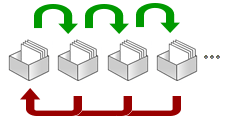
At the novice level, students are speaking with single words and lists initially, then move on to chunked phrases. As students move up to the intermediate proficiency level they begin to create discrete sentences on their own that move beyond chunked phrases. This tends to be the most challenging for students as they begin to create with language and are not relying on memorized phrases to chunk together. Teachers can help scaffold this process for students by assisting them in creating sentences.
 I have found that using question words with students is a simple and effective way to have students add details to their sentences that move from memorized, chunked phrases to discrete sentences that are created by the student. The more they do this the more they will grow in confidence and begin to do it on their own when writing.
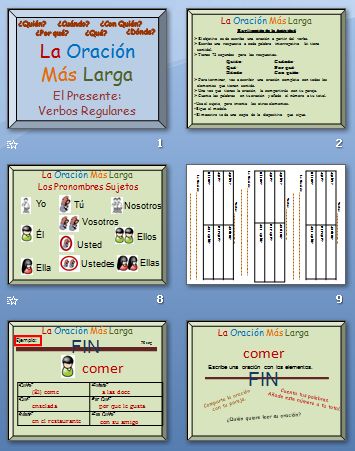
Here is a version of Memory (or concentration) with a twist. Instead of using pictures and words this version uses verb forms. Half of the cards have a subject pronoun and an infinitive. The other cards have the correct verb form to match each subject/verb pair. Along with the conjugated verb forms are 2 or 3 questions words as well as an affirmative or negative symbol [(+) (-)].
In order for the player to win the pair he or she must say a complete sentence that includes the subject and correct verb form as well as the information from the question words and in the negative if indicated. If the player is not able to make a complete sentence he does not get the pair of cards and must turn them back over. The winner is the player who has the most cards when all of the cards have been claimed. The verb cards look like this:


This activity helps move student speaking from the novice level to the intermediate level by showing them how easily and effectively they can can speak in complete, discrete sentences.
You can download resources to use with this proficiency-building activity by clicking the links below.
Like this:
Like Loading...

 This activity presents a made up language. Students look at examples of how verbs show tense and must decipher what words puts a verb in the past, present, or future. This is a great exercise to help students understand the abstract concept of verb tenses. By using an artificial language students will be able to create phrases in the past, present, and future without resorting to grammar rules. You will find yourself referring back to exercise throughout the year as students struggle with understanding verb tense. This great for a language arts class or any foreign language class. You can download a full versions of this activity here.








 posure to vocabulary and structures is needed so that we can readily recall it. The longer it’s been since we’ve practiced a word, the more likely it is that we will have forgotten it. There’s an initial steep decline in our ability to remember a word after the first time we learn it. However, if we practice a word multiple times we are much more likely to remember it over time.