Category Archives: Writing

French Tab Books to Learn, Practice and Apply Grammar and Vocabulary

I wrote a post recently on foreign language class lesson planning that follows the “Learn, Practice, Apply” sequence that I learned about from the teachers that I work with in Nicaragua.  I have found this simple framework very useful when planning lessons and activities in my foreign language classroom.  I created these French Tab Books that follow this sequence.

French Tab Books to Learn, Practice and Apply Grammar and Vocabulary ww.wlteacher.wordpress.comThe first pages provide scaffolded notes so that students get familiar with the new material, then they practice the material on the next pages, and finally students apply the material on the last page. The “apply” stage is often left out when teaching new material. These tab books assure that  students get to this stage in the learning process.

Setting Up the Tab Book:
-Cut the pages in half on the dotted line.
-Cut out the box on the bottom of each page along the dotted lines.

French Tab Books to Learn, Practice and Apply Grammar and Vocabulary ww.wlteacher.wordpress.com Photo Feb 13, 8 27 16 PM
-Place the pages on top of each other so that the tabs are visible on the bottom.  Students can highlight the tab titles.
-Staple the pages together in the upper right corner.  Students can also highlight the tabs on the bottom.

French Tab Books to Learn, Practice and Apply Grammar and Vocabulary ww.wlteacher.wordpress.com

These Tab Books can be glued into an interactive notebook and/or referenced as needed when reviewing. It has all the information needed to review in one convenient place.

You can get over 30 versions of these French Tab Books by clicking the link below.

Introducing Writing in the Novice Level Foreign Language Classroom

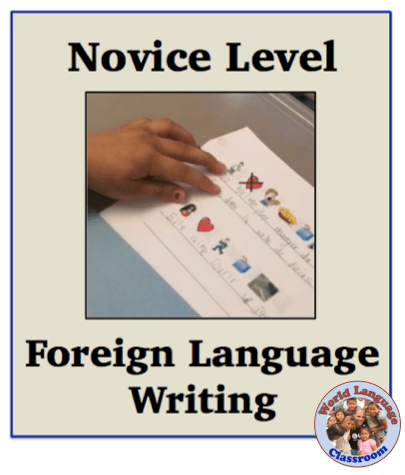
I’ve been working on writing with my novice mid class (3rd graders). They are consistently in the novice mid range when speaking.

Introducing Writing in the Novice Level Foreign (World) Language Classroom (French, Spanish) wlteacher.wordpress.com

In this activity I first gave students a sheet with pictures of words that they know well orally and have seen written. They wrote in the words as they remember them (challenging in French because there are lots of unpronounced letters..but their spelling is recognizable to a sympathetic reader). I then gave them picture sentences and they wrote the sentences using their reference sheet. In this video I am going around and asking students to “read” the sentences without looking at what they wrote.

In a follow-up they  cut out the sentences that they wrote and the individual pictures. They then reconstructed the picture sentence based on what they wrote. This is helpful to reinforce syntax.

French and Spanish Vocabulary and Grammar Tab Books

I recently wrote a post on foreign language class lesson planning that follows the “Learn, Practice, Apply” sequence that I learned about from the teachers that I work with in Nicaragua.  I have found this simple framework very useful when planning lessons and activities in my foreign language classroom.  I created Tab Books on a number of French and Spanish vocabulary and grammar topics that follow this sequence.

French and Spanish Vocabulary and Grammar Tab Books www.wlteacher.wordpress.comThe first pages provide scaffolded notes so that students get familiar with the new material, then they practice the material on the next pages, and finally students apply the material on the last page. The “apply” stage is often left out when teaching new material. These tab books assure that  students get to this stage in the learning process.

Setting Up the Tab Book:
-Cut the pages in half on the dotted line.
-Cut out the box on the bottom of each page along the dotted lines.

French and Spanish Tab Books www.wlteacher.wordpress.com
-Place the pages on top of each other so that the tabs are visible on the bottom.  Students can highlight the tab titles.
-Staple the pages together in the upper right corner.
-These Tab Books can be glued into an interactive notebook and/or referenced as needed when reviewing. It has all the information needed to review in one convenient place.

You can get over 50 versions of these French and Spanish Tab Books by clicking the links below.

Spanish Verb Form and Vocabulary Task Cards

Task Cards are individual cards that offer students opportunities to engage with a particular topic in various forms.  Each typically has a prompt or activity that students complete either individually or in pairs or small groups.  There are usually different challenge levels as well.  Task cards are particularly useful because they provide lots of opportunities for hands-on activities and movement in the classroom.  They also lend themselves very easily to differentiation.

Spanish Verb Form and Vocabulary Task Cards wlteacher.wordpress.comThere are 6 categories of prompts in the verb form task card sets, prompts include:

  • 1 Subject Pronoun, 4 Infinitives, student writes verb forms (cards 1-6)
  • 1 Infinitive, 4 Subject Pronouns, student writes verb forms (cards 7-12)
  • 4 Verb Forms, student writes infinitive (cards 13-18)
    Subject Pronouns and Conjugated Verb, student completes sentence (cards 19-24)
  • Sentence with Verb Missing, students chooses verb and writes form (cards 25-30)
  • Infinitive, student writes complete sentence (cards 31-36)
    These activities can be done in writing (response sheet included) or orally.

Spanish Verb Form and Vocabulary Task Cards wlteacher.wordpress.com

There are 5 categories of prompts in each vocabulary task card set.  Prompts include:

  • Picture with choice of 4 words (cards 1-12)
  • Word with choice of 3 pictures (cards 13-18)
  • Fill in missing letters (cards 19-24)
  • 2 pictures, student writes words (cards 25-30)
  • Picture, student writes a sentence with the word (cards 31-36)

Spanish Verb Form and Vocabulary Task Cards wlteacher.wordpress.com

For additional ideas on using these Spanish Task Cards see my previous post on 10 Ways to Use Task Cards in the Foreign Language Classroom.

French Verb Form and Vocabulary Task Cards

Task Cards are individual cards that offer students opportunities to engage with a particular topic in various forms.  Each typically has a prompt or activity that students complete either individually or in pairs or small groups.  There are usually different challenge levels as well.  Task cards are particularly useful because they provide lots of opportunities for hands-on activities and movement in the classroom.  They also lend themselves very easily to differentiation.

French Verb Form and Vocabulary Task Cards wlteacher.wordpress.comThere are 6 categories of prompts in the verb form task card sets, prompts include:

  • 1 Subject Pronoun, 4 Infinitives, student writes verb forms (cards 1-6)
  • 1 Infinitive, 4 Subject Pronouns, student writes verb forms (cards 7-12)
  • 4 Verb Forms, student writes infinitive (cards 13-18)
    Subject Pronouns and Conjugated Verb, student completes sentence (cards 19-24)
  • Sentence with Verb Missing, students chooses verb and writes form (cards 25-30)
  • Infinitive, student writes complete sentence (cards 31-36)
    These activities can be done in writing (response sheet included) or orally.

French Verb Form and Vocabulary Task Cards wlteacher.wordpress.com

There are 5 categories of prompts in each vocabulary task card set.  Prompts include:

  • Picture with choice of 4 words (cards 1-12)
  • Word with choice of 3 pictures (cards 13-18)
  • Fill in missing letters (cards 19-24)
  • 2 pictures, student writes words (cards 25-30)
  • Picture, student writes a sentence with the word (cards 31-36)

French Verb Form and Vocabulary Task Cards wlteacher.wordpress.com

For additional ideas on using these French Task Cards see my previous post on 10 Ways to Use Task Cards in the Foreign Language Classroom.

Emerging Literacy in a Foreign Language

This is a typical writing and reading (Emerging Literacy) activity that I do with novice students (with the goal being to read and write at a novice mid sentence level*). In this particular version, my 3rd graders had learned lots of words for animals and we had recently begun learning the words for places in nature where they can be found.

Emerging Literacy in a Foreign (World) Language. (French, Spanish) wlteacher.wordpress.comThe class could list about 20 animals (individual words-novice low*), and they are beginning to recognize how they are written. We started this class by listing the words on the board (animals and places in nature), then I gave them the verb “est” (is) and some prepositions to go along with the places (as phrases; “sur l’herbe” -on the grass). Students then put the structure together verbally in pairs to makes sentences (novice mid). We then moved on to writing the sentences and drawing a picture to show the meaning (novice mid*).  Once done, I went around to each student and had then read the sentences, then I covered the sentences and had them describe the pictures orally.

*ACTFL Proficiency Scale

Foreign Language Writing Project

This project started as a simple writing assignment a few years back and I have reworked it in recent years to make it more interactive and to respond to students’ requests to read each others’ writing.  The photo is of the assignment with a 7th grade novice high/intermediate mid class, but I have used it with various proficiency levels.

Foreign (World) Language Writing Project. (French, Spanish) wlteacher.wordpress.comStudents begin with a writing prompt and create a brainstorm (mapping) sheet with the ideas they want to include.  I go over these sheets for content before students write a first draft of their writing. This gives them a chance to focus on content independent from language structures.  Students read each others’ drafts in class and comment on content and discuss any grammatical concerns.  Based on this feedback students complete a second draft that I go over with suggestions for richer content and highlighting grammatical issues.  It is very important to give prompts at the appropriate proficiency level of the students or the teacher will spend more time going over the grammar than it took for the student to write the draft.  This is a clear sign the proficiency level of the prompt was too high.

When students get the draft back they type a final draft to hand in along with an additional sheet that includes pictures or drawings of the content.  I post the writing and picture sheets on a bulletin board.

Foreign (World) Language Writing Project. (French, Spanish) wlteacher.wordpress.comI hand out a question sheet to students to complete as a homework assignment.  They need to read their classmates writing and find the information to fill in the question grid.  The picture sheet helps to guide students in understanding their classmates’ writing if there are words that they do not know.  I typically make several versions of the question sheet with 5-7 names on it.  I hand these sheets out to students, making sure that they do not get a sheet that requires them to read their own writing.

Foreign (World) Language Writing Project. (French, Spanish) wlteacher.wordpress.comStudents enjoy engaging with the writing of their classmates and look forward to opportunities to share their writing and to read what their classmates write.

Spanish & French Verb Tense and Sentence Writing Powerpoint Activities

It’s one thing for students to learn verb forms, it’s another for them to know the meaning and be able to actively use them in a sentence.  To help with this, I created these verb tense (form) and sentence writing activities that are interactive.  I use Powerpoint to keep the process moving and engaging.

Spanish & French Verb Tense and Sentence Writing Powerpoint Activities wlteacher.wordpress.comThe teachers begins each slide with a single click that produces a number written in words on the bottom of the screen. Students find the digit in the grid and write the subject and correct verb form based on the column and row of the digit.

A circle appears and begins to disappear (20 seconds for the first 20 slides) during which time students write the subject and correct verb form. They can write this on a sheet of paper or on mini-white boards. The board is covered with a “Fin” square after 20 seconds.

A second click reveals the digit and the subject and verb so that students can verify that they found the correct number and the correct subject and verb form.

After practicing this activity on the first 20 slides, students can then write complete sentences on the next 20 slides by writing the subject, correct verb form and an answer to the question word that accompanies the infinitive. The timer on these slides is set to 30 seconds to allow more time to write the sentences. Students can then read examples of the sentences that they wrote.

Spanish & French Verb Tense and Sentence Writing Powerpoint Activities

The teacher is free to use as many or as few of the subject/verb slides before moving on to the subject/verb/question slides.

You can download over 25 versions of these activities in French and Spanish by clicking the links.

Topics include:

  • Present tense (regular, irregular, stem-change, accent-change verbs)
  • Past Tenses (preterit, present perfect, passé composé)
  • Present progressive
  • Simple future
  • Conditional
  • Subjunctive
  • Reflexive Verbs

Foreign Language Writing Activity: Students Use Vocabulary in Context

The importance of teaching and learning vocabulary in context is spreading.  Gone (hopefully) are the days of teaching words in isolation and out of context.  We need to keep this in mind as well when students write.  I am guilty of asking students to “write each vocabulary word in a sentence” when the sentences are in isolation and don’t follow any sort of logic or context.

Foreign (World) Language Writing Activity: Vocabulary in Context (French, Spanish) wlteacher.wordpress.comWhen would anyone need to write like this?  The answer is never, or only in a foreign language class.  So, I needed to change my writing prompts to make sure that students are writing with a context.  This tends to be a bit more manageable with students that have a higher proficiency, but I wanted to make sure that I was instilling the concept and skill of writing in context with my younger (lower proficiency) students early on so that this would become the norm as they gain in proficiency.

Here is an example of a writing assignment that I do with my elementary students to scaffold them into writing in context.  It is a foldable that represents a house.  They begin by “building” their house, which is simply folding a piece of paper in half, then folding in each side.  Students then cut two lines on each flap and glue on a roof. Next, they write the names of rooms in the house (and the yard) on the flaps, which represent doors or windows.

Foreign (World) Language Writing Activity: Vocabulary in Context (French, Spanish) wlteacher.wordpress.comStudents then write six sentences stating what they like or don’t like to do in each room in the house.  This gives them an opportunity to use all the verbs they have learned in context along with the rooms in the house.  Once I go over the draft sentences with each student, they write the sentence inside the room.

Foreign (World) Language Writing Activity: Vocabulary in Context (French, Spanish) wlteacher.wordpress.comFinally, students cut out a picture of the activity and glue that inside the room as well.  This is a great way to reinforce the meaning of the words in the sentence without resorting to translation.

Foreign (World) Language Writing Activity: Vocabulary in Context (French, Spanish) wlteacher.wordpress.com When finished, these can be used to have a conversation with students where they read the sentences of other students and respond to react to what they read.

Foreign (World) Language Writing Activity: Vocabulary in Context (French, Spanish) wlteacher.wordpress.com Foreign (World) Language Writing Activity: Vocabulary in Context (French, Spanish) wlteacher.wordpress.com

Lots of possibilities with other concepts.  I’m just getting starting.  Please comment on other ideas.

Foreign Language Creative Writing with an Artistic Touch : The Cinquain

Cinquin: Foreign (World Language Creative Writing (Frencch, Spanish) www.wlteacher.wordpress.comStudents are more motivated to write when the topic is of personal interest.  I recently saw a colleague, Katya Hottenstein, working with a Spanish class on writing short poems.  The poem was the classic Cinquian, but she took it a step further and the students created artistic representations of their poems.  The topics were chosen by students and the artistic rendering was left up to the writer.  Cinquain poems are typically written in one of these forms.

  • Line 1: One word
  • Line 2: Two words
  • Line 3: Three words
  • Line 4: Four words
  • Line 5: One word
  • Line 1: A noun
  • Line 2: Two adjectives
  • Line 3: Three -ing words
  • Line 4: A phrase
  • Line 5: Another word for the noun
  • Line 1: Two syllables
  • Line 2: Four syllables
  • Line 3: Six syllables
  • Line 4: Eight syllables
  • Line 5: Two syllables

Here are some examples of the creative writing projects that the students created.

Foreign Language Creative Writing with an Artistic Touch : The Cinquain