Category Archives: Speaking

Foreign Language Assessment: Knowing about language and doing something with language

Assessments often focus on knowing about the language at the exclusion of what the student can do with the language.  Below are some guidelines to help distinguish these two practices.  Take some time to find the balance of assessing what students can do with the language (context-based) and what they know about the language (minimal context).  I focus on the language particulars more when tasks involve writing and more on what students can do with the language when speaking.

Foreign Language Assessment: Knowing about language and doing something with language (French, Spanish) www.wlclassroom.com

These are some assessment characteristics that show what students know about  language:

  • They assess discrete points.
  • The answers are either right or wrong.
  • They are easily and quickly scored.
  • They test language content: vocabulary, grammar, and culture.
  • They involve the lower-level thinking skills of knowledge and comprehension.
  • They are usually given in formal testing periods.

These are some assessment characteristics that show what students can do with language:

  • They require that students create a product or do a demonstration.
  • They are scored holistically.
  • They are task-based.
  • The tasks are situation-based or use real-world content.
  • They involve higher-level thinking skills of application, integration, analysis, synthesis, and evaluation.
  • They are given in both formal and informal testing situations.

Take a look at the tasks and activities that you give students and determine what it is that they are actually assessing.  Are they focused on what students know about the language or what they can do with the language?

Activities that show what students know about language:

  • True/false
  • Multiple choice
  • Fill in the blanks
  • Match
  • Give the correct form of the noun, adjective, verb
  • Change one word for another, e.g. noun for pronoun
  • State the facts
  • Translate
  • Follow the model
  • Repeat, recite
  • Answer the questions

Activities that show what students can do with the language:

  • Complete the sentence logically.
  • State your opinion, thoughts, or comments.
  • Give personal answers.
  • Create a situation.
  • Seek information.
  • Develop a product, e.g. advertisement, brochure, collage, poem, song, essay, video, etc.
  • Demonstrate your knowledge.
  • Summarize, paraphrase.
  • Change the ending.

Find the balance in assessment and make sure that there are opportunities for students to demonstrate what they can do with the language in addition to what they know about it.

Verb Form Writing and Speaking Activity-Interactive Powerpoint

This is an engaging class activity to review and reinforce verb forms. The teacher divides the class into teams (ABCD). Teams choose a square and say the number of the square  and either say or write the correct verb form. The teacher clicks the square (while in slideshow mode) to reveal the correct answer and the points that the team earns. The point values are arbitrary and meant to add a bit of excitement to the game. If the team is correct, the teacher types the score in the box next to the team letter. The team with the highest score at the end wins.


French & Spanish Speaking Activity: Shipwreck

Your students will build their proficiency, polish their skills and create increasingly complex sentences with this dynamic and interactive speaking activity. Naufragio/Naufrage encourages strategic thinking and friendly competition.

Let’s take a look at how it works:

  • In each of the squares, there are pictures, numbers, time or subject/infinitive. Whatever the theme is that students are working on. Students play against an opponent or two and each player has a different colored pencil.
  • Player 1 begins by choosing a box and  identifies the verb form or picture and then creates a sentence, depending on the proficiency level. There are reference pages to support students in level up their language.
  • Players use a colored pencil to claim squares by forming rows as they earn points and hone speaking skills. They also try to block the other players from doing the same. That’s where it gets really fun and engaging. So fun that they forget about how much of the language that are actually using.

Students have useful and essential tools to engage in this small-group activity, including reference pages to assist in building sentences and checking their accuracy.

Each resource includes:

  1. Directions for how to do the activity
  2. A reference page with vocabulary or verb forms
  3. A reference page for building sentences 
  4. Game boards

There is absolutely no prep required. Just print out and you’re ready to go.

Spanish Naufragio Vocabulary Topics:

Spanish Naufragio Verb Form Topics:

French Naufrage Vocabulary Topics:

French Naufrage Verb Form Topics:

Verb Reference when Speaking and Writing

This handy reference for students has verb forms on both sides. I photocopy it on  card stock (two-sides) and cut it into strips so that students can put it in their books, usually in the lesson we are currently studying.  My students really like having this easily accessible reference so that they don’t always have to go looking through their book for verb forms when speaking and writing.  The example below is for beginning/intermediate students, but more advanced students would benefit from more advanced verb forms and conjugations.

This handy reference can be made in a WORD document by making columns or text boxes.  You can also download them completed in French and Spanish here:

Classic Battleship to Get Kids Speaking

I always like to use classic games such as battleship in the foreign language classroom.  These types of activities don’t typically require a lot of explanation because students are familiar with the how the game is played and they can get right on task practicing their language skills.  You can read about how language instruction is improved with “fun and games” in a post that I wrote previously. 

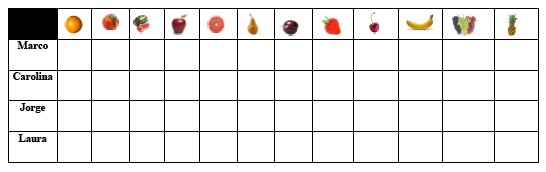
Classic Battleship in the Foreign (World) Language Classroom (French, Spanish) wlteacher.wordpress.comHere is an example of how battleships can be used to practice  clothing vocabulary and colors in Spanish.  Students place boats (filled in boxes) on the game board. Students play against another student and try to find and sink the boats of the opponent. There are pictures of clothing down the left side and colors across the top (this can also easily be done with with subjects and verbs). To choose a square, the player must say the article of clothing and the correct form of the color.   All of the necessary vocabulary (boat names, hit, sunk, miss, examples of how to say a sentence) are on the sheet for student reference. There are two grids for each player to use, one to put his/her own “boats” on and the other to keep track of the opponent.

Classic Battleship in the Foreign (World) Language Classroom (French, Spanish) wlteacher.wordpress.comDownload Battleship Games Here:

Find your Match-Speaking Activity to Practice Foreign Language Vocabulary

This is a great well to keep students in the target language while they focus on a particular vocabulary theme.  The example below using clothing.  Give slip of paper to each student with pictures of five articles of clothing.  There are 6 six pairs total.  In the example below the slips on the left are paired with slips on the right.

Students circulate in the classroom and ask each other which clothing they have (they should not look at others’ answers or show theirs).  The entire activity should take place in the target language.  The objective is to find the other person who has the exact match.  If there are more than 12 students in the class, photocopy additional slips and students need to find their group of 3 or 4 that all match.  If there is an odd number of students in the class, be sure to give a slip that matches a group.

The first group to pair up without speaking English or looking at each other’s slip wins the round.  Students can then exchange slips and play a second and third time. Before playing, review the vocabulary that students will need.

These activities can be made in a WORD document by cutting and pasting images, or you can download the activities that are already made here:

Teaching Circumlocution to Students

It is often challenging for students to say or write something when they do not know the correct word (or can’t remember the word) that they want to use.  During a conversation or speaking activity, students sometimes struggle to find the right word.  When this happens, it’s usually not practical or possible to use a dictionary.  For this reason it is important to explicitly teach the skill of using circumlocution.

Teaching Foreign (World) Language Circumlocution. (French, Spanish) wlteacher.wordpress.comCircumlocution is a strategy for describing or defining a concept instead of saying or writing the specific words.  Students should be taught how to do this and the teacher can give them tools to help in the process.

Here are some suggestions to teach students the art of circumlocution explicitly:

  • Use vocabulary that you already know.
  • Try to think of another way to convey the message.
  • Use a synonym.
  • Use a more general category word (fruit, clothing, etc.)
  • Explain what and object is not.
  • Point and use gestures, actions, and sounds.

Here are two documents that give examples of how to use circumlocution as well as some activities to practice the strategies.

This is what my Circumlocution wall looks like with the English translation below.

Verb Tense Writing or Speaking Activity

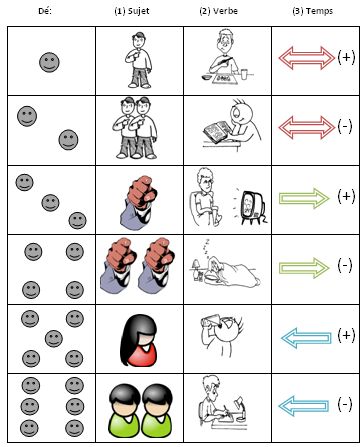
This is a great interactive writing or speaking activity for students.  Students throw a die three times and write a sentence based on the number sequence (or they can throw three dice at once and line them up). Each number corresponds to picture of a  subject pronoun, verb and verb tense.  Students write the sentence or say it out loud.  This is a great way to get students writing without translating. Subjects and verbs can also be easily written on the board and numbered 1-6 along with various verb tenses as well.  This is a grid that I use with students.

Information Gap Activities

Information Gap Activities require students to communicate with each other in order to find all the necessary information to complete the activity.  Each partner has information that the other does not.  It is very important that students have the appropriate level of language in order to complete the activity.  There is sometimes a lot of repetition in the communication as students try to narrow down the information.  This can be very useful when you want the students to focus on a particular structure.  Here is an example of an activity (El Adivino, Le Devin) where students first choose their “secret” information that their partner must then discover.

Download Information Gap Activities Here:

Avoiding Native Language in the Foreign Language Classroom

Avoiding Native Language in the Foreign (World) Language Classroom (French, Spanish) wlteacher.wordpress.com

We have all had issues with students reverting to their native language the foreign language classroom.  Here are some questions and suggestion to consider as you create these speaking activities that will help to keep students speaking in the target language.

Is the activity at the right level for the students?

The activity or prompt should be at the appropriate proficiency level. It is helpful to review necessary vocabulary and phrases in advance.  If the language required to perform the activity is too high student will undoubtedly revert to their native language. If the task is too easy they may get bored and also stop using the target language.

Are all the students actively involved and is the activity stimulating and of interest to the group and individual students?

If students do not have something to say or do, or don’t feel the need to speak, they will revert to their native language and discuss something that is more of interest to them.  Provide prompts and tasks that are of interest to students.

Is the timing of the activity hindering the execution?

The timing of a speaking activity in a class can be crucial. Often when put in a group students quickly continue conversations that began before class.  This is why it is best to wait until a few minutes into class time to begin a group speaking activity.  Use the first part of class time to refocus attention with another sort of activity or review.

Are students using the target language even when they know the teacher is not  listening?

It is imperative that the teacher walk around the classroom monitoring participation and target language use and giving support and help to students as they need it.   But, students are very good at knowing when they can get away with not speaking the target language because the teacher is working with another group.  For this reason, it important to put a time limit and a product on the task so that group needs to stay focused.