Category Archives: Speaking

Who is it? Speaking Activity for the Foreign Language Classroom

Who is it? Foreign (World) Language Speaking Activity. (French, Spanish) wlteacher.wordpres.comThis game  motivates students to speak and to recall vocabulary.  Any type of thematic vocabulary can be used.

The Set -Up: Lay out abut 5 or 6 index cards or slips if paper.  Choose three vocabulary themes (numbers, colors, family, professions, verbs, etc.).  Choose one word and write it on half of the cards.  Choose another word and write it on the rest of the cards.  Do the same thing for the two remaining vocabulary themes.  Each card should have three words.  Make sure that no two cards have the same three words.

The Activity: Hand the cards out to students and have those students go to the front of the room.  Tell the rest of the students (and write on the board) all of the words that are written on the cards.  The teacher chooses one of the cards in advance and it is the class’s task to figure out who has the card by asking questions of each person who is holding a card.  They need to keep track of the information that they learn and make a guess when they think that they figured out the right person.

Keep it Communicative: Write digits,  draw lines in color, draw (print out) pictures, etc. for the cards so that students must use their own language to play the game rather than simply reading words.  Use these for the students who are asking the questions as well.

There are many variation for this activity, including more advanced questions using various tenses (the card may say “to eat-preterit” and the question would be “did you eat?”).  This can also be used several times in the same class, just switch the students and choose another card.

Foreign Language Vocabulary Activity: Circle

1540243-1515334-331This is a great way to get students reading new words and understanding their meaning.  Begin by placing the same number of slips of paper as you have students in your world language class side by side on a table in front of you.  On the first slip write the word for “start” in the target language.  On the back of the slip of paper, write a new vocabulary word that the class has been familiar with for a few class periods.  On the next slip of paper write the English translation of the vocabulary word.  On the back of that slip, write another new vocabulary word in the target language.  On the next slip, write the English translation of the word with another target language word on the back of that sheet.  Continue with these words on both sides of the slips of paper until there are enough for all of the students in the class.  Write “end” in the target language on the back of the last slip of paper.

In class, give a slip of paper to each student in the class.  The student with the word “start” begins by saying his or her target-language word and the student who has the translation says the meaning in English, then turns his or her paper over and says the target-language word.  The student the translation of that word then turns the paper over and says the target language word.  The class continues until the student with the word “end” says “end”.  Time the class and try to have them beat their time by repeating the activity.  Have students exchange slips of paper to change the order and to expose them to other words.  If a student is absent be sure to give two slips to another student so that the process continues.

This can also be done with verb tenses.  Write a subject and verb on the card and the verb in a the chosen-tense on the other card.  If the class has done a number of tenses, you can write a subject and verb along with one of the tenses (i.e. yo/comer/imperfecto or io/mangaiare/pasato remoto).  Try using adjectives as well, with a noun and an adjective (des chats/noir) and write the correct form of the adjective on another sheet).

Another variation is to have students put themselves in the correct order without speaking.

Speaking Game

This game essentially works like Connect Four.

Put students  into pairs or groups of three.  Give each group colored slips of paper (different color for each play) to cover the boxes.

The goal  is to make a line of 4 squares on the board – the first person to do this is the winner.  The lines can be up, across or diagonal.

To win a square, the play must say a sentence using the phrase that matches the picture in that square or a word that is in the square.

The other players have to decide whether the sentence is correct.  If it is, he/she covers the the square with his/her colored slip of paper.

Remind students that they can’t choose a square that has nothing underneath it. They must magine that you are dropping counters into the grid from the top – they fall  straight to the bottom unless there is another counter underneath them.

Here is what the grid might look like:

You can download a Connect 4 Grid.

Foreign Language Speaking Activities Using Pictures and Photos

An effective way of getting students speaking is to have them describe a picture or photo, but this can a get a little old after a few times.  There are many paired and group activities that students can do with an image beyond a simple description.

Foreign Language Speaking Activities Using Pictures and Photos (French, Spanish) www.wlclassroom.com

I compiled 50 speaking activities using images and photos in the foreign language classroom.  Two of them are are:

  • One student orally describes a picture to a second student who then draws a copy of it.
  • One student orally describes a picture to another student who then is given a choice of pictures and must choose the one described.

You can download the entire document with all 50 ideas by clicking the box below.

These are fairly low-prep activities.  All the teacher really needs to do is find pictures (easily done on the Internet) that represent the vocabulary or topics. Why not involve students in process as well?


Writing Activities that Facilitate Foreign Language Speaking

Consider these writing activities that can be used to facilitate  speaking of the target language.

Free-Writing

The free-writing technique is one of the ways to make writing more like speaking. It is a pre-writing technique which encourages students to overcome their fear of the blank page and their preoccupation with correctness. By pre-writing is meant the first stage of the writing process, followed by drafting, revising and editing, when the purpose is to teach writing skills. In this case, however, since our aim is to facilitate speaking, we concentrate only on the first stage. Free-writing can be seen as the closest writing can get to impromptu speech.

Writing Activities that Facilitate Foreign Language Speaking. (French, Spanish) wlteacher.wordpress.com

Mapping

The goal is to generate and connect subtopics. The subject is placed in the center, and topics are added on extending lines as the writer thinks of them. So, if asked to speak on the “mapped” topic, the learner knows what to talk about, how to organize his/her speech and how to connect subtopics.

Foreign Language Tongue Twisters

Foreign (World)Language Tongue Twisters. (French, Spanish) wlteacher.wordpress.comIf you want students to practice their pronunciation and to have fun while doing it, try out some tongue-twisters.  This is a great way to have students focus on their pronunciation without relying on repetition.  It’s fun to make it into a game and see who can say it the fastest.  Once students get more comfortable with the pronunciation they can begin to make their own tongue-twisters in the target language.  This would be a great opportunity to see if students understand the sound-symbol relationship between letters, letter combinations, or characters.  Very often as well, the content of the tongue-twister is a window into the culture.

Here are some tongue-twisters to get you started:

Rao k’ou ling (Mandarin)

Tongue-Twisters (English)

Virelangues (French)

Zungenbrecher (German)

Scioglilingua (Italian)

Hayakuchi Kotoba (Japanese)

Trava Linguas (Portuguese)

Trabalenguas (Spanish)

Presenting Foreign Language Vocabulary with Powerpoint

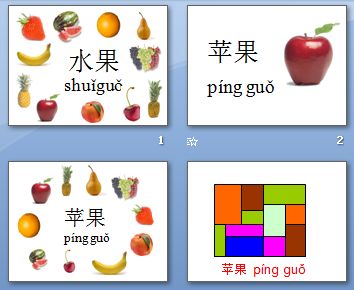
There are many ways to use powerpoint animation tools to visually capture the interest of students.  When presenting vocabulary for the first time, particularly if the vocabulary is concrete, the visual along with the word helps students to retain the vocabulary and recall it on their own.  In the sequence below (you can download the entire powerpoint to see how the animation works), first the word and the image is presented, then students choose the image when they see the word, then they identify the image on their own when the boxes are removed, then finally students identify the vocabulary when the image spins quickly.  The sequence moves students from the word and the visual to being able to identify the image on their own.  When done in a 45 minutes class with about 10-12 new words, students typically can recall almost all of the words.

Download full Powerpoints:

Group Speaking-Powerpoints

Zut Alors

This game is a great opportunity for students to work in groups in order to discuss answers.  The teacher can easily change the categories and make up any questions that he/she would like.  The idea is that if a team gets a “Zut Alors” they lose their points and turn.  This version is in French, but it can be easily modified for any language.

Je Valide

This a question game/activity that provides information about the correct answer. Each question is preceded by a category if the teacher would like to make it into a game in which teams wager points before hearing/seeing the question.

Classroom Phrases

These are great downloads that you can put up in your classroom.  They include key phrases for students to use and they are all illustrated so that no translation is necessary.

Download the Spanish version HERE.

Download the French version HERE.

Download the Italian version HERE.

Download the Chinese version HERE.

Lingt: Great Free Site that Facilitates Speaking

lingt

www.lingtlanguage.com

This is a great new site that is extremely easy to navigate and is very user-friendly.  The teacher can easily record his/her voice for students to hear, then the student simply clicks and records his/her own response to the question.  The student can then listen to what he/she said and easily delete and redo.  The teacher can add in text, YouTube Videos, and images as well.  The great thing about this site is that it is completely online and does not require downloading any software onto your computer or the student’s computer.  The students submit their spoken (or typed) response to the site and the teacher accesses the student work through his/her Lingt account.  Student do not have to sign up for an account, just the teacher (and it is FREE).  Students simply title their work with their name and the teacher accesses it that way.

I recently met the two MIT students who created this site and they are eager to get teachers using it so that they can make it as user-friendly and efficient as possible.  They are also committed to keeping this fundamental part of the site FREE.  You have to visit and try it out for yourself.  Wow!

Here is a rubric that I use to assess student performance using Lingt.

Try it out HERE.