Category Archives: Writing

Verb Form Writing and Speaking Activity-Interactive Powerpoint

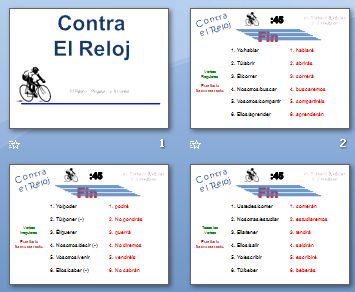
This is an engaging class activity to review and reinforce verb forms. The teacher divides the class into teams (ABCD). Teams choose a square and say the number of the square  and either say or write the correct verb form. The teacher clicks the square (while in slideshow mode) to reveal the correct answer and the points that the team earns. The point values are arbitrary and meant to add a bit of excitement to the game. If the team is correct, the teacher types the score in the box next to the team letter. The team with the highest score at the end wins.


Foreign Language Writing Prompts with Outlines

Foreign (World) Language Writing Prompts and Outlines (French, Spanish) wlteacher.wordpress.comIn an effort to try to cut down on the number of drafts that students need to write, particularly when the language issues are in the areas of spelling, accent placement, verb forms and adjective agreement, try using this approach.  Give the students the topic in advance of an in-class writing assignment along with the prep sheet (see example below).  The prep sheet is for student use and reference during the writing assignment in class.  The left hand side has room for brainstorming and outlining, while right hand site has spaces for nouns, verbs in the infinitive, verb conjugation tables and any other grammatical or mechanical language element that students need to focus on.  Students then write in class and use this sheet, which they have completed on their own based in the topic.  This information is essentially what students will need to reference when working on additional drafts that the teacher has corrected.  This approach has students notice and reference on their own and will most likely make an additional draft unnecessary.  Try having students write on a topic with and without this type of sheet and see how the student work is different.  The grammar topics on the right side should reflect the topic and what the teacher wants the students to use while writing.

Verb Reference when Speaking and Writing

This handy reference for students has verb forms on both sides. I photocopy it on  card stock (two-sides) and cut it into strips so that students can put it in their books, usually in the lesson we are currently studying.  My students really like having this easily accessible reference so that they don’t always have to go looking through their book for verb forms when speaking and writing.  The example below is for beginning/intermediate students, but more advanced students would benefit from more advanced verb forms and conjugations.

This handy reference can be made in a WORD document by making columns or text boxes.  You can also download them completed in French and Spanish here:

Class Starters (Do Nows, Warm Ups) for the Foreign Language Classroom

Class Starters (Do Nows, Warm Ups) for the Foreign (World) Language Classroom (French, Spanish) wlteacher.wordpress.comClass Starters (often called Do Nows, Warm Ups or Quick Questions) are a great way to set the tone for the work to be done in class.  It is also a great opportunity to have students review vocabulary and grammar regularly so that the concepts stay active.   These activities are also an effective tool for class management, particularly when students know that they are receiving a grade.   typically give a grade out of 5 points for each day. 

Below are some ideas for class starters in a world language class as well the document that students use to record their answers.

  • Reorganize jumbled-up letters in a word
  • Write words in singular or plural
  • Write correct form of an adjective
  • Write correct verb forms (in various tenses)
  • Organize words to make a sentenc

Here is a more extensive list of Do Now Activities.

Click here for my  blog post about short activities that can be used as Do Nows or activities for Fast Finishers.

Reorganise jumbled up letters in a word (To practice spelling, alphabet and revise vocabulary) Tell students the topic that all words belong to.

Write words in the singular or the plural (To practice singular and plural articles)

Determine the correct form of the adjective (To practice adjective forms and agreement)Give students a noun and they write the correct form of the adjective)

Give the correct verb forms (To practice the forms of regular and irregular verbs)

Give students a subject pronoun and 5 or 6 verbs.  Students write the verb forms.

Reorganise words within a sentence (To practice word order, agreements and revise vocabulary) Tell students the topic.

Teaching Circumlocution to Students

It is often challenging for students to say or write something when they do not know the correct word (or can’t remember the word) that they want to use.  During a conversation or speaking activity, students sometimes struggle to find the right word.  When this happens, it’s usually not practical or possible to use a dictionary.  For this reason it is important to explicitly teach the skill of using circumlocution.

Teaching Foreign (World) Language Circumlocution. (French, Spanish) wlteacher.wordpress.comCircumlocution is a strategy for describing or defining a concept instead of saying or writing the specific words.  Students should be taught how to do this and the teacher can give them tools to help in the process.

Here are some suggestions to teach students the art of circumlocution explicitly:

  • Use vocabulary that you already know.
  • Try to think of another way to convey the message.
  • Use a synonym.
  • Use a more general category word (fruit, clothing, etc.)
  • Explain what and object is not.
  • Point and use gestures, actions, and sounds.

Here are two documents that give examples of how to use circumlocution as well as some activities to practice the strategies.

This is what my Circumlocution wall looks like with the English translation below.

Verb Tense Writing or Speaking Activity

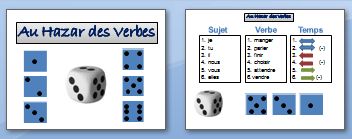
This is a great interactive writing or speaking activity for students.  Students throw a die three times and write a sentence based on the number sequence (or they can throw three dice at once and line them up). Each number corresponds to picture of a  subject pronoun, verb and verb tense.  Students write the sentence or say it out loud.  This is a great way to get students writing without translating. Subjects and verbs can also be easily written on the board and numbered 1-6 along with various verb tenses as well.  This is a grid that I use with students.

Beginner Students and Poetry

poets-corner-colorThe musical quality of poetry, the careful selection of the  words of poetry, and the ability of poetry to give make us think and reflect  make it an ideal vehicle for writing tasks in a foreign language class.    Here are some ideas for incorporating poetry based on the work of Jan Labonty and Lori Borth (in their article el elefante y la hormiga: Writing Poetry in Foreign Language Classes, NECTFL Review 58 Spring/Summer 2006).

Writing patterned poetry reinforces description and grammatical structures. It nurtures vocabulary development and is an activity that places the emphasis on a finished product of which to be proud rather than writing something acceptable.

I used to be … but now poems
Students can use the following pattern:
I used to be ______________________________________
But now I’m _____________________________________
Yo era ________________ pero ahora soy ________________.
________________ era yo pero ahora ________________ soy.

The sentence was repeated and the word order mixed to add some interest and variety.These sentences were added to the end of name using their English name or a Spanish name,if Spanish names were used in class. They  chose an adjective that described them for each letter of their name and then used  adjectives with opposite meanings for the final sentences. Use of interesting adjectives and attention to adjective agreement were stressed.

Sample of student work:
JESSICA
Joven
Enérgica
Simpática
Sensible
Independiente
Curiosa
Ambiciosa
Yo era tímida pero ahora soy extrovertida.
Callada era yo pero ahora habladora soy.

Alphabet Pyramids:
These cumulative poems contain specific parts of speech that begin with the same letter.They are appropriate for all levels and are ideal for illustrating and displaying in  the classroom. They are also fun to share orally and are good “tongue twisters” to  practice pronunciation.They rarely translate well.
Line 1:the letter
Line 2:a noun
Line 3:add an adjective
Line 4:add a verb or verb form
Line 5:add an adverb

Samples of student work:
R
Ranas
Ranas Rápidos
Reduzco Ranas Rápidos
Reduzco Ranas Rápidos Raramente

Terquain
A terquain is a descriptive, three-line poem.This is appropriate for all levels and can be used as a directed work with the instructor providing the first line or offering a general topic to be addressed.It encourages the use of vivid words to create an  image or reaction. It can be as simple or complex as the skill level of the writer  allows.
Line 1:one word,the subject
Line 2:one or two words about the subject
Line 3:one word,a feeling about the subject

Samples of student work:
Arte
Mi foco
Salvación

Writing Activities that Facilitate Foreign Language Speaking

Consider these writing activities that can be used to facilitate  speaking of the target language.

Free-Writing

The free-writing technique is one of the ways to make writing more like speaking. It is a pre-writing technique which encourages students to overcome their fear of the blank page and their preoccupation with correctness. By pre-writing is meant the first stage of the writing process, followed by drafting, revising and editing, when the purpose is to teach writing skills. In this case, however, since our aim is to facilitate speaking, we concentrate only on the first stage. Free-writing can be seen as the closest writing can get to impromptu speech.

Writing Activities that Facilitate Foreign Language Speaking. (French, Spanish) wlteacher.wordpress.com

Mapping

The goal is to generate and connect subtopics. The subject is placed in the center, and topics are added on extending lines as the writer thinks of them. So, if asked to speak on the “mapped” topic, the learner knows what to talk about, how to organize his/her speech and how to connect subtopics.

Building Sentences Through Images

I have found it extremely useful to use pictures to represent words and to add on to these picture sentences as the year moves on.  I tend to use an LCD projector to show these pictures, but have used printed pictures and overhead transparencies in the past and the process works just as well.

I begin the year with a simple picture of heart and another of a heart with an X on it.  These represent “I like” and “I don’t like.”  About 10-15 verbs are introduced (again through pictures) and students then “read” their first sentence, something such as “I like to run.”  I purposely use only “I like/don’t like” at this stage so that students don’t have to be concerned with verb forms.  As we begin to study more vocabulary I add on to these pictures.

For example, they learned the rooms in the house.  As soon as they were comfortable recognizing the pictures of the rooms I added the previous words to them to make more complex sentences, such as “ I don’t like to sleep in the living room.”

As we added on food vocabulary I again using words/pictures that they already knew to make more complex sentences, such as “I like to eat strawberries in the living room.”

It is very important to use the same pictures rather than changing them so that the students become comfortable recognizing them.  I was very surprised and impressed this past year when some of my youngest students (3rd grade) began creating their own sentences based on the pictures and they began trying to create the longest sentence.
This process has helped students to retain the majority of vocabulary that they have learned throughout the year and they enjoy what they are able to accomplish.  You can go in many directions with these pictures once students are comfortable with them.  They can “read” the sentences out loud, write the sentences in the target language based on the picture sequence, or “write” what they are reading.  This entails giving sentences to students that are in the target language along with a group of pictures that they assemble in the correct order.

Here is a Powerpoint that demonstrates this concept:  Image Sentences

picture sentence

Writing Outlines for Foreign Language

writing-colorWhat to focus on most in foreign language classes (speaking, listening comprehension, reading, and writing or some other order or combination), is the subject of much research into language acquisition. However, exposure to all elements of language and increased confidence are unquestionably necessary. Regardless of your approach to language teaching and order in which you expose your students to the different mediums of language and culture, consider this writing exercise, keeping in mind that this model is easily adaptable to any level or theme.

It very helpful for the entire class to write together collectively before students work independently. The result will provide each student a chance to see that he/she was able to write a paragraph appropriately (albeit a collective one) before engaging in the task on his/her own. The paragraph produced by the class also serves as a model for the individual writing. In time, perhaps several months, students will no longer have to refer to the model paragraphs, but will rather be more able to engage the process on his/her own from the beginning.

  • Begin with an outline that resembles this (the handout should be in the target language):
  • Name: ________________
  • Age: He/she is ________ years old.
  • Class: 6th 7th 8th
  • School: ________________
  • Activity: ________________
  • Time: ________________
  • With whom: ________________
  • Where: ________________
  • Clothing: ________________

Put a copy on however many desks as there are students in the class, plus one for the teacher. Each student will begin with the paper on his/her desk and fill in a name (any name). All students will then rotate to another sheet and fill in the next piece of information. The class (and the teacher) will continue to rotate until all information is filled in. Students need to pay attention to what is already on the outline so that they add appropriate places, times, and clothing.

Once the outlines are done (collectively), students return to their seats and now have an outline completely filled in. The teacher will also have one. Ideally (perhaps in a follow-up class or immediately if the teacher has access to a copy machine), each student will have a copy of the teacher’s outline to follow as the class helps the teacher to write a paragraph based on his (her) outline. The teacher writes the paragraph on the board and students contribute and write down the model paragraph. Here is an example of what one of these initial paragraphs might look like (although in the target language):

  • John is twelve years old. He goes to Collins Middle School. He is in the 7th grade. John plays baseball at three o’clock. He plays with his friends Craig, Mark, and Peter. They play at the park. John wears a green tee-shirt, white shorts, and gray sneakers.

Students then take their own outlines and write their own paragraphs (from their outlines) using the model paragraph as a guide. Once the students are familiar with the process, they can fill in their own outlines in the future. It is helpful to continue writing a model paragraph together as a guide until students no longer need one.

These kinds of outlines improved student writing a great deal. Also, make the outlines as specific as possible: perhaps all written in the first person or in the present tense, etc. Students like to use funny names, make outlandish outfits, and have people doing amusing things.

It is beneficial to allow this freedom and allow them to enjoy the process. Once students are at a more sophisticated linguistic level, they can begin to combine.