Category Archives: Teaching Methodology and Research

Tips for Successful Foreign Language Class Project-Based Learning

Project-Based Learning can happen in many ways and the product and outcome may not be what is expected, but the process is where the learning is most powerful.

Tips for Successful Foreign Language Class Project-Based Learning (French, Spanish) www.wlclassroom.comHere are some helpful suggestions for planning, coaching and mentoring students through successful project-based learning.

  • Student Choice and Creativity that empowers and inspires the students to own their own learning and engage deeply in the project.
  • Tackles Relevant Issues and importance beyond the classroom.
  • Exemplary Models by other students, teachers, or professionals, to set criteria for high-quality work and set strategies to attain them.
  • Incorporates Hands-On Work, such as: art, technology, or processes- related to the discipline.
  • Lasting Learning of a deeper learning skill, idea, or way of thinking that is relevant to students’ lives, their futures, and transforms who they are as human beings.
  • Mirrors Real-World Work of professionals in craft, process, or skill (e.g. historians, writers, mathematicians, artists).
  • Moves Beyond Classroom in purpose, audience, or contribution to community.

You can read the full article by Bob Lenz on Edutopia HERE.

Blooms Taxonomy in the Foreign Language Classroom

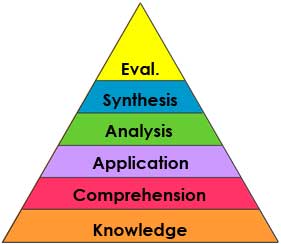
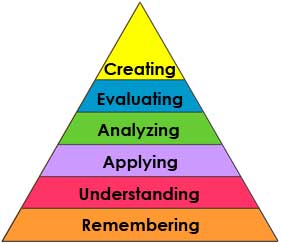
In 1956, Benjamin Bloom and a group of educational psychologists developed a classification of levels of intellectual behavior important in learning.  In the 1990’s Lorin Anderson (a former student of Bloom) and a new group of cognitive psychologists updated the taxonomy to reflect relevance to 21st century skills.  The new taxonomy is much more useful in language instruction.

Original Version:

Blooms Taxonomy in the Foreign (World) Language Classroom (French, Spanish) wlteacher.wordpress.com

Revised Version:

Blooms Taxonomy in the Foreign (World) Language Classroom (French, Spanish) wlteacher.wordpress.com

Even more applicable to language learning and teaching is this graphic representation of the Bloom levels that demonstrates how these skills are not a hierarchy, but are interrelated and dependent on each other to function most efficiently and effectively.  It shows that creating language is dependent on understanding and so forth.

Blooms Taxonomy in the Foreign (World) Language Classroom (French, Spanish) wlteacher.wordpress.com

Foreign Language Project Based Learning

Project Based Learning is being implemented more often in foreign language classes.  These projects provide opportunities for students to engage with the language authentically.

Foreign Language Project Based Learning (French, Spanish) www.wlclassoom.com

It is also a chance for students to use their language skills while researching and presenting the final product.  Below are some are some Project Based Learning (PBL) tips and suggestions to keep in mind to help ensure a high quality process and product.  You can also download a pdf of these tips in a checklist format along with some additional tips for specifically implementing PBL in the foreign language classroom.

  • A concrete timeline that helps students learn how to benchmark and manage projects.
  • An engaging presentation of the project that grabs student interest.
  • Academic rigor and alignment with standards with a focus on content and skill mastery.
  • An essential question that is based on the appropriate skill and age level of students.
  • A product that demonstrates knowledge and skill in which students show evidence that they have mastered the standards and objectives of the project.
  • Applied learning so that students think and do something new with their knowledge or skills.
  • An authentic audience that helps to keep the process and product focused on authenticity.
  • High-quality products or performance at the end of the project that demonstrates the results through applied knowledge and skills

Interpersonal Communication in the Foreign Language Classroom

Interpersonal Communication in the Foreign (World) Language Classroom (French, Spanish) wlteacher.wordpress.comI am always trying to make foreign language activities that are more communicative and give students opportunities to use the target language authentically.  I do firmly believe that accuracy has a place in language production and I do not focus only on fluency tasks, but even when practicing accuracy I try to have a communicative component.  To ensure this, I keep in mind the table below that reminds me what interpersonal communication is and is not.

Interpersonal Communication…

Interpersonal Communication in the Foreign (World) Language Classroom (French, Spanish) wlteacher.wordpress.com

Foreign Language Modes of Communication

Here are key points to distinguish the modes of communication (Presentational, Interpretive and Interpersonal) in a very accessible manner:

Screen Shot 2013-02-25 at 6.50.17 PMScreen Shot 2013-02-25 at 6.50.30 PMScreen Shot 2013-02-25 at 6.50.41 PM

Alternatives to Traditional Homework Assignments

Below is a grid from Kathleen Cushman’s Fires in the Mind: What Kids Can Tell us About Motivation and Mastery.  It is a clear and concise review of teaching objectives, traditional homework assignments related to the objects, suggestions for more interactive and student-centered assignments, and suggestion of when and where to complete these activities.

Alternatives to Traditional Homework Assignments (French, Spanish) wlteacher.wordpress.com

Fluency and Accurancy in the Foreign Language Class

A major goal of Communicative Language Teaching is to improve fluency in speaking and writing in the target language.  Fluency can be defined as the natural use of language that occurs when a speaker takes part in meaningful interaction that maintains ongoing communication even when there are some limitations in accuracy.  Classroom activities that develop fluency require students to negotiate meaning, address misunderstandings and  avoid breakdowns in communication. Accuracy,  on the other hand, focuses on creating correct examples of language use. Here are some key differences  between activities that focus on fluency and those that focus on accuracy :
Fluency-Focused Activities:

  • Reflect natural use of language
  • Focus on achieving communication
  • Focus on meaningful use of language
  • Employ  communication strategies
  • Do not use predictable language is not
  • Link language use to context

Accuracy-Focused Activities:

  • Focus on classroom use of language
  • Focus on  correct examples of language
  • Use language out of context
  • Focus on producing small amounts of language
  • Don’t focus on meaningful communication
  • Dictate language structures and vocabulary

Foreign Language Teacher Self Assessment

This is a document that I create to help myself stay focused on effective and productive language teaching.  I assembled the criteria from many different sources including state and national standards as well as my own research in applied linguistics and psycholinguitics (second language acquisition).  I keep the document handy and refer to it once in a while to remind myself of what needs to be happening in my classroom.  Each school year I make it a point to focus on one of the areas and make a strong effort to improve in that area.  These topics are typically what are evaluated in highly-effective foreign/world language programs so using a document like this on a personal level will help to keep the teacher track and prepared for more formal evaluations.

Foreign (world) Language Teacher Self Assessment (French, Spanish) wlteacher.wordpress.com

You can download a pdf of the document HERE.

The TELL Project (Teacher Effectiveness for Language Learning)

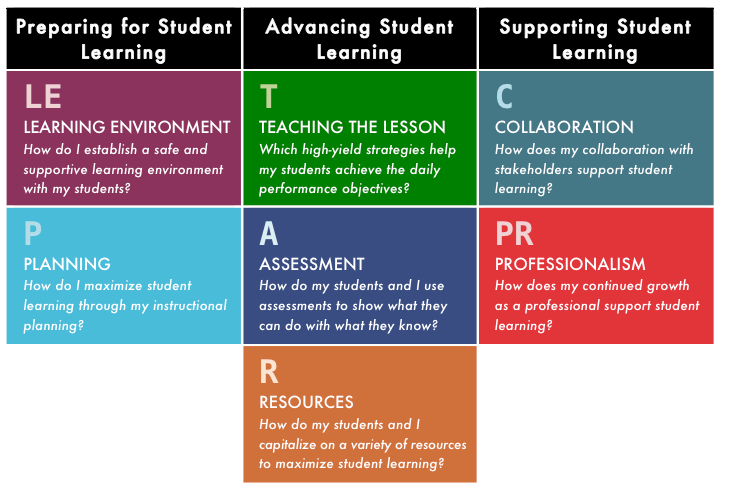
The Teacher Effectiveness for Language Learning (TELL) Project is a collection of products and processes that world language educators can use to enhance their effectiveness as teachers and leaders. The foundational piece is the Teacher Effectiveness for Language Learning Framework, which establishes those characteristics and behaviors that model teachers exhibit.
The Framework consists of 7 domains (Learning Environment, Planning, Teaching the Lesson, Assessment, Resources, Collaboration, Professionalism) organized around the three competency standards of the National Board for Professional Teaching Standards: Preparing for Student Learning, Advancing Student Learning, Supporting Student Learning.
The TELL Project is a collaborative initiative led by world language district coordinators Sharon Deering (Arlington [TX] Independent School District), Thomas Sauer (Jefferson County [KY] Public Schools), Alyssa Villarreal (Memphis [TN] City Schools), and independent consultant, Greg Duncan (InterPrep).

Using the Gouin Series in the Foreign Language Classroom

The Gouin Series is an activity that helps to move students from listening to speaking.  It was developed by Francois Gouin in the 19th century.

The teacher presents a series of six to eight relatively short statements that describe a logical sequence of actions that takes place in a specific context—buying a gift, cooking a meal, making a cake, making a phone call, writing and sending an email. The statements include concrete action verbs and use the same tense and the same person.  The teacher first presents the statements to the class orally, accompanying them with pantomime of the actions involved.  Props are useful. The class responds first by doing the actions, and then responds by saying the words while still performing the actions. The class speaks first as a group and then as individuals.

Elements of a Gouin Series:

  • An introduction to  set the scene
  • Concrete action verbs
  • One specificcontext
  • One tense
  • One person
  • 7-10 -syllables
  •  6-8 statements
  •  Props or visuals
  • Logical sequence

How to Teach a Gouin (Action) Series:

  1. Teacher presents orally, with pantomime and props
  2. Teacher repeats orally, class pantomimes with teacher
  3.  Teacher repeats orally without pantomime, class pantomimes,
  4. Teacher repeats orally, individuals pantomime
  5. Class repeats orally and pantomimes
  6. Individuals lead the series
  7. Possible reading, writing activities

Example of a Gouin Series:

Going to Class

  • I put my book in my bag.
  • I walk to class.
  • I enter the classroom.
  • I sit down.
  • I take out my book.
  • I put my book on the table.
  • I open book.