Category Archives: Speaking

Assessing Student Performance in Foreign Language Group and Pair Activities

Assessing Foreign (World) Language Group and Pair Activities (French, Spanish) wlteacher.wordpress.comThis is a form that I created to help track and assess student performance in group and pair work.

Assessing Foreign (World) Language Group and Pair Activities (French, Spanish) wlteacher.wordpress.comI write the name of a student in the left column and rate ( +, , -) the listed categories (Listening, Speaking, Accuracy of Language and time on Task).  I usually check the student at two different times during the activity and count up the points for the score, which I put in the column on the right.  Ideally I would get to all students, but this is rarely possible.  Instead, I tell the class that 2-4 students will be chosen at random during the activity.  I try to get to each student at least once a week during speaking activities so that by the end of the week all students in the class have a grade.  I learned not to tell them when they have been graded until end of the week when they all get their grades so that they  continue to try their best throughout the week.  Download the Spanish and French versions HERE:

Assessing Foreign (World) Language Group and Pair Activities (French, Spanish) wlteacher.wordpress.comAssessing Foreign (World) Language Group and Pair Activities (French, Spanish) wlteacher.wordpress.com

Interactive Foreign Language Activities with …Cothespins?

Clothespin activities are an engaging way to practice listening and speaking skills in the target language. Everyone has a card and a clothespin. They hear a question or prompt and clip the clothespin on the card to mark the answer. Clipping on the clothespin engages students  and the teacher can quickly check the answers visually.

Interactive Foreign (World) Language Activities with ...Cothespins? (French, Spanish) wlteacher.wordpress.comClothespin activities can provide excellent listening and speaking opportunities. Students can ask the questions and take turns giving instructions to the group or they can work in pairs.   You can make this more interactive with cards that students flip over with a picture and words to pin or subjects and infinitives with conjugated verb forms to pin.  This is a a good version for small groups or pairs and it can be a little competition.

Activity that Focuses on Verb Meaning and Accuracy

Once students have seen (in writing) or heard verb forms in context the next step is to begin producing language.  This activity is an effective follow-up and extension to comprehensible input activities that helps students to see that they can recognize forms and patterns that they have seen in context.

Activity that Focuses on Verb Meaning and Accuracy (French, Spanish)

If you are moving away from direct instruction of verb conjugations, try this out with students. If they have had sufficient contextualized exposure to the verb forms and meanings you will  see that students can choose the accurate form based on what “sounds right.”

When this happens we know that they are progressing in their proficiency and moving toward accurate language output. This activity also supports students as they level up to the Intermediate Low Proficiency Level where they are creating sentences on their own.

These French and Spanish activities are done in Powerpoint and the animation is all set up.  All you have to do is click.

Activity that Focuses on Verb Meaning and Accuracy (French, Spanish)Activity that Focuses on Verb Meaning and Accuracy (French, Spanish)

There are two possible ways to use these Powerpoints:

  • Students write sentences based on the subject and infinitive on each slide when an infinitive and a subject pronoun are revealed. Students see 4 possible verb forms. An additional click reveals the correct form for students to verify their form along with question words so that students can write a complete sentence with the verb form.

Activity that Focuses on Verb Meaning and Accuracy (French, Spanish)

  • Another option is for two students to go to the screen (where powerpoint is projected) and each one has a fly swatter. The activity begins just as the first possibility, but in this version the first student to slap the correct verb form says a complete sentence with the accurate verb form once the form is revealed and the question word appears.

Activity that Focuses on Verb Meaning and Accuracy (French, Spanish)Activity that Focuses on Verb Meaning and Accuracy (French, Spanish)


Interactive Crossword Puzzle to Practice Foreign Language Vocabulary

Interactive Foreign (World) Language Crossword Puzzles (French, Spanish) wlteacher.wordpress.comWith this Interactive Crossword Puzzle students have the opportunity to practice speaking, listening and writing in the target language.

  • Partner #1 has the A picture sheet and the B crossword puzzle.
  • Partner #2 has the B picture sheet and the A crossword puzzle.

The two partners alternate reading a clue out loud from the crossword clues on his/her crossword puzzle sheet. The other students has the answers on the picture sheet and provides the answer orally at which point the student reading the clue fills in the answer.

These can be created using websites to create word puzzles or you can download the activities below.

French Interactive Crossword Puzzles:

Spanish Interactive Crossword Puzzles:

Communicative Foreign Language Activity (Speak, Listen, Write)

Give your students an opportunity to practice and gain confidence in speaking, listening and writing in the target language. This activity  can focus on any verb tense as well various other grammar points.

Communicative Foreign (World) Language Activity (Speak, Listen, Write) (French, Spanish) wlteacher.wordpress.comStudents circulate in the classroom and ask each other questions using the subject pronoun and verb (in the correct form) found on their paper. The objective is to find the other person who has the same 6 sentences. My activities typically include 6 matches. If there are more than 12 students in the class, I simply photocopy additional slips and students need to find their group of 3 or 4 that all match.

When a match (or group) is found, the students work together to write the six sentences in the target language. The entire activity can easily take place in the target language.  The example below is for reflexive verbs in French.  These two papers match, but only these two. The other four have one verb that is different.

Here is a template to create your own

Complete French Activities:

Complete Spanish Activities

Fluency and Accurancy in the Foreign Language Class

A major goal of Communicative Language Teaching is to improve fluency in speaking and writing in the target language.  Fluency can be defined as the natural use of language that occurs when a speaker takes part in meaningful interaction that maintains ongoing communication even when there are some limitations in accuracy.  Classroom activities that develop fluency require students to negotiate meaning, address misunderstandings and  avoid breakdowns in communication. Accuracy,  on the other hand, focuses on creating correct examples of language use. Here are some key differences  between activities that focus on fluency and those that focus on accuracy :
Fluency-Focused Activities:

  • Reflect natural use of language
  • Focus on achieving communication
  • Focus on meaningful use of language
  • Employ  communication strategies
  • Do not use predictable language is not
  • Link language use to context

Accuracy-Focused Activities:

  • Focus on classroom use of language
  • Focus on  correct examples of language
  • Use language out of context
  • Focus on producing small amounts of language
  • Don’t focus on meaningful communication
  • Dictate language structures and vocabulary

Foreign Language Speaking Activity with Reflexive Verbs

This is a great activity that I use to get students moving around the classroom and speaking to each other in the target language using reflexive verbs along with reflexive pronouns.  Student ask each other when they do certain activities (wake up, go to bed, wash up, etc) and record answers. I provide students with a question sheet as well as an answer sheet ( which includes times to use in response to questions). All information is presented with pictures to avoid translation. A follow-up activity requires students to ask about another person so that a different reflexive pronoun is also used.  Students have a lot of fun with this communicative activity.

You can create these activities in WORD or you can download complete activities that are ready to use here:

Foreign Language Class Group Speaking Project for a Food Unit

Foreign (World) Language Food and Restuarant Project (French, Spanish) wlteacher.wordpress.com

You can download full versions of this project here:

We have the food unit that comes up in our foreign language classes almost every year and every text book has at least one chapter devoted to it.  I  created this group project that has students incorporate everything that they learn during a food and restaurant unit.  Students work in groups to create a sales pitch. They have 5 minutes to present their concept for a restaurant to a group of judges (I use other teachers in the school who can understand this level of the language).  Sometimes I record the presentations and email the videos to faculty members to vote on.  Presentations include ideas for the style and decor, the place setting, uniforms, a menu, a chef, and one prepared specialty of the house for the judges to test.

Foreign (World) Language Food and Restuarant Project (French, Spanish) wlteacher.wordpress.com Foreign (World) Language Food and Restuarant Project (French, Spanish) wlteacher.wordpress.comTo keep it completely proficiency-based, they have visuals to represent decor, menu, restaurant style, uniforms, etc. but they speak in the moment with no notes. The idea is to have them speak completely at their proficiency level without any memorized, prepared language. This is a great way to have them use everything that they learn throughout a food unit, and it’s an effective alternative to skits. I always give students an a a sheet with useful phrases and vocabulary to use during the presentation as well as an in-depth rubric that the judges also use. This is lots of fun and all about proficiency and showing the students what they can do with the language, and the project-based learning aspects are very effective as well.

You can download full versions of this project here:

Build Foreign Language Proficiency with Language Ladders

Language Ladders are words or phrases that are linked together because of a common function or meaning.  For example, different words or phrases to express degrees of liking or not liking something. These lists work in a similar way to Functional Chunks of Language, but in this case there is the element of degree, variety and choice.

  • J’adore (I love)
  • J’aime beaucoup (I like a lot)
  • J’aime (I like)
  • J’aime un peu (I kind of like or like a little)
  • J’aime un peu (I like a little)
  • Je n’aime pas (I don’t like)
  • Je n’aime pas du tout (I don’t like at all)

Build Foreign Language Proficiency with Language Ladders (French, Spanish) wlclassroom.comWhereas with early learners the functional chunks would have only one way of saying something, language ladders offer various possibilities and students can choose from among the options depending on how they feel about a topic or how formal or informal they should be with the language that they are using.

Language Ladders offer students an opportunity to personalize their language and is a very effective language tool when students are chunking together language to create phrases as they progress through the novice levels of proficiency.

Here is another example of a Language Ladder that students can access to add the detail of frequency to their sentences and phrases:

  • siempre (always)
  • casi siempre (almost always)
  • a menudo (often)
  • de vez en cuando (every once in a while, from time to time)
  • raramente (rarely)
  • casi nunca (almost never
  • nunca, jamás (never)

You can also have groups of students create these language ladders and look up the expressions on their own.  You’ll be surprised at what topics they come up with. This is a language ladder that my students created to express “I’m sorry”:

  • pardon (sorry, no big deal)
  • excuse-moi (excuse me, informal)
  • excusez-moi (excuse me, formal)
  • désolé (sorry)
  • je suis désolé (I’m sorry)
  • je suis vraiment désolé (I’m really sorry)
  • je suis sincèrement désolé (I’m sincerely sorry)
  • je suis navré (my condolences)

Post these types of language ladders around your classroom for students to access when speaking and writing.  You will soon see that students are personalizing their language more often and speaking and writing with more detailed output.

Functional Chunks of Language in the Foreign Language Classroom

Language teachers need to provide students with many opportunities to use the language that they are learning.  However,  students often do not get enough opportunity to use the language because teachers usually do most of the talking.

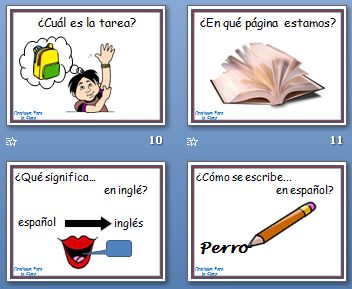
Functional Chunks of Language in Foreign (World) Language (French, Spanish) wlteacher.wordpress.comFunctional Chunks of Language are expressions, phrases or words that students learn as a chunk without necessarily understanding the grammatical structure.  They do however learn where and when to say them when communicating (i.e. the function).  These Functional Chunks of Language will empower students to use the language early and often and they also help to keep the target language the dominant language in the classroom by both the students and the teacher.  These phrases might include:

  • How do you say…in….?
  • What does …mean in…?
  • How do you spell…?
  • I forget my…
  • Can I borrow a…
  • I need a …
  • Can I go to the bathroom.
  • I’m not feeling well?
  • What page?
  • Can you repeat that please?
  • Can you please say that more slowly?
  • What is the homework?
  • Can we start the homework now?
  • What is the date?

These suggestions are based on the phrases that I hear most often from my students so I have them up on the wall so that students can look at them when they need them.

You can find complete poster sets here:

Functional Chunks of Language in Foreign (World) Language (French, Spanish) wlteacher.wordpress.com

Functional Chunks of Language in Foreign (World) Language (French, Spanish) wlteacher.wordpress.comThey all have an image with them as well to make sure that students know what they mean.  After referencing them a few times you will be impressed by how quickly students learn and use them without looking back at them.  I also spend some time at the beginning of each year explicitly going over them.  If a student attempts to make a comment or ask a question in English that is one of the functional phrases on the wall I simply gesture to it and and require the student to say it in the target language.  They learn quickly that they need to use these to communicate in class and it becomes second nature.