Yearly Archives: 2012

Foreign Language Speaking Activity with Reflexive Verbs

This is a great activity that I use to get students moving around the classroom and speaking to each other in the target language using reflexive verbs along with reflexive pronouns.  Student ask each other when they do certain activities (wake up, go to bed, wash up, etc) and record answers. I provide students with a question sheet as well as an answer sheet ( which includes times to use in response to questions). All information is presented with pictures to avoid translation. A follow-up activity requires students to ask about another person so that a different reflexive pronoun is also used.  Students have a lot of fun with this communicative activity.

You can create these activities in WORD or you can download complete activities that are ready to use here:

Foreign Language Teacher Self Assessment

This is a document that I create to help myself stay focused on effective and productive language teaching.  I assembled the criteria from many different sources including state and national standards as well as my own research in applied linguistics and psycholinguitics (second language acquisition).  I keep the document handy and refer to it once in a while to remind myself of what needs to be happening in my classroom.  Each school year I make it a point to focus on one of the areas and make a strong effort to improve in that area.  These topics are typically what are evaluated in highly-effective foreign/world language programs so using a document like this on a personal level will help to keep the teacher track and prepared for more formal evaluations.

Foreign (world) Language Teacher Self Assessment (French, Spanish) wlteacher.wordpress.com

You can download a pdf of the document HERE.

The TELL Project (Teacher Effectiveness for Language Learning)

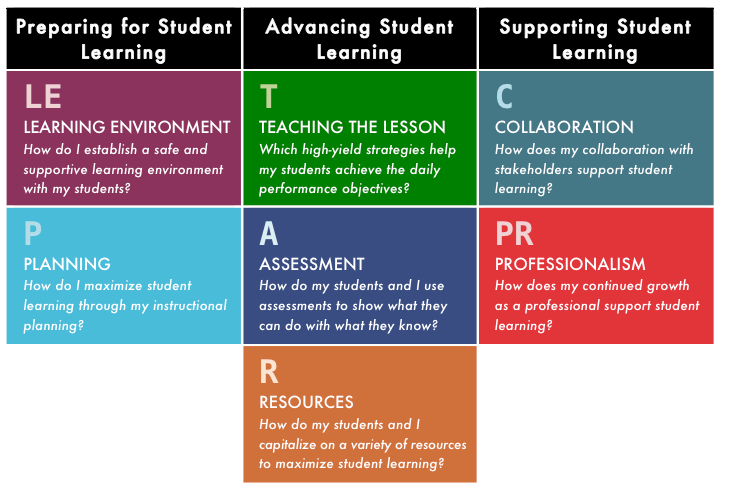
The Teacher Effectiveness for Language Learning (TELL) Project is a collection of products and processes that world language educators can use to enhance their effectiveness as teachers and leaders. The foundational piece is the Teacher Effectiveness for Language Learning Framework, which establishes those characteristics and behaviors that model teachers exhibit.
The Framework consists of 7 domains (Learning Environment, Planning, Teaching the Lesson, Assessment, Resources, Collaboration, Professionalism) organized around the three competency standards of the National Board for Professional Teaching Standards: Preparing for Student Learning, Advancing Student Learning, Supporting Student Learning.
The TELL Project is a collaborative initiative led by world language district coordinators Sharon Deering (Arlington [TX] Independent School District), Thomas Sauer (Jefferson County [KY] Public Schools), Alyssa Villarreal (Memphis [TN] City Schools), and independent consultant, Greg Duncan (InterPrep).

Foreign Language Travel Scrapbook Project

Foreign (World) Language Travel Scrapbook Project (French, Spanish) wlteacher.wordpress.comThis is a project that can be done with level 1 students in a foreign language.  It gives them an opportunity to use the vocabulary and structures typically taught in a first year course.

The focus of this project is travel and geography vocabulary.  Once students make the scrapbook of a trip, there are opportunities to use the books to do additional speaking, reading, listening and writing activities.

  • Begin by giving a sheet with directions for creating a travel scrapbook with directions for each page including examples.
  • Then hand out a storyboard for students to do a rough draft of their book.
  • Students then assemble the travel scrapbook.
  • When the books are done, students read their book to the entire class or to a small group.
  • Provide a sheet to those students who are listening so they can fill in information when they are listening to other students in the class read their final book.

A final activity gives  students a chance to use the information that they recorded during the presentations to write sentences about that they heard and saw. You can download complete, ready-to-use versions of these projects here:

Very Effective Online Vocabulary Activities for Foreign Language Class

The activities on the links below are great for students to individually practice many vocabulary topics in a very interactive way.  Some of the activities include sound and students can practice their listening comprehension as well as their ability to recognize words when they see them in print.  These are also effective for the smartboard as well. The activities work just as well on an individual computer screen.

Digital Dialects-Great tool for the Foreign (World) Language Classroom(French, Spanish) wlteacher.wordpress.com

Interactive Music and Lyric Activities for Foreign Language Practice

Interactive Music Video Website for Foreign (World) Language (French, Spanish) wlteacher.wordpress.comThese are very interactive music activities that I came across on Lyricsgap.com.  The songs are on video (linked to youtube) and for each song there are 2 types of activities to practice the lyrics: Fill in the missing word or phrase (three levels) and karaoke.

There are lots of song in different languages and you can even add to the activities or upload your own song to the site.  The song and activities are assessed and approved before they are placed on the site.  These are fun activities for students to do individually or in pairs:

Foreign Language Class Group Speaking Project for a Food Unit

Foreign (World) Language Food and Restuarant Project (French, Spanish) wlteacher.wordpress.com

You can download full versions of this project here:

We have the food unit that comes up in our foreign language classes almost every year and every text book has at least one chapter devoted to it.  I  created this group project that has students incorporate everything that they learn during a food and restaurant unit.  Students work in groups to create a sales pitch. They have 5 minutes to present their concept for a restaurant to a group of judges (I use other teachers in the school who can understand this level of the language).  Sometimes I record the presentations and email the videos to faculty members to vote on.  Presentations include ideas for the style and decor, the place setting, uniforms, a menu, a chef, and one prepared specialty of the house for the judges to test.

Foreign (World) Language Food and Restuarant Project (French, Spanish) wlteacher.wordpress.com Foreign (World) Language Food and Restuarant Project (French, Spanish) wlteacher.wordpress.comTo keep it completely proficiency-based, they have visuals to represent decor, menu, restaurant style, uniforms, etc. but they speak in the moment with no notes. The idea is to have them speak completely at their proficiency level without any memorized, prepared language. This is a great way to have them use everything that they learn throughout a food unit, and it’s an effective alternative to skits. I always give students an a a sheet with useful phrases and vocabulary to use during the presentation as well as an in-depth rubric that the judges also use. This is lots of fun and all about proficiency and showing the students what they can do with the language, and the project-based learning aspects are very effective as well.

You can download full versions of this project here:

Using the Gouin Series in the Foreign Language Classroom

The Gouin Series is an activity that helps to move students from listening to speaking.  It was developed by Francois Gouin in the 19th century.

The teacher presents a series of six to eight relatively short statements that describe a logical sequence of actions that takes place in a specific context—buying a gift, cooking a meal, making a cake, making a phone call, writing and sending an email. The statements include concrete action verbs and use the same tense and the same person.  The teacher first presents the statements to the class orally, accompanying them with pantomime of the actions involved.  Props are useful. The class responds first by doing the actions, and then responds by saying the words while still performing the actions. The class speaks first as a group and then as individuals.

Elements of a Gouin Series:

  • An introduction to  set the scene
  • Concrete action verbs
  • One specificcontext
  • One tense
  • One person
  • 7-10 -syllables
  •  6-8 statements
  •  Props or visuals
  • Logical sequence

How to Teach a Gouin (Action) Series:

  1. Teacher presents orally, with pantomime and props
  2. Teacher repeats orally, class pantomimes with teacher
  3.  Teacher repeats orally without pantomime, class pantomimes,
  4. Teacher repeats orally, individuals pantomime
  5. Class repeats orally and pantomimes
  6. Individuals lead the series
  7. Possible reading, writing activities

Example of a Gouin Series:

Going to Class

  • I put my book in my bag.
  • I walk to class.
  • I enter the classroom.
  • I sit down.
  • I take out my book.
  • I put my book on the table.
  • I open book.

Build Foreign Language Proficiency with Language Ladders

Language Ladders are words or phrases that are linked together because of a common function or meaning.  For example, different words or phrases to express degrees of liking or not liking something. These lists work in a similar way to Functional Chunks of Language, but in this case there is the element of degree, variety and choice.

  • J’adore (I love)
  • J’aime beaucoup (I like a lot)
  • J’aime (I like)
  • J’aime un peu (I kind of like or like a little)
  • J’aime un peu (I like a little)
  • Je n’aime pas (I don’t like)
  • Je n’aime pas du tout (I don’t like at all)

Build Foreign Language Proficiency with Language Ladders (French, Spanish) wlclassroom.comWhereas with early learners the functional chunks would have only one way of saying something, language ladders offer various possibilities and students can choose from among the options depending on how they feel about a topic or how formal or informal they should be with the language that they are using.

Language Ladders offer students an opportunity to personalize their language and is a very effective language tool when students are chunking together language to create phrases as they progress through the novice levels of proficiency.

Here is another example of a Language Ladder that students can access to add the detail of frequency to their sentences and phrases:

  • siempre (always)
  • casi siempre (almost always)
  • a menudo (often)
  • de vez en cuando (every once in a while, from time to time)
  • raramente (rarely)
  • casi nunca (almost never
  • nunca, jamás (never)

You can also have groups of students create these language ladders and look up the expressions on their own.  You’ll be surprised at what topics they come up with. This is a language ladder that my students created to express “I’m sorry”:

  • pardon (sorry, no big deal)
  • excuse-moi (excuse me, informal)
  • excusez-moi (excuse me, formal)
  • désolé (sorry)
  • je suis désolé (I’m sorry)
  • je suis vraiment désolé (I’m really sorry)
  • je suis sincèrement désolé (I’m sincerely sorry)
  • je suis navré (my condolences)

Post these types of language ladders around your classroom for students to access when speaking and writing.  You will soon see that students are personalizing their language more often and speaking and writing with more detailed output.

Functional Chunks of Language in the Foreign Language Classroom

Language teachers need to provide students with many opportunities to use the language that they are learning.  However,  students often do not get enough opportunity to use the language because teachers usually do most of the talking.

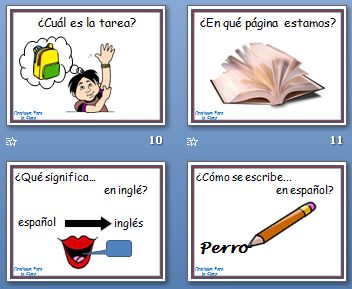
Functional Chunks of Language in Foreign (World) Language (French, Spanish) wlteacher.wordpress.comFunctional Chunks of Language are expressions, phrases or words that students learn as a chunk without necessarily understanding the grammatical structure.  They do however learn where and when to say them when communicating (i.e. the function).  These Functional Chunks of Language will empower students to use the language early and often and they also help to keep the target language the dominant language in the classroom by both the students and the teacher.  These phrases might include:

  • How do you say…in….?
  • What does …mean in…?
  • How do you spell…?
  • I forget my…
  • Can I borrow a…
  • I need a …
  • Can I go to the bathroom.
  • I’m not feeling well?
  • What page?
  • Can you repeat that please?
  • Can you please say that more slowly?
  • What is the homework?
  • Can we start the homework now?
  • What is the date?

These suggestions are based on the phrases that I hear most often from my students so I have them up on the wall so that students can look at them when they need them.

You can find complete poster sets here:

Functional Chunks of Language in Foreign (World) Language (French, Spanish) wlteacher.wordpress.com

Functional Chunks of Language in Foreign (World) Language (French, Spanish) wlteacher.wordpress.comThey all have an image with them as well to make sure that students know what they mean.  After referencing them a few times you will be impressed by how quickly students learn and use them without looking back at them.  I also spend some time at the beginning of each year explicitly going over them.  If a student attempts to make a comment or ask a question in English that is one of the functional phrases on the wall I simply gesture to it and and require the student to say it in the target language.  They learn quickly that they need to use these to communicate in class and it becomes second nature.