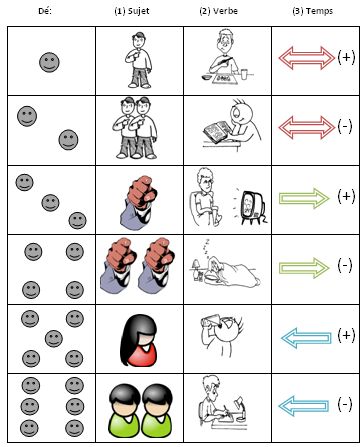
Your students will build their proficiency, polish their skills and create increasingly complex sentences with this dynamic and interactive speaking activity. Naufragio/Naufrage encourages strategic thinking and friendly competition.

Let’s take a look at how it works:
- In each of the squares, there are pictures, numbers, time or subject/infinitive. Whatever the theme is that students are working on. Students play against an opponent or two and each player has a different colored pencil.
- Player 1 begins by choosing a box and identifies the verb form or picture and then creates a sentence, depending on the proficiency level. There are reference pages to support students in level up their language.
- Players use a colored pencil to claim squares by forming rows as they earn points and hone speaking skills. They also try to block the other players from doing the same. That’s where it gets really fun and engaging. So fun that they forget about how much of the language that are actually using.

Students have useful and essential tools to engage in this small-group activity, including reference pages to assist in building sentences and checking their accuracy.

Each resource includes:
- Directions for how to do the activity
- A reference page with vocabulary or verb forms
- A reference page for building sentences
- Game boards
There is absolutely no prep required. Just print out and you’re ready to go.
Spanish Naufragio Vocabulary Topics:
- Numbers 1-100
- Time
- Seasons and Weather
- Colors
- Classroom Vocabulary
- Food
- Fruit
- Clothing
- House and Furniture
Spanish Naufragio Verb Form Topics:
- AR Verbs
- ER Verbs
- IR Verbs
- Regular Verbs
- Irregular Verbs
- Stem-Change Verbs
- Regular Preterite
- Irregular Preterite
- Imperfect
French Naufrage Vocabulary Topics:
- Numbers 1-100
- Time
- Seasons and Weather
- Colors
- Classroom Vocabulary
- Food
- Fruit
- Clothing
- House and Furniture
French Naufrage Verb Form Topics:
- ER Verbs
- IR Verbs
- RE Verbs
- Regular Verbs
- Irregular Verbs
- Accent and Spelling-Change Verbs
- Passé Composé with Avoir
- Passé Composé with Être
- Passé Composé with Irregular Past Participles
- Imperfect

 In an effort to try to cut down on the number of drafts that students need to write, particularly when the language issues are in the areas of spelling, accent placement, verb forms and adjective agreement, try using this approach. Give the students the topic in advance of an in-class writing assignment along with the prep sheet (see example below). The prep sheet is for student use and reference during the writing assignment in class. The left hand side has room for brainstorming and outlining, while right hand site has spaces for nouns, verbs in the infinitive, verb conjugation tables and any other grammatical or mechanical language element that students need to focus on. Students then write in class and use this sheet, which they have completed on their own based in the topic. This information is essentially what students will need to reference when working on additional drafts that the teacher has corrected. This approach has students notice and reference on their own and will most likely make an additional draft unnecessary. Try having students write on a topic with and without this type of sheet and see how the student work is different. The grammar topics on the right side should reflect the topic and what the teacher wants the students to use while writing.