Yearly Archives: 2010

Verb Tense Writing or Speaking Activity

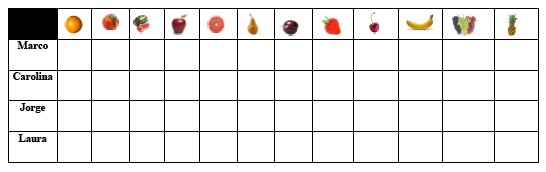
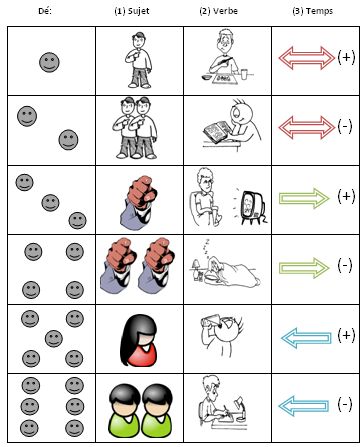
This is a great interactive writing or speaking activity for students.  Students throw a die three times and write a sentence based on the number sequence (or they can throw three dice at once and line them up). Each number corresponds to picture of a  subject pronoun, verb and verb tense.  Students write the sentence or say it out loud.  This is a great way to get students writing without translating. Subjects and verbs can also be easily written on the board and numbered 1-6 along with various verb tenses as well.  This is a grid that I use with students.

Information Gap Activities

Information Gap Activities require students to communicate with each other in order to find all the necessary information to complete the activity.  Each partner has information that the other does not.  It is very important that students have the appropriate level of language in order to complete the activity.  There is sometimes a lot of repetition in the communication as students try to narrow down the information.  This can be very useful when you want the students to focus on a particular structure.  Here is an example of an activity (El Adivino, Le Devin) where students first choose their “secret” information that their partner must then discover.

Download Information Gap Activities Here:

Avoiding Native Language in the Foreign Language Classroom

Avoiding Native Language in the Foreign (World) Language Classroom (French, Spanish) wlteacher.wordpress.com

We have all had issues with students reverting to their native language the foreign language classroom.  Here are some questions and suggestion to consider as you create these speaking activities that will help to keep students speaking in the target language.

Is the activity at the right level for the students?

The activity or prompt should be at the appropriate proficiency level. It is helpful to review necessary vocabulary and phrases in advance.  If the language required to perform the activity is too high student will undoubtedly revert to their native language. If the task is too easy they may get bored and also stop using the target language.

Are all the students actively involved and is the activity stimulating and of interest to the group and individual students?

If students do not have something to say or do, or don’t feel the need to speak, they will revert to their native language and discuss something that is more of interest to them.  Provide prompts and tasks that are of interest to students.

Is the timing of the activity hindering the execution?

The timing of a speaking activity in a class can be crucial. Often when put in a group students quickly continue conversations that began before class.  This is why it is best to wait until a few minutes into class time to begin a group speaking activity.  Use the first part of class time to refocus attention with another sort of activity or review.

Are students using the target language even when they know the teacher is not  listening?

It is imperative that the teacher walk around the classroom monitoring participation and target language use and giving support and help to students as they need it.   But, students are very good at knowing when they can get away with not speaking the target language because the teacher is working with another group.  For this reason, it important to put a time limit and a product on the task so that group needs to stay focused.

The PACE Model

The PACE Model (Donato and Adair-Hauck, 1992) encourages the language learner to reflect on the use of target language forms.  Essentially the teacher and learners collaborate and co-construct a grammar explanation.

Download PDF with PACE Model Explanation and Lesson Plan Template.

The PACE Model (French, Spanish) wlclassroom.com

Much like  authentic language  learning that happens outside of the classroom, this approach stresses that learning happens between people through social interaction (reminiscent of Vygotsky).  The PACE model requires the learner to be an active participant in the language learning process.

Download PDF with PACE Model Explanation and Lesson Plan Template.

The PACE model is a “four-step” process that includes elements that encourage student comprehension and participation. The four stages are:

1. PRESENTATION :
The teacher foreshadows the grammar structure with an appropriate text, with emphasis on meaning. Typically, the teacher recycles the storyline through pictures, TPR activities, etc., to increase comprehension and student
participation.  The focus is not on the grammar structure at this point, but it is used by the teacher and in the text.

2. ATTENTION :
The teacher now has students focus on the language form or structure through the use of  images or highlighting a particular linguistic form.

3. CO-CONSTRUCTION :
After the teacher has focused student attention on a particular target-language form, together they co-construct the grammatical explanation. The teacher provides scaffolding and assists the learners with questions that encourage them to reflect, predict and form generalizations regarding the consistencies  of the language.  Students “write” their own grammar rules, guided by the teacher who will make sure that they end up with an appropriate explanation.

4. EXTENSION :
The learners use grammatical structures to complete a task relating to the
theme of the lesson, which helps the language remain communicative while also highlighting a particular structure.

The PACE Model is a great way to teach grammar as a concept, one of the ACTFL Core Practices.

Download PDF with PACE Model Explanation and Lesson Plan Template.

Reference: Donato, R. & B. Adair-Hauk. “A Whole Language Approach to Focus on Form.” Paper presented at the American Council for the Teaching of Foreign Languages. San Antonio,Texas (1992).

Using Proverbs in the Foreign Language Classroom

Using Proverbs in the Foreign (World) Language Classroom (French, Spanish) wlteacher.wordpress.comProverbs will very often reflect the history and values of a community of people (Ciccarelli, 1996). Since these phrases tend to be short, the vocabulary and sentence structure don’t require a lot of time to understand linguistically. When a new vocabulary list is presented to students, consider providing a few proverbs or idioms that use some of the words and engage a conversation about how the phrase might be important in the target language culture as well as who might use it and in what circumstances. This is also a great opportunity to have students reflect on cultural similarities and differences as they consider whether or not the proverb exists in English, and if not, why?

Here are some proverbs by language for use in the classroom:

Reference: Ciccarelli, A. (1996). Teaching culture through language: Suggestions for the Italian language class. Italica, 73(4), 563-576.

Foreign Language Text Types and Reading Strategies

Foreign (World) Language Text Types and Reading Strategies (French, Spanish) wlteacher.wordpress.comCompetent readers use various reading skills when approaching a text written in a foreign language.  Reading techniques vary depending on the type of text.  These different approaches and techniques help the reader to more effectively understand a particular writing style or content.  Students are better able to engage and understand a text in the target language when the accompanying activities are scaffolded toward these styles.

Keep these ideas in mind when developing reading activities:

  • When reading for specific information, activities need to provide ways for students to ask themselves, “Have I obtained the information I was looking for?”
  • When reading for pleasure, activities should lead students need to ask themselves, “Do I understand the story line/sequence of ideas well enough to enjoy reading this?”
  • When reading for thorough understanding (intensive reading), Activities should be geared toward students asking themselves, “Do I understand each main idea and how the author supports it? Does what I’m reading agree with my predictions, and, if not, how does it differ?” To check comprehension in this situation, students may stop at the end of each section to review and check their predictions, restate the main idea and summarize the section

Traditional comprehension questions are a useful tool, but they can be modified to scaffold student engagement with the text so that they are better able to navigate the various styles and objectives of the text. Here are come additional suggestions from the NCLRC.

Determining the Level of Difficulty in a Text

Dteremining the Level of Difficulty in a Foreign Language Text. (French, Spanish) wlteacher.wordpress.comHelpful guidance from the NCLRC.

How is the information organized? Does the story line, narrative, or instruction conform to familiar expectations? Texts in which the events are presented in natural chronological order, which have an informative title, and which present the information following an obvious organization (main ideas first, details and examples second) are easier to follow.

How familiar are the students with the topic? Remember that misapplication of background knowledge due to cultural differences can create major comprehension difficulties.

Does the text contain redundancy? At the lower levels of proficiency, listeners may find short, simple messages easier to process, but students with higher proficiency benefit from the natural redundancy of authentic language.

Does the text offer visual support to aid in reading comprehension? Visual aids such as photographs, maps, and diagrams help students preview the content of the text, guess the meanings of unknown words, and check comprehension while reading.

Developing Foreign Language Reading Activities

Developing  Foreign (World) Language Reading Activities (French, Spanish) wlteacher.wordpress.comDeveloping interpretative reading activities involves more than identifying a text that is “at the right level”  and writing a set of comprehension questions for students to answer.  A fully-developed interpretative reading activity supports students as readers through pre-reading, during-reading, and post-reading activities.

Here are some guidelines and suggestion to keep in mind when creating an interpretive reading activity for students.

  • Keep in mind that complete recall of all the information in a text is not the goal.  The goal is to comprehend the text and learn from the content.
  • Construct the reading activity around a purpose that has significance for the students.  The goal is not simply to read and understand, but to take the knowledge gained and do something with it.
  • Define the activity’s instructional goal and the appropriate type of response. What will students do with the content that they take away from the text?
  • Check the level of the text.  Is it accessible given the proficiency level of the students?
  • Use pre-reading activities to prepare students for the content.
  • Assess students’ background knowledge of the topic and linguistic content of the text.
  • Give students the background knowledge necessary for comprehension of the text, or activate the existing knowledge that the students possess.
  • Clarify any cultural information that may be necessary to comprehend the text.
  • Make students aware of the type of text they will be reading and the purpose(s) for reading.  Interpretive reading activities should have a clear goal and information gained from reading should be used for a follow-up activity.
  • Provide opportunities for group or collaborative work and for class discussion activities.

Keep these tips and suggestions in mind and when putting together an interpretive reading activity.  They will help to keep the goal of reading and using the content learned in the text.

Foreign Language Vocabulary and Verb Form Activities-Based on Sudoku

mzl.yqsjcqhb.175x175-75I always see kids and adults working on Sudoku puzzles in books and in newspapers. I decided that I wanted to take advantage of the Sudoku craze.  I figured that if kids were into this number puzzle they could possibly transfer this enjoyment and motivation onto a Sudoku-like vocabulary activity.  I tried a few different ways of crafting it, but it got a bit complicated and the end result was that there was more of a focus on the logic than on the letters, spelling, and vocabulary.  But, I didn’t give up.

I eventually came up with a way to use the Sudoku solutions board to make a verb form activity.  Students need to find the correct verb form in the grid (there are multiple) and fill in the correct number.  When each box has a number, the student can verify his or her work by adding up each row.  The total will be 45 for each row, column and diagonal (since each line will have the numbers 1-9, which add up to 45).  Here is an example:

–Find the « je » form of the verbs « manger » and « finir » and write the number « 1 » in the box (nine number « 1 » total).  Continue with the other subjects.  To check your answers, add up the numbers in each row, column and diagonal. The total is 45.

You can easily make your own boards using the solutions to Sudoku puzzles (available in any Sudoku book or in a newspaper.  You can write the verb forms in by hand, but I find that it is easier to make a template in a Word document with the numbers so that you can just type over the number.  Make a few templates that you can use so that the numbers are not in the same places every time.  Here are a few templates to get you started or you can download some Sudoku verb activities that are already made:

Foreign Language Verb Form Puzzles

French and Spanish Verb Form Puzzles wlteacher.wordpress.com

Students enjoy working in pairs and I have found that this activity really focuses their attention on verb forms.  Essentially you fill in subjects and infinitives on one side of each line and the correct verb form on the other.  The teacher then cuts up the individual squares (or students can do it as well).  Students then must mix up and then match up the subject/verb pair with the correct verb form. When done correctly there will be a 16-square puzzle (4X4). Multiple puzzles can also be combined to make a larger  puzzle. This is a fun and effective way for students to work together to practice verb forms.  You can also use this activity to practice numbers, verb tenses or any type of vocabulary.